Your company has decided to deploy AI voice customer service. You open a search engine and find options ranging from US-based cloud giants to Taiwanese startups — every vendor claims to be "the most advanced," "the easiest to use," and "highest accuracy." But the question you actually need answered — will this system work in my specific business context? — none of them proactively address.
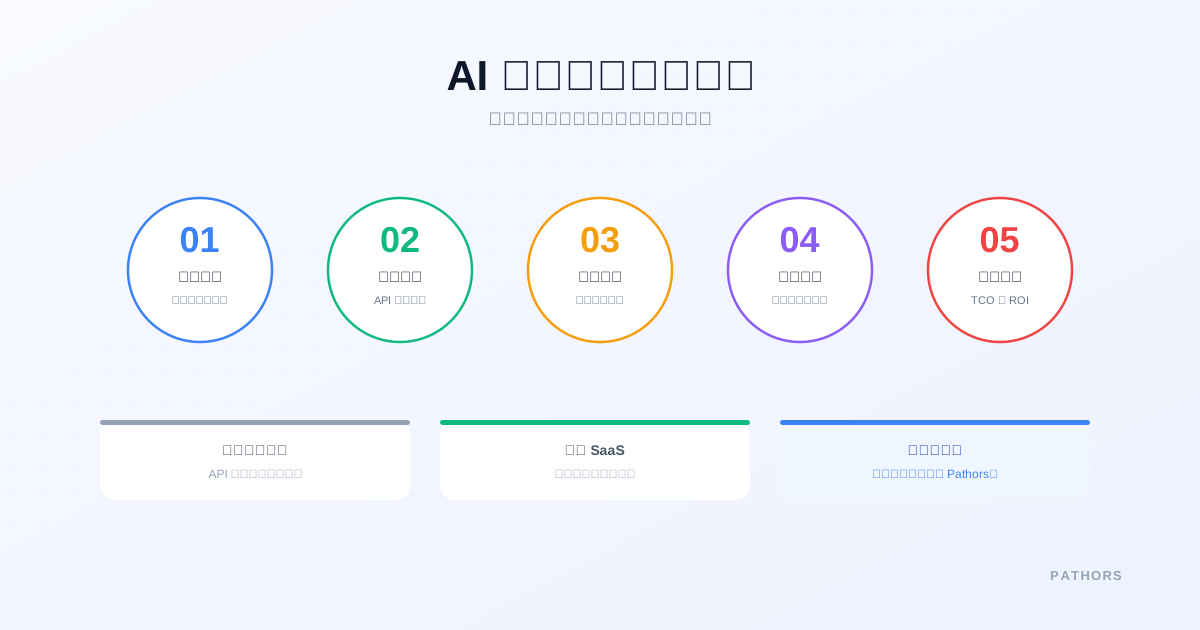
AI voice customer service platforms fall into a few broad categories: international cloud platform voice AI services (general-purpose, requiring your own integration work), vertical SaaS focused on voice customer service (out-of-the-box but limited flexibility), and localized AI voice solutions (deeply optimized for specific languages and markets).
Which category you choose matters less than the criteria you use to evaluate them. Here are the five dimensions we consider most critical when evaluating AI customer service systems in 2026.
Before Comparing Vendors: The Three Kinds of "AI Customer Service System"
The phrase "AI customer service system" covers three fundamentally different products. Step one of vendor selection isn't comparing features — it's confirming which category your problem belongs to. Pick the wrong category and every evaluation after that is wasted work.
| Type | Problem it solves | Typical scenario | Best fit |
|---|---|---|---|
| Text AI (chatbot) | Written messages on web, LINE, social | E-commerce returns, marketing chat | Brands with high message volume, low call volume |
| Voice AI customer service | Inbound phone answering and outbound calls | Bookings, order status, missed-call callback, outbound notifications | Businesses where the phone is still the primary channel |
| AI call center platform | Omnichannel + human agent desktop + QA | Overall operations of a 5+ seat support team | Mid-to-large teams upgrading an existing call center |
The three aren't mutually exclusive — many companies run "text deflects half the volume, voice AI takes the calls, complex cases reach agents." The starting point is simple: look at where your customers' complaints concentrate. Unanswered messages → fix text first. Missed calls, busy lines, no after-hours coverage → fix voice first. For a deeper text-vs-voice breakdown, see our chatbot vs voice bot comparison.
The five criteria below focus on voice — the category with the highest technical bar and the widest gap between vendors.
Criterion 1: Real-World Speech Recognition Performance in Your Language Context
This is the most fundamental dimension, and the most commonly overlooked. Many platforms claim "100+ language support" and "95%+ accuracy" — but those numbers are typically measured in ideal conditions using standardized test sets.
The question you need to ask is: What is the accuracy rate on my customers' actual phone calls, spoken the way my customers actually speak?
For businesses serving Taiwan, this means checking several specific things: accuracy on Taiwanese-accented Mandarin (not mainland Putonghua); the ability to handle code-switching between Mandarin and Hokkien; recognition rates for proper nouns like addresses, personal names, and product model numbers; and performance on 8kHz telephone audio quality.
The best approach: ask vendors to run a proof-of-concept (POC) using your own real call recordings, rather than relying solely on their official benchmark numbers.
Criterion 2: System Integration — Can It Connect to Your Existing Tools?
AI voice customer service doesn't exist in isolation. It needs to integrate with your CRM, order management system, scheduling system, and ticketing system to actually *do things* rather than just answer questions.
Key questions: Does it provide APIs and webhooks for connecting to your own systems? Does it support common third-party tools (LINE, HubSpot, Salesforce, Google Calendar)? Can it read and write data from backend systems in real time during a call?
If a platform has excellent speech recognition but can't look up orders, modify reservations, or create tickets during a call, it's fundamentally still a "smarter IVR" — not a true AI voice assistant.
Criterion 3: Conversation Flow Design Flexibility
Every business has different customer service SOPs. A good AI voice platform should let your team define the conversation flow, not force you to work within the platform's templates.
Specifically: Can you design multi-step conversation scripts? How does the system handle unexpected customer input (fallback mechanisms)? Can you customize the triggers for transferring to a human agent? How convenient and immediate is knowledge base updating?
Some platforms emphasize no-code visual flow editors for non-technical teams to get started quickly. Others provide SDK and API-level control for teams with development capabilities to do deep customization. Neither is inherently better — it depends on your team's technical capabilities and requirements.
Criterion 4: Latency and Call Experience
Beyond accuracy, there's another frequently overlooked technical metric that directly affects customer experience: end-to-end latency.
From the moment a customer finishes speaking to when the AI begins responding, the system goes through four steps: speech recognition (ASR), intent understanding (NLU), response generation, and speech synthesis (TTS). Each step adds delay. If the total exceeds one second, calls start feeling unnaturally stilted. Beyond two seconds, customers assume the system has crashed.
Questions to ask: What is your average end-to-end latency in milliseconds? Does latency spike under high concurrency? How natural does the text-to-speech sound — robotic or human-like?
Pathors' design principle on this dimension: keep latency under 800 milliseconds while ensuring speech synthesis quality that doesn't make customers feel like they're talking to a machine.
Criterion 5: Pricing Structure and ROI Calculation
AI customer service pricing models vary significantly across vendors: some charge per call minute, some per API call, some offer monthly subscriptions, and some charge per seat.
When comparing costs, don't just look at unit price — calculate the full TCO (Total Cost of Ownership): platform monthly or annual fees, speech recognition usage costs, telephone line costs (SIP trunk), integration development labor, and ongoing maintenance and knowledge base update labor.
Then compare TCO against expected benefits: how much human agent cost does it save? How much lost revenue from missed calls does it recover? How much improvement in renewal rates does higher customer satisfaction drive?
Based on our experience, for mid-sized businesses with 3,000–10,000 monthly calls, AI voice customer service typically achieves payback within 3–6 months.
Comparison: Strengths and Weaknesses of Three Platform Types
| Dimension | International Cloud Giants | Vertical SaaS | Localized Solutions (e.g. Pathors) |
|---|---|---|---|
| Speech Recognition | General model, multilingual but weak localization | Moderate, relies on third-party ASR | Deep optimization for target language |
| System Integration | Rich APIs but requires self-development | Pre-built connectors for common tools | Varies by platform, typically has API |
| Conversation Design | Highly flexible but steep learning curve | Template-driven, fast onboarding | Visual + API dual track |
| Latency | Depends on architecture | Moderate | Optimized for telephone scenarios |
| Pricing | Usage-based, better at scale | Monthly subscription, SMB-friendly | Scenario-based pricing, ROI-oriented |
| Best For | Large enterprises with dev teams | Mid-size companies wanting fast deployment | Taiwan businesses prioritizing local language |
No single option is the best answer for every scenario. The key is: first identify which dimension you can't compromise on, then use the five criteria above to make a structured evaluation.
Vendor selection is a process, not a gut call: classify the type, verify against the five criteria, then always run a POC on your own real scenarios. Further reading: our AI call center ROI guide to quantify the benefit, and the AI customer service RFP guide to turn requirements into a document vendors can quote against.
Want to test AI voice customer service performance against your real business scenarios? Book a free Pathors POC — we can run an actual accuracy test and scenario simulation using your call recordings.
Frequently Asked Questions
What types of AI customer service systems are there?
Three common categories: text chatbots handling written messages (web, LINE, social), voice AI handling phone calls (inbound answering and outbound), and AI call center platforms integrating omnichannel routing with human agent desktops. They solve different problems — identify your primary channel before comparing vendors.
Can we deploy just one — text or voice?
Yes, and most companies should start with the channel that hurts most. Message backlogs call for a text bot; missed calls and no after-hours coverage call for voice AI. Both can share one knowledge base, so you can expand later.
What's the single most important metric when evaluating a voice AI platform?
Real-world speech recognition accuracy in your context — your customers' accents, your product names, over 8kHz telephone audio — not the vendor's headline benchmark. After that: end-to-end latency (over one second breaks the conversation) and integration depth (can it look up orders and change bookings mid-call).
How long does implementation take?
Depends on type and integration depth: text bots typically take days to two weeks; voice AI with script design, system integration and testing usually runs 2–6 weeks; a full call center platform is measured in months. Ask vendors to POC with your real call recordings before signing.
How do we verify a vendor's claimed recognition accuracy?
Skip the slide-deck numbers. Hand the vendor 20–30 of your own support call recordings, have them run a test, and compare transcript error rates — paying special attention to names, addresses and product codes. Vendors confident in their localization will welcome this kind of POC.