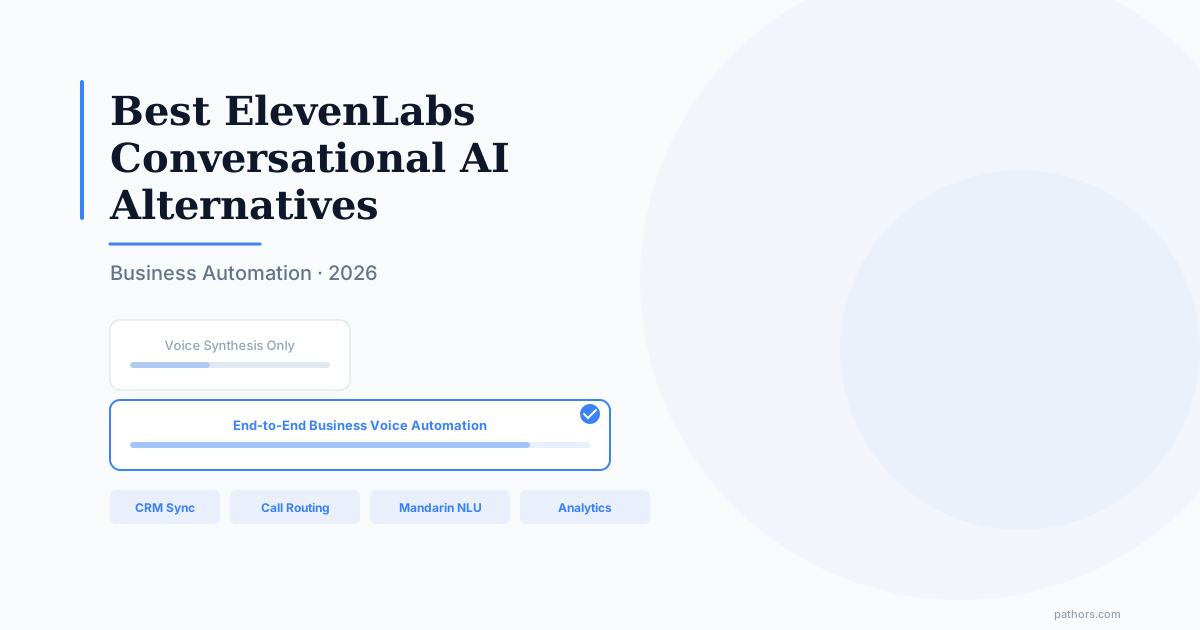
ElevenLabs has built a deserved reputation for industry-leading voice cloning and text-to-speech technology. But when businesses need more than a realistic-sounding voice — when they need AI that can actually handle customer calls, integrate with CRMs, and execute business logic — ElevenLabs' product positioning reveals clear gaps. Forrester's 2025 Enterprise AI Voice Report found that 78% of businesses rank "business process integration capability" as their top evaluation criterion for AI voice solutions, yet only 31% are satisfied with their current tool's integration capabilities. This article examines why businesses need solutions beyond voice synthesis and evaluates the alternatives worth considering.
Why Businesses Look Beyond ElevenLabs
ElevenLabs' voice synthesis and cloning quality genuinely leads the industry. According to TTS Arena's 2025 blind test rankings, ElevenLabs places in the top 3 for English voice naturalness. But enterprises deploying AI voice for actual business operations hit several structural limitations.
The Gap Between Voice Synthesis and Complete Call Handling
ElevenLabs' core product is a voice synthesis API and conversational AI components. Businesses must build their own call handling logic, dialogue management, and business system integrations on top. For large enterprises with engineering teams, this is feasible. For mid-market companies, building a complete call automation system from scratch typically takes 6-12 months of development.
Asian Language Support Depth
While ElevenLabs supports Chinese voice synthesis, the contextual understanding, colloquial expressions, and local terminology for Taiwanese Mandarin lag significantly behind its English performance. Gartner's 2025 survey found that AI voice solution satisfaction in non-English markets is 34% lower than in English markets, primarily due to insufficient contextual understanding and tonal naturalness.
Pricing Model at Enterprise Scale
Per-character pricing models work well for small-scale testing, but when businesses process tens of thousands of calls monthly, the combined cost of voice synthesis plus self-built dialogue management and system integration frequently exceeds projections. Total cost of ownership becomes a serious concern.
5 Evaluation Criteria for Business AI Voice Solutions
When evaluating ElevenLabs alternatives, we recommend assessing candidates across five dimensions.
End-to-End Call Handling
Does the solution cover the complete flow from call answer/initiation, speech recognition, intent understanding, dialogue management, to business action execution? Or does it only provide one piece of the puzzle (e.g., voice synthesis)?
Business System Integration
Can it natively integrate with existing CRM, ERP, e-commerce platforms, and helpdesk systems? McKinsey's 2025 Digital Transformation report identifies system integration difficulty as the second leading cause of AI project failure (behind data quality), accounting for 27% of failures.
Target Language Depth
Voice naturalness is table stakes. What matters more is contextual understanding and cultural appropriateness. The same sentence is expressed differently in Taiwan and mainland China — the AI system must handle these variations.
Deployment Speed and Operational Complexity
How long from proof of concept to production? Can script adjustments and performance optimization happen without engineering involvement after launch?
Compliance and Data Security
Where is call data stored? What encryption and access controls are in place? For businesses operating in Taiwan, Personal Data Protection Act compliance is non-negotiable.
Alternatives Worth Evaluating
Pathors: Enterprise End-to-End Voice Automation
Pathors delivers a complete solution spanning speech recognition, dialogue management, business logic execution, and system integration — businesses don't need to build underlying infrastructure.
Key differentiators:
Best for: Mid-to-large enterprises wanting rapid deployment, strong Mandarin call quality, and an all-in-one solution.
General-Purpose Conversational AI Platforms
Several platforms offer conversational AI frameworks that businesses can build voice applications on. The advantage is high customization flexibility, but they require significant development resources and longer implementation timelines.
Best for: Large enterprises with engineering teams, highly customized requirements, and extremely complex conversation scenarios.
Telecom Provider Cloud Contact Center Solutions
Some telecom providers offer cloud contact center packages that bundle communications and AI capabilities. The advantage is stable communications infrastructure and guaranteed call quality, but AI capabilities are typically delivered through third-party partnerships, which can limit integration depth and iteration speed.
Best for: Businesses already within a telecom provider's ecosystem who prioritize communications reliability.
Voice Synthesis API Plus Custom Build
For businesses with substantial technical teams, purchasing a voice synthesis API (from ElevenLabs or other providers) and building custom dialogue management and business logic is also viable. This approach offers maximum flexibility but the highest TCO and requires ongoing maintenance investment.
Best for: Large tech companies with dedicated AI engineering teams who need complete control over the technology stack.
How to Choose
The core decision question is: "Do you need voice technology, or a voice-powered business solution?"
| Evaluation Dimension | Pathors | General AI Platforms | Telecom Solutions | Custom Build |
|---|---|---|---|---|
| End-to-end call handling | Native | Requires building | Partial | Requires building |
| Deployment time | 2-3 weeks | 3-6 months | 4-8 weeks | 6-12 months |
| Mandarin depth | Deeply optimized | Model-dependent | Partner-dependent | Varies |
| Engineering resources needed | Low | High | Medium | Very high |
| Total cost of ownership | Medium | Medium-high | Medium | High |
If you're evaluating AI voice solutions for your business, the Pathors team offers complimentary needs consultations and technical feasibility assessments.
When choosing an ElevenLabs alternative, the first question businesses need to answer is whether they're solving a "voice quality" problem or a "business process automation" problem. ElevenLabs' leadership in voice synthesis is undeniable, but enterprise AI voice requirements typically extend far beyond synthesis alone. Finding a solution that covers the complete call lifecycle and deeply integrates with business systems is the key to long-term success.
Frequently Asked Questions
What's the biggest difference between ElevenLabs Conversational AI and Pathors?
ElevenLabs' core strength is voice synthesis and cloning technology, with Conversational AI as an extension. Pathors approaches from the enterprise call automation angle, providing a complete solution including speech recognition, dialogue management, business logic, and system integration. Simply put, ElevenLabs solves the 'voice' problem; Pathors solves the 'call workflow' problem.
How hard is it to switch from ElevenLabs to Pathors?
The main migration work involves redesigning conversation scripts and establishing system integrations, typically requiring 3-4 weeks. If your team has accumulated conversation design experience on ElevenLabs, that knowledge transfers directly to Pathors' script design, making the learning curve relatively gentle.
How does Pathors' voice synthesis quality compare to ElevenLabs?
In a pure English voice synthesis quality comparison, ElevenLabs is genuinely best-in-class. However, for Taiwanese Mandarin naturalness and contextual appropriateness, Pathors' deep local market optimization provides a clear advantage. The right choice depends on your target market language and business requirements.
Is Pathors suitable for small businesses?
Pathors offers configurations for businesses of all sizes, from SMBs to enterprises. For small businesses, the standard plan has a lower entry threshold and requires no engineering team. However, if monthly call volume is very low (under 200 calls), the ROI case may need careful evaluation.
What languages does Pathors support beyond Chinese?
Pathors' core strength is Taiwanese Mandarin, but it also supports English and other Asian languages. For businesses primarily serving Taiwan or Mandarin-speaking markets, Pathors' Chinese voice quality and contextual understanding represent the strongest competitive advantage.
Can Pathors handle both inbound and outbound calls?
Yes. Pathors natively supports both inbound call handling (customer service, support) and outbound calling (sales follow-up, appointment reminders, surveys). Both directions share the same dialogue management engine and business system integrations, providing a unified platform for all voice automation needs.