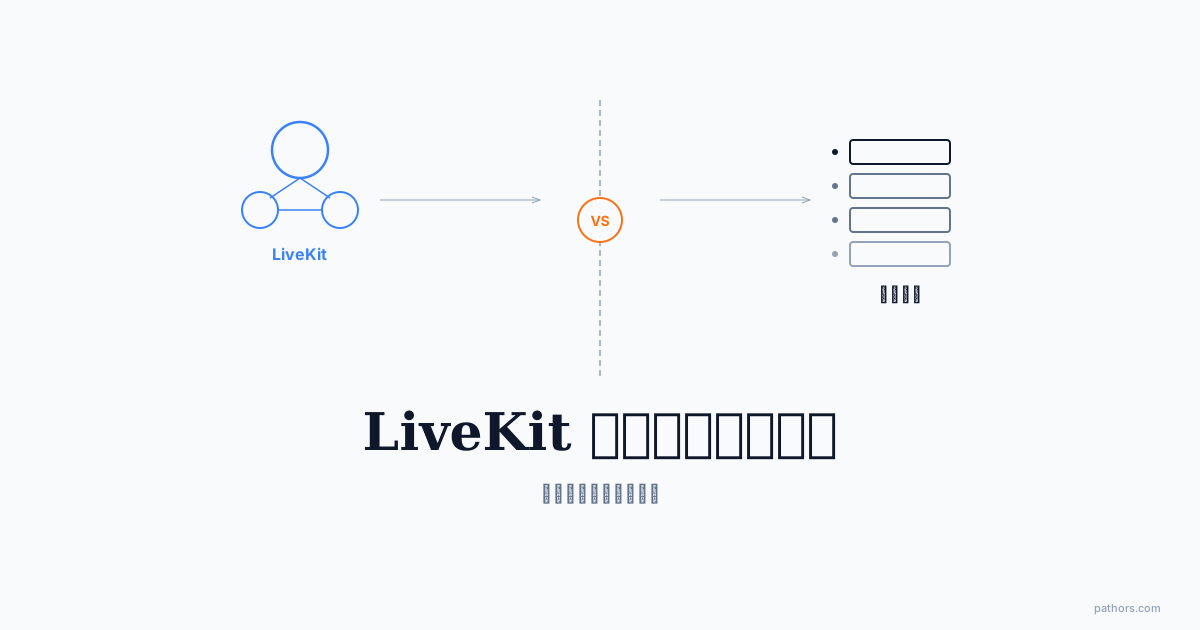
You have probably already built a proof-of-concept on LiveKit. The WebRTC layer works, the latency numbers look acceptable in a demo, and someone on the team has figured out the Agents framework well enough to wire up a basic voice bot. Then you try shipping it to real users in Taipei — and the cracks start showing.
The Mandarin ASR falls back to a generic model that confuses 四 and 十 half the time. The pricing that seemed reasonable at 50 concurrent sessions triples when you need 500. And the self-hosted deployment you were counting on requires an SRE team you do not have. These are not edge cases; they are the exact reasons teams start searching for alternatives roughly three months after their first LiveKit deploy.
What Actually Breaks When You Scale LiveKit Voice Agents
LiveKit's open-source real-time infrastructure is genuinely impressive for what it was designed to do: low-latency audio and video routing. The Agents framework added a programmable layer on top. But a voice AI agent in production is more than a WebRTC pipe — it is an ASR engine, an LLM orchestrator, a TTS renderer, a telephony gateway, and a business-logic runtime, all chained together with tail-latency budgets measured in hundreds of milliseconds.
Gartner's 2025 Voice AI Infrastructure report estimates that 62% of enterprise voice AI projects that stall do so not because of model quality but because of integration complexity. LiveKit gives you the transport layer and leaves the rest to you. For teams that need to go live in weeks rather than quarters, it becomes a bottleneck.
The pattern we see most often: a team builds a working demo in two weeks, then spends three months on telephony integration, CRM connectors, and Mandarin-specific ASR tuning. By month four, the internal champion is fielding uncomfortable questions about timeline.
Five Dimensions for Evaluating Alternatives
1. End-to-end latency under real conditions. Demo latency and production latency are different animals. Ask for p95 numbers at 200+ concurrent sessions with PSTN callers. Anything above 800ms round-trip makes conversations feel robotic — McKinsey's 2025 CX benchmarking study found that perceived agent quality drops 40% once latency crosses that threshold.
2. Language and accent coverage. If your market includes Mandarin, Taiwanese Hokkien, or Cantonese, generic multilingual ASR will not cut it. Word error rate below 8% for Mandarin business conversations is the bar; most general-purpose engines sit around 12-15%.
3. Telephony integration depth. SIP trunking, PSTN dial-out, IVR tree replacement, call transfer to human agents — table stakes for contact-center use cases. A platform that only handles WebRTC means you are building the telephony bridge yourself.
4. Pricing model transparency. Per-minute, per-session, per-seat, or platform fee plus usage? The real question: can you predict your bill at 10x current volume? Hidden costs in STT/TTS pass-through, LLM token relay, or recording storage add up fast.
5. Time to production. Not time to demo — time to production. Security review, data residency compliance, monitoring dashboards, and graceful degradation when the LLM provider has an outage. Platforms that handle these out of the box save you months.
Top Alternatives to LiveKit for Voice AI Agents
1. Pathors
Pathors is purpose-built for AI voice agent deployment in markets where Mandarin and multilingual support are non-negotiable. The platform handles the full pipeline — ASR, LLM orchestration, TTS, and telephony — as a managed service, so you are not stitching together five SDKs.
Key differentiators: sub-600ms end-to-end latency on PSTN calls, a Mandarin ASR engine with 5.2% word error rate on business-domain conversations, built-in CRM integration (Salesforce, HubSpot, custom webhooks), and per-minute pricing with no hidden infrastructure fees. Teams typically go from kickoff to production in 2-4 weeks.
The platform also handles outbound calling, appointment scheduling, and human handoff natively — features that would require months of custom development on a transport-layer-only solution.
2. Full-stack voice AI platforms
Several vendors offer end-to-end voice agent platforms with varying degrees of customization. These tend to excel in English-first markets and may require additional work for CJK language support. Pricing typically follows a per-minute model ranging from $0.05-0.15/min depending on features enabled.
3. Programmable voice infrastructure providers
If your team has strong infrastructure engineering capability and wants maximum control, programmable platforms give you building blocks similar to LiveKit but with managed hosting. More flexibility, more integration work.
4. Conversational AI platforms with voice add-ons
Traditional chatbot platforms that have added voice capabilities. Voice quality tends to lag purpose-built solutions, but if you already have a text-based bot deployed, adding voice as a channel can be the fastest path to market. Watch for latency — many route audio through text pipelines, adding 200-400ms.
How to Make the Decision
If you need maximum control and have 2-3 engineers dedicated to voice infrastructure, LiveKit or a similar open framework might still be right. The total cost of ownership is higher than it looks in the first month, but you own every piece.
If you need to be live in production within a month, serving real customers over phone lines, with Mandarin support that does not embarrass your brand — a managed platform removes the months of integration work between a demo and a deployment.
The question worth asking is not which platform has the best feature list. It is: what is the cost of being three months late to market?
The voice AI infrastructure market in 2026 is bifurcating. On one side, open transport layers let you build anything — if you have the team and the timeline. On the other, purpose-built platforms compress months of integration into days. The platforms that win will be the ones where developers stop thinking about infrastructure and start thinking about conversations.
Frequently Asked Questions
Is LiveKit free to use for voice AI agents?
LiveKit's core server is open-source and free to self-host. However, production deployments require infrastructure costs plus separate ASR, LLM, and TTS services. Total cost of ownership for a production voice agent on self-hosted LiveKit typically runs $0.08-0.20/min when you factor in all components.
What is the main limitation of LiveKit for voice AI?
LiveKit excels at real-time audio transport but is not an end-to-end voice AI platform. You need to build and maintain the ASR pipeline, LLM orchestration, TTS rendering, telephony integration, and business logic layer yourself. For teams without dedicated voice AI infrastructure engineers, this integration burden is the primary bottleneck.
Which LiveKit alternative is best for Mandarin voice AI?
Pathors is purpose-built for Mandarin and multilingual Asian markets, with a fine-tuned ASR engine achieving 5.2% word error rate on Mandarin business conversations — significantly better than general-purpose engines at 12-15%.
How long does it take to deploy a voice AI agent with an alternative platform?
Purpose-built platforms like Pathors typically enable production deployment in 2-4 weeks, compared to 3-6 months for a self-built solution on LiveKit. The difference comes from pre-built telephony integration, CRM connectors, and optimized ASR/TTS pipelines.
Can I migrate from LiveKit to another platform without rebuilding?
Most migrations require rewriting the agent logic layer since each platform has its own orchestration API. However, your conversation design, business rules, and CRM integrations can usually transfer. Pathors offers a migration guide and technical support, typically completing the transition in 1-2 weeks.