Twilio Flex was a revelation when it launched. A fully programmable contact center — you could customize every pixel of the agent desktop, build custom routing logic, and own the entire stack. For engineering teams that wanted control, it was the obvious choice.
Then the AI wave hit, and the value proposition shifted. The same flexibility that made Flex powerful also made it expensive to maintain. Adding a voice AI agent to Flex means integrating a separate ASR provider, wiring up an LLM, building a TTS pipeline, and writing the orchestration glue between all of them. Teams that chose Flex for its programmability are now spending more time maintaining infrastructure than building customer experiences.
Why Teams Are Looking Beyond Twilio Flex in 2026
The contact center market has undergone a structural shift. IDC estimates that 45% of customer service interactions will be handled by AI agents by the end of 2026, up from 18% in 2024. Twilio Flex was designed for a world where human agents were primary and software customized their workflow. That world is inverting.
Flex's pricing model reflects its origins: per-active-user-hour for the platform, plus separate charges for Twilio Voice, Twilio Studio, and any AI services you bolt on. A mid-size contact center running 50 agents with AI augmentation can easily hit $15,000-25,000/month before accounting for engineering time to maintain custom integrations.
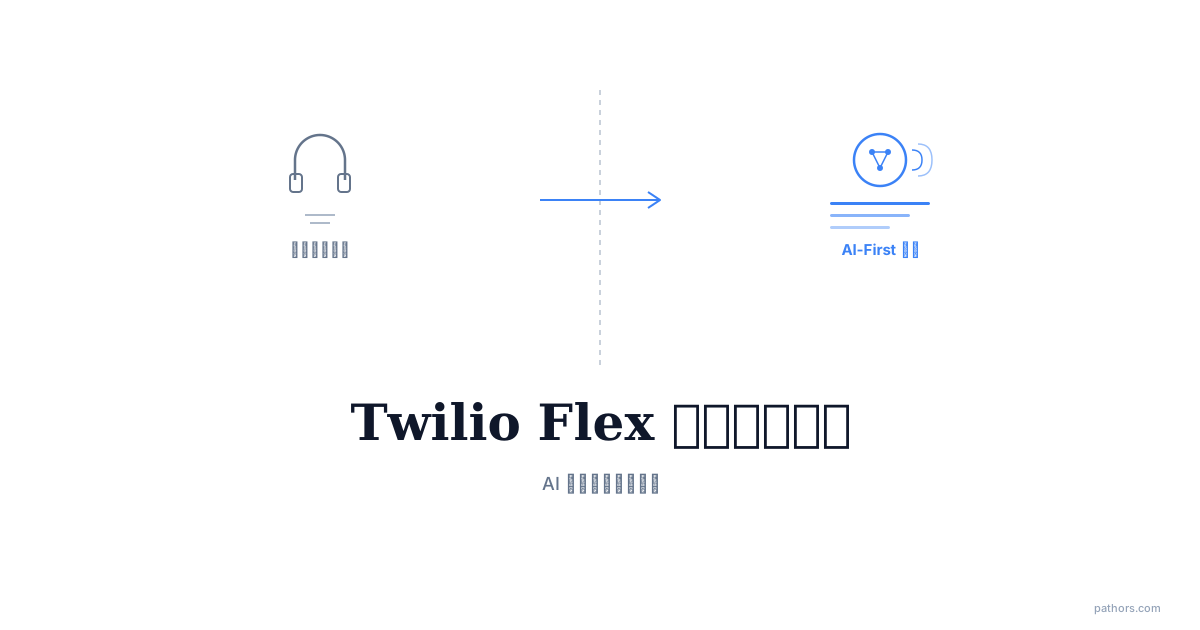
The deeper issue is architectural. Flex treats AI as an add-on to a human-agent workflow. AI-first platforms flip the model: AI handles the conversation by default, and humans step in when needed. That changes the data model, the routing logic, the analytics, and the cost structure.
What to Look for in a Flex Alternative
Native voice AI, not bolted on. The platform should handle ASR, NLU, dialog management, and TTS as core capabilities, not third-party integrations you maintain. Every integration point is a latency source and a failure mode.
Intelligent routing that understands intent. Traditional ACD routes based on queue, skill group, and availability. AI-first routing should understand caller intent in real time and decide whether to handle the call autonomously, route to a specialized AI agent, or escalate to a human — all within the first 3 seconds.
Unified analytics across AI and human interactions. If your AI conversations and human conversations live in separate dashboards, you cannot optimize the handoff. Look for platforms that give you a single view of resolution rate, sentiment, and escalation patterns across both channels.
Transparent, predictable pricing. Per-minute or per-conversation pricing that includes AI processing is easier to model than Flex's layered pricing of platform + telephony + AI services. You should be able to forecast your bill at 5x volume without a spreadsheet.
Compliance and data residency. For regulated industries, where your call data lives matters. Taiwan's PDPA and upcoming AI governance frameworks add requirements that global-first platforms may not prioritize.
Top Alternatives for AI-First Contact Centers
1. Pathors
Pathors approaches the contact center from an AI-first perspective: every inbound call is handled by a voice AI agent that can resolve common queries, collect information, schedule appointments, and transfer to human agents when needed.
For teams migrating from Flex: no ASR/TTS integration to maintain (built in), Mandarin optimization with sub-6% word error rate, native telephony (SIP/PSTN) without separate Twilio Voice charges, and a deployment timeline of weeks. Pricing is per-minute with all AI processing included — no surprise bills from stacking five different products.
The platform includes outbound campaign management, which on Flex would require Twilio Studio flows plus a separate dialer integration. Pathors handles the full lifecycle: campaign creation, AI-powered conversations, outcome tracking, and CRM sync.
2. Cloud contact center platforms with AI layers
Major cloud providers offer contact center solutions with varying degrees of AI integration. These platforms benefit from ecosystem integration but may lag purpose-built solutions in voice AI quality and latency. Best for enterprises already deep in a specific cloud ecosystem.
3. Conversational AI platforms with CCaaS features
Some conversational AI companies have expanded into contact center territory. The AI tends to be strong, but the contact center features may feel less mature. Best for teams where AI conversation quality is the top priority.
4. Traditional CCaaS with AI add-ons
Established contact center platforms that have added AI capabilities through acquisitions or partnerships. The contact center features are battle-tested, but AI is typically a separate module. Best for large enterprises with complex routing and existing CCaaS investments.
Migration Considerations
The things that transfer easily: your conversation flows (the logic, not the Twilio Studio JSON), your CRM integration requirements, your routing rules, and your reporting requirements.
The things that do not transfer: Twilio Studio flows, Flex Plugins (React components), and TaskRouter configurations. These are Flex-specific implementations that need rebuilding.
The migration question that matters most: how many of your current Flex customizations are solving problems that an AI-first platform handles out of the box? We have seen teams with 15,000 lines of custom Flex plugin code discover that 80% of it becomes unnecessary on a platform where AI handles routine interactions.
Twilio Flex earned its place by giving engineering teams unprecedented control over the contact center stack. But control has a maintenance cost, and the stack itself has changed. The conversations that matter in 2026 start with AI, and the platforms that win will be the ones where adding a new use case means configuring a conversation flow, not writing integration code.
Frequently Asked Questions
How much does Twilio Flex cost compared to AI-first alternatives?
Twilio Flex charges $1/active user hour for the platform, plus separate costs for Twilio Voice, Studio, and AI services. A 50-agent center with AI typically costs $15,000-25,000/month. AI-first platforms like Pathors use per-minute pricing ($0.05-0.12/min all-inclusive), which can reduce total cost by 30-50%.
Can I keep my existing phone numbers when migrating from Twilio Flex?
Yes, phone number porting is standard practice. Most platforms support number porting from Twilio, typically completing in 1-2 weeks. Pathors handles the porting process as part of migration support with zero downtime.
How does AI-first routing differ from Twilio Flex's TaskRouter?
TaskRouter decides which human gets the call. AI-first routing decides whether a human is needed at all. The AI agent handles the initial interaction, resolves what it can, and only escalates when human judgment is required. This typically resolves 40-60% of calls without human involvement.
What happens to our Twilio Flex customizations during migration?
Flex-specific code needs rebuilding on any new platform. However, business logic and integration requirements transfer directly. Many teams find 60-80% of custom Flex code becomes unnecessary on AI-first platforms.
Is Pathors suitable for large enterprise contact centers?
Pathors handles hundreds of concurrent AI voice agents across inbound and outbound channels with SIP trunking, PSTN integration, CRM sync, and compliance features for regulated industries.