Property management is an industry built on responsive communication. Resident maintenance requests don't wait for Monday morning — pipe leaks happen at 2 AM, elevators break down on Saturday afternoons, and noise complaints arrive around the clock. According to the Institute of Real Estate Management's 2025 Asia-Pacific survey, property management companies average 180-220 calls per month per 100 residential units, with 35% occurring outside business hours. The traditional solution is staffing after-hours shifts, but the cost is steep and service quality is inconsistent. A mid-sized firm managing 2,000 units can spend over $100,000 annually on 24/7 phone coverage alone.
Four Operational Pain Points in Property Management Customer Service
After-Hours Service Gaps
Most property management companies operate with minimal after-hours coverage — often just a single on-call phone. When multiple calls arrive simultaneously, hold times spike and calls go unanswered. JLL's 2025 Asia-Pacific Property Technology Report found that "inability to reach someone by phone" has been the top resident dissatisfaction driver for three consecutive years, cited by 41% of survey respondents.
The stakes are higher than mere inconvenience. Approximately 22% of after-hours calls involve urgent situations — water/electrical failures, elevator shutdowns, fire alarm activations — that require immediate response. Missed calls in these scenarios can escalate from resident frustration to safety incidents and legal liability.
Information Loss in Repair Reporting
Traditional phone-based repair reporting relies on on-call staff recording details on paper or spreadsheets, then handing off to maintenance teams during business hours. This process suffers from predictable failures:
Internal data from a large APAC property management firm shows that 28% of traditionally created work orders have incomplete information, requiring maintenance staff to call back for clarification and delaying resolution by an average of 4.5 hours.
Emotional Load of Complaint Handling
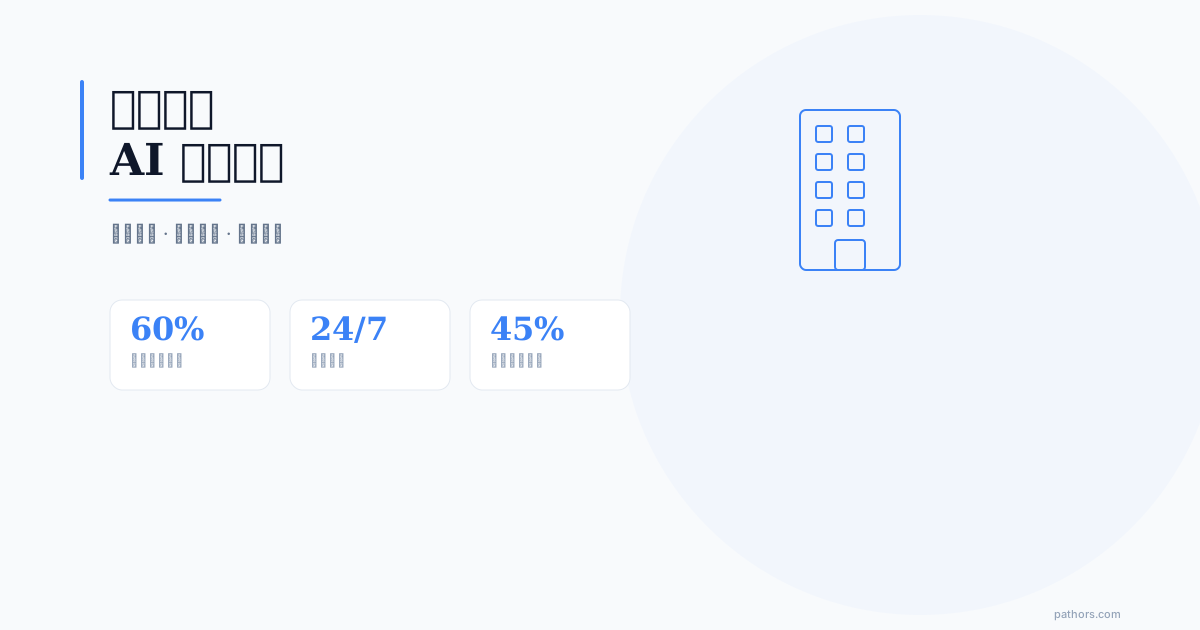
Property complaint calls carry high emotional intensity. Residents calling after enduring a night of leaking pipes or persistent noise are understandably frustrated. On-call staff must simultaneously de-escalate emotions and capture problem details — a demanding combination. CBRE's 2025 workforce report puts annual turnover for property management customer service staff at 45%, well above the 30% general customer service industry average. High turnover means continuous recruitment and training costs.
Status Update Bottleneck
The most frequent post-report question from residents is "What's happening with my repair request?" In traditional workflows, answering this requires staff to manually check the ticketing system and call residents back. This reactive approach consumes staff time and frustrates residents. Buildium's 2025 survey found that 58% of resident dissatisfaction stems from "not knowing the status of their request" rather than actual resolution speed.
How AI Voice Reshapes Property Management Services
24/7 Automated Call Handling and Ticket Creation
AI voice customer service answers resident calls around the clock, collecting repair information through natural conversation:
The system applies urgency classification automatically: emergency issues (water leaks, elevator shutdowns) trigger immediate maintenance crew notification, while routine matters queue for business-hours scheduling.
Deployment data from property companies using AI voice shows automated ticket creation completeness of 94%, compared to 72% for manual recording — a 22 percentage point improvement.
Intelligent Duplicate Report Merging
AI systems recognize when multiple residents report the same issue. When five residents on the third floor all call about hallway flooding, the system identifies this as a single incident, consolidating reports into one ticket rather than creating five separate work orders. This reduces maintenance team confusion and gives managers real-time visibility into the scope of impact.
Proactive Status Updates
When repair status changes — technician dispatched, parts ordered, estimated completion time set — the AI voice assistant automatically calls affected residents with updates. This transforms status communication from reactive inquiry to proactive notification, substantially improving the resident experience.
A property management company overseeing 15 communities and 3,000+ units saw resident satisfaction with repair handling increase from 3.2 to 4.3 (on a 5-point scale) after deploying Pathors, with "timeliness of status updates" showing the most significant improvement.
Priority-Based Emergency Routing
AI voice customer service assesses urgency through conversation content and executes differentiated response protocols:
| Priority Level | Trigger Conditions | Response Protocol |
|---|---|---|
| Critical (Safety) | Fire, gas leak, injury | Immediate transfer to duty manager + auto-notify emergency services |
| High (Livability) | Water leak, power outage, elevator failure | Instant maintenance crew notification + emergency ticket |
| Medium (Routine) | Equipment malfunction, facility damage | Standard ticket + business-hours scheduling |
| Low (Inquiry) | Fee questions, policy inquiries | Automated response or transfer to management office |
Practical Implementation Guide
System Integration Priorities
The most critical integration point is connecting AI voice to your existing work order management system. If you're currently using paper or spreadsheets, Pathors includes a built-in ticket management module. For companies with existing ERP or property management platforms, Pathors supports API and webhook integrations.
Conversation Flow Design
Analyze three months of call records to identify the 10-15 most common call types, then prioritize building conversation flows for these scenarios. Based on deployment experience, the top 10 call types typically cover 85%+ of total call volume. This focused approach delivers maximum impact with minimum configuration effort.
Resident Communication Strategy
Notify residents before launching AI voice service. A community announcement explaining the new 24/7 availability and emphasizing that emergencies will still connect to human staff helps set expectations. Buildium's research shows communities that communicate proactively see 35% higher resident acceptance rates for AI customer service compared to those that don't.
Cost-Benefit Analysis
For a mid-sized property management firm overseeing 1,500 units:
| Metric | Current (Staff Only) | AI Voice Solution |
|---|---|---|
| Annual 24/7 CS Staffing Cost | ~$83,000 USD | ~$27,000 USD (1 staff + AI) |
| Avg. Ticket Creation Time | 8 minutes | 3 minutes |
| Ticket Information Completeness | 72% | 94% |
| After-Hours Missed Call Rate | 25% | <5% |
| Resident Satisfaction | 3.2/5 | 4.3/5 |
| Estimated Annual Savings | — | ~$56,000 USD |
Property management service quality is largely determined by communication responsiveness. Residents don't care about the technology behind the phone line — they care whether someone answers their call, whether their issue gets addressed, and whether they're kept informed about progress. AI voice customer service delivers consistent, reliable performance on all three fronts. If your communities are facing staffing challenges or inconsistent service quality, reach out to the Pathors team for a complimentary service workflow assessment tailored to your portfolio size and management needs.
Frequently Asked Questions
Can AI voice handle emotionally charged resident complaints?
AI voice maintains a consistent, professional tone when receiving complaints and systematically captures issue details. For highly escalated calls, the system detects elevated emotion and automatically transfers to human staff. The advantage is that AI doesn't experience burnout or emotional fatigue, delivering uniform service quality on every call.
Will residents resist talking to an AI system?
Deployment data consistently shows higher acceptance than expected. The key factors are natural-sounding voice, fast response times, and tangible outcomes (tickets created, repairs scheduled, status updates delivered). Surveys from deployed communities show 85% of residents report satisfaction after two weeks of use.
Can AI voice integrate with existing property management systems?
Yes. Pathors supports API and webhook integrations with mainstream property management platforms, including work order management, resident databases, and maintenance scheduling modules. For companies without existing digital tools, Pathors includes built-in ticket management functionality.