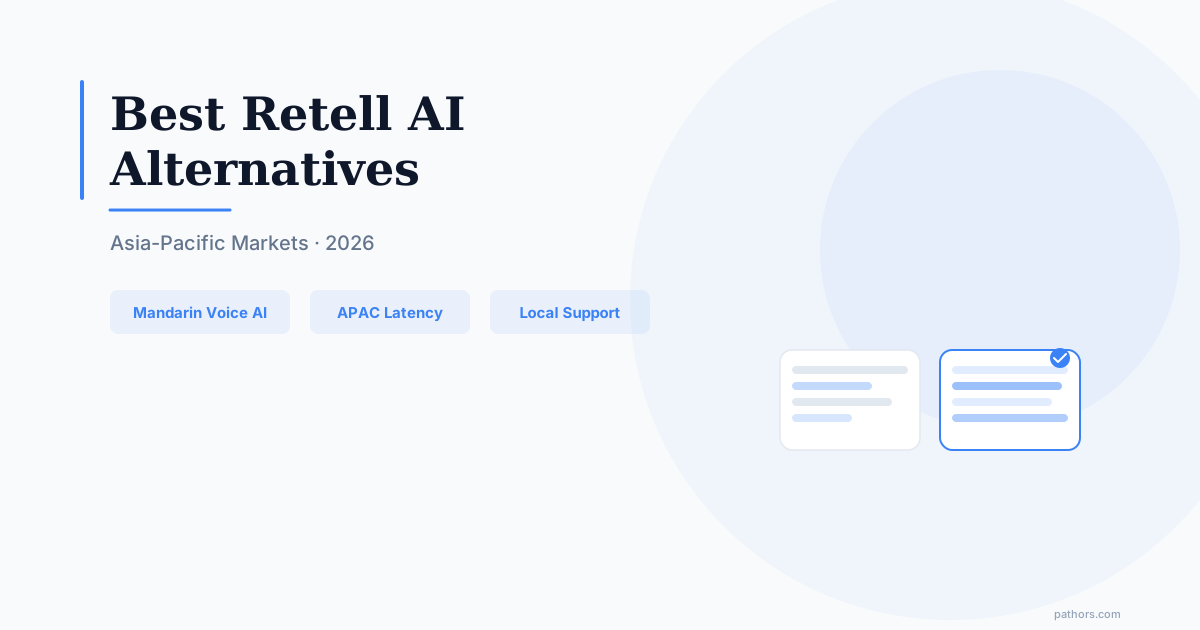
Retell AI has earned a solid reputation in the voice AI space, particularly for its clean API design and fast prototyping capabilities. However, if your customer base is primarily in Taiwan, Southeast Asia, or Greater China, you've likely bumped into some friction points: Mandarin speech recognition that stumbles on local accents, response latency that makes conversations feel stilted, and support tickets that sit overnight because of time zone gaps. According to IDC's 2025 Asia-Pacific AI forecast, the regional voice AI market is projected to reach $4.8 billion by 2026, growing at 23.7% annually. That growth is driving a new wave of platforms purpose-built for APAC deployment.
Why APAC Businesses Are Looking Beyond Retell AI
The core challenge with using Retell AI in Asia-Pacific comes down to three factors: language accuracy, infrastructure proximity, and operational support.
On language accuracy, Stanford HAI's 2025 speech recognition benchmarks showed that leading English-first voice engines have a word error rate (WER) 35-40% higher for Mandarin Chinese compared to English. For Taiwanese-accented Mandarin specifically, the gap widens further. In a customer service context, this directly translates to misunderstood intents and higher human escalation rates.
Latency is the second major issue. With Retell AI's infrastructure concentrated in North America, APAC users typically experience round-trip latency of 180-280 milliseconds. McKinsey's 2025 customer experience research found that every additional 100ms of voice AI response delay reduces customer satisfaction scores by approximately 12%. For natural-sounding conversations, the threshold is around 200ms — beyond that, users perceive awkward pauses.
The third factor is support coverage. When a production issue hits during APAC business hours, waiting 8-12 hours for a North American support team to come online is a significant operational risk. Gartner's 2025 survey of enterprise AI buyers ranked "same-timezone support" as the third most important vendor selection criterion, behind only accuracy and cost.
Five Criteria for Evaluating Voice AI Platforms in APAC
Before comparing specific alternatives, it's worth establishing evaluation criteria. Based on deployment patterns across 120+ APAC enterprises, these five dimensions matter most:
Language and Accent Depth
Don't settle for "supports Chinese" on a features page. Test with 50+ real customer service recordings that include addresses, proper nouns, and domain-specific terminology. Measure WER and intent recognition accuracy separately — a platform can transcribe words correctly but still misunderstand what the caller wants.
Regional Latency Performance
Ask vendors for P95 latency data from APAC points of presence, not just average latency. A P95 target of under 150ms end-to-end is achievable with regional infrastructure.
Compliance and Data Residency
Taiwan's PDPA, Singapore's PDPA, and various APAC data protection regulations require clarity on where data is processed and stored. Confirm whether the vendor operates data centers within your required jurisdictions.
Integration Complexity
Forrester's 2025 enterprise AI survey found that 42% of voice AI project budgets are consumed by system integration. Evaluate how many engineering weeks are needed to connect with your existing CRM, scheduling, and ticketing systems.
Pricing Transparency
Watch for hidden costs: per-minute overage rates, model fine-tuning fees, premium support tiers, and minimum commitment thresholds that penalize usage variability.
Top Retell AI Alternatives for Asia-Pacific
#1: Pathors
Pathors is a voice AI platform built from the ground up for APAC markets, headquartered in Taiwan. Key differentiators:
Customer data shows an average 67% improvement in call handling rate and 40% reduction in staffing costs after Pathors deployment.
#2: An LLM Orchestration-Focused Platform
This platform excels at large language model orchestration, offering deep API flexibility and model selection options. It's well-suited for technical teams that want granular control over conversation logic. The tradeoff is deployment complexity — typically requiring 2-3 engineers over 4-6 weeks. APAC language support is still in early stages, and there are no regional data centers.
#3: A Premium Voice Synthesis Platform
Known for industry-leading voice synthesis quality in English, this platform produces remarkably natural-sounding speech. However, Chinese voice naturalness lags noticeably behind, and per-minute pricing runs approximately 2.5x higher than Pathors. Best suited for English-market premium brands where voice quality is the primary differentiator.
#4: An Outbound-Focused Calling Platform
Specialized for high-volume outbound calls, this platform is a strong choice for telemarketing and collections use cases. Gartner's 2025 report recognized it as a representative vendor in outbound voice AI. However, its inbound customer service capabilities are relatively limited, and it currently lacks APAC data centers.
Making Your Final Decision
The most reliable approach is a structured proof of concept. Deloitte's 2025 AI adoption guide recommends these POC best practices:
| Criteria | Pathors | Platform B | Platform C | Platform D |
|---|---|---|---|---|
| Mandarin ASR Accuracy | 92%+ | 78% | 82% | 75% |
| APAC P95 Latency | <120ms | ~250ms | ~200ms | ~300ms |
| Deployment Time | 3 days | 4-6 weeks | 2-3 weeks | 1-2 weeks |
| Taiwan Data Residency | Yes | No | No | No |
| SMB-Friendly | Yes | No | No | Yes |
Choosing a voice AI platform is a decision that shapes your customer experience for the next 2-3 years. For businesses serving APAC customers, language accuracy, regional latency, and local support should outweigh feature list length in your evaluation. Start with a focused POC on one use case, validate with real data, then expand. If your customers are primarily in Taiwan and the broader APAC region, reach out to the Pathors team to schedule a technical walkthrough.
Frequently Asked Questions
Does Retell AI support Mandarin Chinese?
Retell AI offers basic Mandarin support, but its voice models are primarily optimized for English. Independent testing shows Mandarin WER of approximately 20-25%, with noticeable accuracy drops for Taiwanese accents and specialized terminology. APAC-focused platforms like Pathors achieve Mandarin WER below 8%.
How long does it take to migrate from Retell AI to an alternative?
Migration timelines depend on your existing integration complexity. For basic voice workflows, migrating to Pathors typically takes 1-2 weeks. Deeper API integrations may require 3-4 weeks. Pathors offers migration assistance including workflow mapping and validation testing.
Is Retell AI latency a problem for APAC users?
Yes. Retell AI's North American infrastructure results in 180-280ms round-trip latency for APAC users. Research shows latency above 200ms creates perceptible pauses in voice conversations. Platforms with APAC points of presence can reduce this to under 120ms.
Which Retell AI alternative is best for small businesses in Taiwan?
Pathors is the strongest fit for Taiwan-based SMBs, offering pay-per-minute pricing with no minimums, no-code deployment that doesn't require engineers, local Mandarin-speaking support, and voice models optimized for Taiwanese-accented Mandarin.
How does Retell AI pricing compare to alternatives?
Retell AI charges USD $0.07-0.12 per minute, but cross-region bandwidth costs increase the effective rate for APAC businesses. Pathors prices in TWD with lower per-minute rates and no hidden cross-region fees. APAC businesses typically see 30-50% cost savings.
Can Retell AI handle Taiwanese accents accurately?
Retell AI's accuracy drops significantly with Taiwanese-accented Mandarin, particularly for local place names, colloquial expressions, and industry-specific terms. Platforms like Pathors that train specifically on Taiwanese speech data perform substantially better in these scenarios.