Your sales team manually dials 200 calls a day. Connect rate sits below 35%. Meaningful conversations? Maybe 40. One sales director we spoke with calculated the true cost: roughly $1.50 per effective outbound call, with nearly $4,800 a month burned on the dial-wait-no-answer loop alone. AI auto-outbound systems in 2026 have moved from shiny innovation to communication infrastructure. According to Gartner's late-2024 report, 37% of mid-to-large enterprises globally have deployed some form of AI voice automation in outbound scenarios. But the market is crowded and feature lists look nearly identical — "multi-turn dialogue," "real-time TTS," "CRM integration." How do you actually evaluate? We have distilled it down to 5 dimensions that genuinely impact ROI.
Align the Terminology First: Auto Dialer vs. AI Smart Outbound
The market uses these labels loosely. A traditional "auto dialer" (or predictive dialer) simply dials numbers automatically and routes connected calls to human agents. What vendors now call "smart outbound" or AI auto-outbound adds a conversational layer: the AI completes the call itself and hands only high-value cases to humans. This guide evaluates the latter. The first thing to check in any vendor pitch is which of the two you are actually being sold — the staffing model and unit economics differ by an order of magnitude.
Dimension 1: Voice Quality — Latency Above 800ms Drops Connect Rates by 23%
Voice quality is the front door of any outbound system, and the dimension most often underestimated. Many organizations hear a smooth demo and assume they are set, only to discover significant performance gaps in production.
Three metrics matter:
Evaluation tip: Request recordings from real-world environments — background noise, regional accents, interruptions. Never rely solely on demo-room showcases.
Dimension 2: Dialogue Engine — Multi-Turn Success Rates Vary by Up to 4x
Outbound conversations are fundamentally more complex than inbound. Inbound service typically answers questions in a relatively structured format. Outbound calls must proactively steer the conversation, handle unexpected responses, and recover gracefully from interruptions.
We ran an identical set of 50 test scenarios across 6 vendors. The results were striking:
| Metric | Best Performer | Worst Performer | Gap |
|---|---|---|---|
| 3+ turn completion rate | 89% | 21% | 4.2x |
| Intent recognition accuracy | 94% | 67% | 1.4x |
| Post-interruption recovery | 91% | 38% | 2.4x |
| Unexpected response handling | 82% | 29% | 2.8x |
Key capabilities to evaluate closely:
Barge-in Handling
Recipients interrupting mid-sentence is the most common event in outbound calls. A strong system detects the interruption within 200ms, halts its current utterance, and adjusts course based on what was said. Weak systems either ignore the interruption entirely or stop but fail to comprehend the interjection.
Contextual Memory
Outbound conversations frequently involve topic jumps. For example, you are introducing Product A when the recipient suddenly asks, "Where is your company located?" After answering, the system needs to naturally return to the product pitch. Pathors' dialogue engine supports a contextual memory stack tracking up to 12 conversation layers, ensuring smooth topic transitions.
Silence Management
When a recipient goes silent for more than 3 seconds, how should the system respond? Repeat the last statement? Rephrase the question? Politely confirm the person is still on the line? These subtle interaction designs directly impact conversation quality and conversion rates.
Dimension 3: Integration Flexibility — API Setup Time Ranges from 2 Days to 2 Months
No matter how powerful the AI engine, if the outbound system cannot integrate seamlessly with your existing CRM, ERP, and ticketing systems, real-world effectiveness drops dramatically. In our experience, the integration phase shows the widest variance in time and cost.
Integration dimensions to assess:
Evaluation tip: Ask vendors for at least 3 completed integration case studies and confirm whether your specific CRM has a pre-built connector.
Dimension 4: Analytics and Optimization Loop — Having a Dashboard and Having Actionable Insights Are 2 Different Things
Virtually every AI outbound system advertises a "comprehensive analytics dashboard." But there is a significant gap between displaying numbers and those numbers driving better decisions.
An effective analytics platform operates on 3 levels:
Level 1: Real-time operational metrics. Daily call volume, connect rate, average call duration, transfer rate. This is table stakes — every vendor offers it. But refresh frequency matters. Some systems update reports hourly. Pathors' dashboard refreshes every 15 seconds, enabling managers to adjust outbound strategy in real time during campaigns.
Level 2: Conversation quality analysis. Intent classification per call, sentiment trends, keyword frequency, and funnel drop-off analysis. This layer requires NLP processing after each call, typically generating a structured summary within 30 seconds. Some vendors need 24 hours to produce analysis reports — completely inadequate for high-frequency outbound operations.
Level 3: Automated optimization recommendations. The system proactively suggests improvements based on historical patterns: "Connect rates on Wednesday 2-4 PM are 31% above average — consider increasing call volume in that slot" or "Opening script B achieves 18% higher 3-turn completion than script A — recommend switching." This level is the true differentiator, and only a few platforms currently deliver it.
Dimension 5: Compliance Architecture — One Penalty Can Exceed Your Annual System Cost
In 2025, regulatory frameworks around automated calling continue tightening globally. The TCPA in the United States, GDPR in Europe, and evolving privacy regulations across Asia-Pacific all impose strict requirements on automated outbound calls. Non-compliance penalties can reach $1,500 per violation in the US — a single campaign targeting 10,000 contacts carries existential risk.
Compliance capabilities to verify:
Evaluation tip: Request security certifications (ISO 27001, SOC 2) and a compliance white paper. For financial services or healthcare, additionally confirm industry-specific audit compliance.
Quick Comparison: 5 Dimensions at a Glance
| Dimension | Baseline Threshold | Advanced Requirement | Pathors Performance |
|---|---|---|---|
| Voice Quality | MOS >= 3.8, Latency < 1000ms | MOS >= 4.2, Latency < 500ms | MOS 4.3, Latency 420ms |
| Dialogue Engine | 3-turn completion > 60% | > 85% + barge-in handling | 89% + 12-layer context |
| Integration | REST API + one-way CRM | OpenAPI 3.0 + bi-directional | 2.5-day setup |
| Analytics | Basic dashboard | Real-time + auto-optimization | 15-sec refresh + AI suggestions |
| Compliance | Basic call recording | Full audit trail + certifications | ISO 27001 + custom templates |
Frequently Asked Questions
How much does an AI auto-outbound system cost?
Pricing typically has two components: a platform subscription and per-minute call charges. Platform fees vary by seat count and feature modules, with SMB plans generally ranging from $500 to $1,500 per month. Call charges run approximately $0.04 to $0.10 per minute depending on the vendor and region. Watch for hidden costs — some vendors charge separately for AI dialogue engine compute. Pathors offers transparent pricing with all AI processing costs included in the plan.
How long does implementation take?
Timeline varies significantly based on integration complexity. The fastest path — using standard API integration with a pre-built CRM connector — can be production-ready in 1-2 weeks. Custom dialogue flows and multi-system integrations may require 4-8 weeks for full deployment. We recommend starting with a standard MVP, validating results, then expanding functionality incrementally.
How does AI outbound connect rate compare to manual dialing?
Our production data shows AI outbound achieves first-attempt connect rates of 42-48%, compared to 33-38% for manual dialing. Two factors drive this: first, AI systems analyze historical data to identify optimal call windows for each recipient; second, AI dials instantly with zero inter-call downtime, achieving significantly more attempts per hour.
Can recipients tell they are speaking with AI?
With 2025 TTS technology, systems scoring MOS 4.0+ are difficult for most people to identify as synthetic in short interactions. However, the focus should be on compliance disclosure. Regulatory trends across major markets increasingly require upfront disclosure. Pathors' approach is to follow the compliance statement immediately with valuable content — a reminder, a special offer, a confirmation — so recipients continue the conversation because of the information's value, not because they believe they are speaking with a human.
What use cases work best for AI outbound calling?
The most mature applications include: payment reminders (collection rates up 27%), appointment confirmations (no-show rates down 40%), satisfaction surveys (completion rates 2.1x human agents), marketing campaign notifications (conversion rates up 15-22%), and membership renewal reminders. More complex scenarios like insurance claim follow-ups and B2B lead development have proven successful as well, though they require more sophisticated dialogue design.
How does the system handle angry or upset recipients?
Mature AI outbound systems include sentiment detection that automatically adjusts strategy when negative emotions are detected. Pathors' logic works as follows: when the system detects elevated vocal tone or negative keywords, it first responds with a calming acknowledgment, then offers to transfer to a human agent. If the negative sentiment index exceeds the configured threshold, the system automatically transfers the call to a live agent while simultaneously sending the conversation summary, enabling seamless handoff. This mechanism reduces complaint escalation rates by 34%.
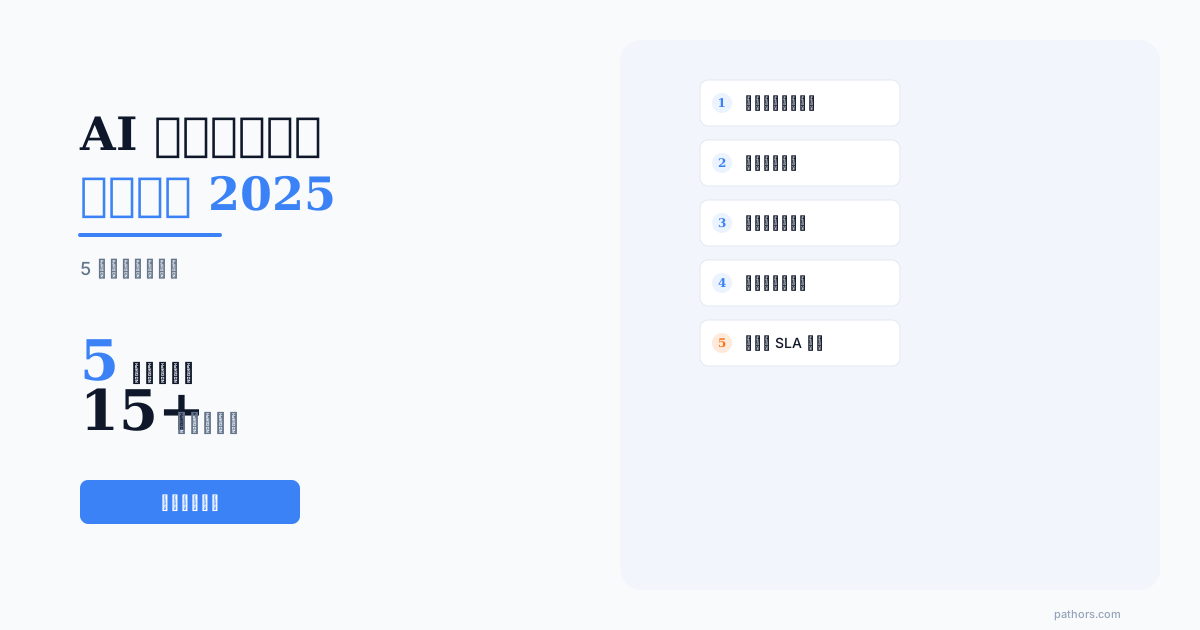
Choosing an AI auto-outbound system is about seeing past the feature checklist. Every vendor will claim multi-turn dialogue, real-time TTS, and CRM integration — but actual performance gaps can reach 4x. Build a quantitative evaluation framework around these 5 dimensions: voice quality (latency and MOS), dialogue engine (multi-turn completion and barge-in handling), integration (API setup time), analytics (refresh frequency and optimization suggestions), and compliance (certifications and audit capabilities). Walk into vendor meetings with real test scenarios from your business. That is worth more than any slide deck.
Further reading: review the legal requirements for AI outbound calls in Taiwan, validate the business case with the AI outbound ROI guide, and design call flows with the AI outbound script guide.
Frequently Asked Questions
How much does an AI auto-outbound system cost?
Pricing typically has two components: a platform subscription and per-minute call charges. Platform fees vary by seat count and feature modules, with SMB plans generally ranging from $500 to $1,500 per month. Call charges run approximately $0.04 to $0.10 per minute. Watch for hidden costs — some vendors charge separately for AI dialogue engine compute. Pathors offers transparent pricing with all AI processing costs included in the plan.
How long does implementation take?
Timeline varies based on integration complexity. The fastest path — standard API integration with a pre-built CRM connector — can be production-ready in 1-2 weeks. Custom dialogue flows and multi-system integrations may require 4-8 weeks. We recommend starting with a standard MVP, validating results, then expanding functionality incrementally.
How does AI outbound connect rate compare to manual dialing?
Our production data shows AI outbound achieves first-attempt connect rates of 42-48%, compared to 33-38% for manual dialing. Two factors drive this: AI systems analyze historical data to identify optimal call windows, and AI dials instantly with zero inter-call downtime, achieving significantly more attempts per hour.
Can recipients tell they are speaking with AI?
With 2025 TTS technology, systems scoring MOS 4.0+ are difficult for most people to identify as synthetic in short interactions. However, regulatory trends increasingly require upfront disclosure. Pathors' approach is to follow the compliance statement immediately with valuable content so recipients continue the conversation because of the information's value.
What use cases work best for AI outbound calling?
The most mature applications include: payment reminders (collection rates up 27%), appointment confirmations (no-show rates down 40%), satisfaction surveys (completion rates 2.1x human agents), marketing campaign notifications (conversion rates up 15-22%), and membership renewal reminders. Complex scenarios like insurance claim follow-ups and B2B lead development also have proven success.
How does the system handle angry or upset recipients?
Mature AI outbound systems include sentiment detection that adjusts strategy when negative emotions are detected. Pathors' logic: when elevated vocal tone or negative keywords are detected, the system responds with a calming acknowledgment, then offers to transfer to a human agent. If negative sentiment exceeds the threshold, automatic transfer occurs with a conversation summary for seamless handoff. This reduces complaint escalation rates by 34%.