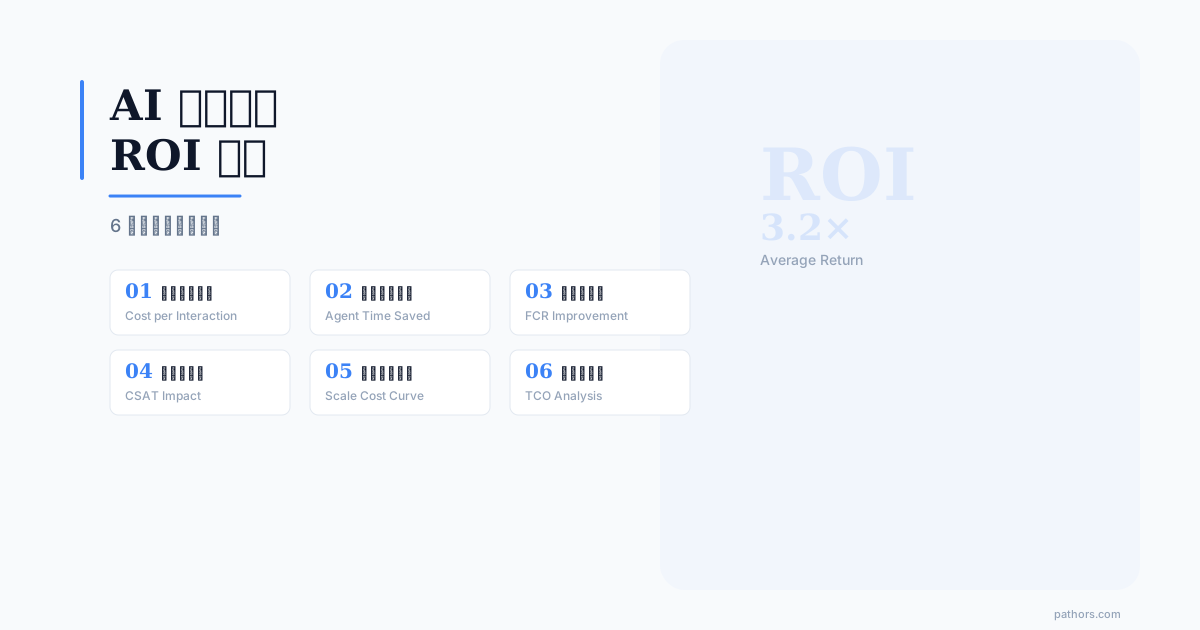
According to Deloitte's 2025 Enterprise AI Procurement Survey, 64% of businesses cite "inability to clearly calculate ROI" as the primary reason for delaying AI customer service adoption. The issue isn't that AI benefits don't exist — it's that most organizations lack a structured evaluation framework. Through our work helping businesses assess AI call center implementations, we've identified 6 metrics that provide the most actionable ROI insights. This guide goes beyond definitions to include calculation logic and worked examples you can adapt directly to your own context.
Metric 1: Cost per Interaction
Cost per interaction is the most fundamental and intuitive ROI metric. IBM's 2025 Customer Service Efficiency Report shows that traditional call center human interaction costs range from USD 5.50-11.00 per contact, while AI-handled interactions cost USD 0.25-0.80.
The Formula
Human cost per interaction = (Agent salary + management overhead + equipment + training) / monthly volume
AI cost per interaction = (Platform fee + API usage + maintenance) / monthly volume
Worked Example
Consider a business with 10 agents, each costing USD 1,700/month fully loaded (salary, benefits, management overhead, equipment). Each agent handles 800 calls monthly.
After AI implementation, assuming 60% of calls handled by AI (4,800 calls) at $0.50 per interaction; remaining 40% (3,200 calls) handled by humans:
Metric 2: Agent Time Savings
McKinsey's 2025 research found that customer service agents spend an average of 35% of their working hours on automatable tasks: looking up order statuses, repeatedly answering FAQs, and manually documenting call summaries. When AI handles these tasks, agent time can be reallocated to higher-value activities.
Three Sources of Time Savings
Worked Example
With 10 agents handling 40 calls each per day, averaging 6 minutes per call:
Metric 3: First-Call Resolution Rate Improvement
SQM Group's 2025 research shows that each 1 percentage point improvement in first-call resolution (FCR) rate drives a 1 percentage point increase in customer satisfaction. Additionally, each repeat contact costs approximately 1.5x the cost of the initial contact.
How AI Improves FCR
Based on our client data, FCR rates improve from an average of 68% to 82% after AI implementation, reducing repeat contacts by approximately 20%.
Cost Impact of Reduced Repeat Contacts
For a call center receiving 8,000 calls monthly with an initial 32% non-resolution rate (2,560 calls needing repeat contact), improving to 18% (1,440 calls):
Metric 4: Customer Satisfaction Impact
Gartner's 2025 report found that AI customer service satisfaction depends primarily on two factors: resolution speed and interaction quality. Notably, when resolution speed is fast enough, customer sensitivity to "whether it's AI" drops significantly.
The Revenue Value of Satisfaction
According to Temkin Group research, satisfied customers spend 140% more than dissatisfied customers over the following 12 months. For a business with 10,000 active customers averaging $160 annual spend:
This figure is frequently underestimated because it doesn't appear in the customer service department's budget reports, but the revenue impact is tangible.
Measurement Approach
Implement identical CSAT surveys (post-call automated questionnaire, 1-5 scale) before and after AI deployment. Track satisfaction scores separately for AI-handled and human-handled interactions to establish comparison baselines.
Metric 5: Scalability Cost Curve
Human customer service costs scale nearly linearly: every additional 1,000 calls requires approximately 1.25 more agents. AI cost curves show step-function decreases — there's a fixed upfront cost (platform fee, setup), but marginal costs are minimal.
Cost Comparison at Different Scales
| Monthly Volume | Human-Only Monthly Cost | AI Hybrid Monthly Cost | Savings |
|---|---|---|---|
| 3,000 calls | $6,400 | $4,500 | 29% |
| 8,000 calls | $17,000 | $9,200 | 46% |
| 20,000 calls | $42,500 | $17,000 | 60% |
| 50,000 calls | $106,500 | $32,000 | 70% |
Higher volumes amplify AI's cost advantage. This matters especially for industries with seasonal fluctuations (retail, travel) — AI doesn't require severance during slow periods or hiring and training time during peaks. Forrester's 2025 analysis found that businesses with high seasonal volatility see 35% higher AI customer service ROI than steady-state businesses.
Metric 6: Implementation & Maintenance TCO
Many businesses calculate ROI considering only the platform's monthly fee, overlooking one-time implementation costs and ongoing maintenance. IDC's 2025 report shows that actual AI project TCO averages 42% higher than budgeted, primarily due to underestimated integration and maintenance costs.
Four TCO Components
Payback Period Calculation
Using the 8,000 calls/month scenario above:
With Pathors' standard plans, most clients achieve payback within 2-4 months, depending on call volume and existing cost structure. If you'd like a customized ROI analysis for your specific situation, Pathors offers complimentary cost-benefit assessments — reach out to our team to get started.
AI call center ROI assessment shouldn't stop at a simple "human cost vs. AI cost" comparison. The six metrics — cost per interaction, agent time savings, first-call resolution rate, customer satisfaction impact, scalability cost curve, and total cost of ownership — together form a comprehensive evaluation framework. Mastering these numbers isn't just about securing budget approval from leadership. It's about establishing the baselines needed to continuously track benefits, optimize configuration, and ensure your AI call center becomes a genuine engine for business growth.
Frequently Asked Questions
How long does it typically take to see ROI from an AI call center?
Based on our client data, most businesses reach payback within 2-4 months of deployment. The first month is typically an adjustment period, with ROI improving markedly from month two onward. Higher call volumes accelerate the payback timeline.
What's the most commonly overlooked cost when calculating AI call center ROI?
Maintenance costs (script updates, performance monitoring) and opportunity costs (transition-period efficiency losses as agents adapt to new roles) are most frequently underestimated. We recommend budgeting 15-20% of platform fees for maintenance and 10% for first-quarter transition adjustment costs.
Is AI customer service cost-effective for small businesses with under 1,000 monthly calls?
At sub-1,000 monthly call volumes, absolute cost savings are smaller and payback periods may extend to 6-8 months. However, if the business faces peak-period staffing shortages or inconsistent service quality, the service quality improvements and customer satisfaction gains can still justify the investment.
Does AI call center ROI improve over time?
Typically yes, for three reasons: first, AI models and scripts improve continuously, increasing automation rates month over month; second, marginal costs decrease as volume grows; third, accumulated call data enables service quality improvements and business insights. Most businesses see second-year ROI 40-60% higher than the first year.
How do I build a business case for AI call center investment for leadership?
We recommend a three-layer approach: first, use the six metrics in this guide to build a concrete ROI calculation showing financial returns; second, reference industry peer case studies and results as benchmarks; third, propose a limited pilot (e.g., handling one call type first) to reduce decision risk. Most platforms, including Pathors, support flexible pilot configurations.
Does Pathors help with ROI calculations?
Yes. Pathors provides complimentary cost-benefit analysis. Our team builds a customized ROI report based on your call volume, existing cost structure, and business objectives, including projected savings, payback timeline, and phased implementation recommendations.