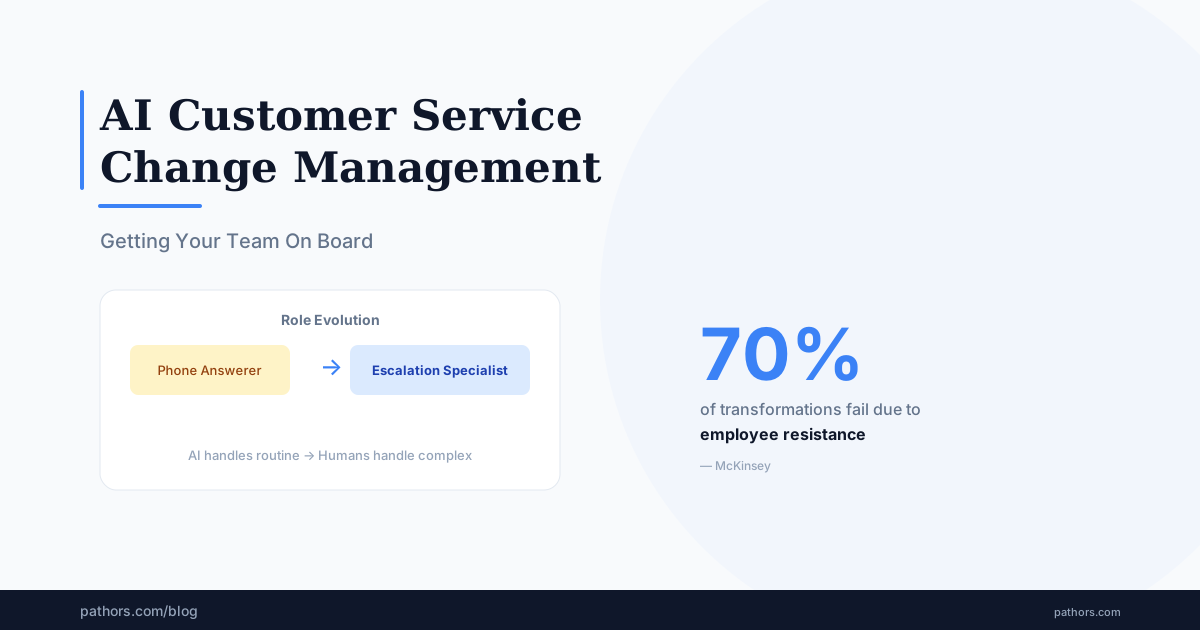
The number one reason AI customer service projects fail has nothing to do with the AI. It is the humans. A widely cited McKinsey study found that 70% of organizational transformations fail due to employee resistance and lack of management support. In customer service specifically, where agents have built their careers around the very skills AI is automating, resistance runs even deeper.
We have guided dozens of customer service teams through AI adoption, and we can tell you this with certainty: the organizations that invest in change management alongside technology deployment succeed. The ones that treat people as an afterthought do not. This guide covers the practical, week-by-week work of getting your customer service team to work with AI rather than against it.
Why Customer Service Teams Resist AI (and They're Not Wrong)
Before we talk about overcoming resistance, we need to acknowledge something important: customer service agents have legitimate reasons to be skeptical about AI. Dismissing their concerns as "fear of change" is both disrespectful and strategically foolish.
Here is what agents are actually worried about, based on a 2024 Salesforce survey of 5,500 service professionals:
These concerns are grounded in reality. Agents have watched other industries automate roles away. They have seen poorly implemented chatbots frustrate customers. Their skepticism is a rational response to real signals.
The mistake most organizations make is trying to convince agents that their fears are unfounded. A more effective approach is to acknowledge the fears, provide honest answers about what will change, and then demonstrate — through actions, not presentations — that AI adoption benefits agents directly.
Prosci's 2024 benchmarking data shows that projects with excellent change management are 7x more likely to meet objectives than those with poor change management. The investment pays for itself.
The Change Management Framework That Works
We have refined a change management framework across multiple AI customer service deployments. It operates on three parallel tracks: communication, role redesign, and training. Each track has a specific timeline.
Communication Timeline
Communication starts before the technology does. We recommend beginning structured communication at least 6 weeks before any AI system goes live.
| Week | Communication Action | Audience | Format |
|---|---|---|---|
| -6 | Announce AI initiative, share strategic rationale | All CS staff | Town hall + written FAQ |
| -5 | Share specific timeline and what will/will not change | All CS staff | Team meetings |
| -4 | Open Q&A sessions, collect concerns anonymously | All CS staff | Small groups (max 15) |
| -3 | Address top concerns publicly, share pilot plan | All CS staff | Town hall + email |
| -2 | Introduce pilot team, explain selection criteria | All CS staff | Team meetings |
| -1 | Pilot team deep-dive on tools, process, expectations | Pilot team only | Workshop |
| 0 | Go-live communication, establish feedback channels | All CS staff | Multi-format |
Two rules make this timeline work. First, never let agents hear about AI changes from anyone other than their direct leadership. If the CEO announces an AI initiative at an all-hands before the CS team has been briefed, trust is already damaged. Second, every communication must include a specific answer to the question "What does this mean for my job?" Vague reassurances increase anxiety. Specifics reduce it.
According to Towers Watson research, companies with highly effective communication practices are 3.5x more likely to significantly outperform their peers during organizational changes.
Role Redesign Track
Role redesign runs parallel to communication but involves smaller groups of CS leadership and HR. The goal is to have new role definitions ready before the AI goes live — not after. We cover this in detail in the next section.
Training Track
Training begins 2 weeks before go-live and continues for at least 90 days after. We cover the training structure in a dedicated section below.
Redesigning Roles, Not Eliminating Them
This is the section that matters most to your agents, and it is the one most organizations handle poorly. A 2024 World Economic Forum report found that 83% of organizations expect AI to change job roles significantly, but only 29% have actually redesigned job descriptions to reflect AI augmentation.
Here is how we approach role redesign for AI-augmented customer service teams:
The Role Evolution Map
For every existing CS role, we create a three-column analysis:
Current Tasks → AI-Handled → Human-Enhanced
Example for a Tier 1 Customer Service Agent:
| Current Task | After AI Deployment | New Human Focus |
|---|---|---|
| Answer routine inquiries (order status, hours, basic troubleshooting) | AI handles 70-80% of these | Monitor AI quality on routine calls, handle exceptions |
| Route calls to specialists | AI routes automatically based on intent detection | Define and refine routing rules, handle misroutes |
| Log call notes and disposition codes | AI generates call summaries automatically | Review and correct AI summaries for accuracy |
| De-escalate frustrated customers | AI handles initial de-escalation, escalates when needed | Handle complex escalations, coach AI on de-escalation patterns |
| Upsell during service calls | AI identifies opportunities, human closes | Focus entirely on high-value upsell conversations |
The pattern here is consistent: AI takes on volume work, and humans move into quality, exception handling, and strategy. The key insight — supported by Accenture's 2024 workforce study showing that AI-augmented workers are 40% more productive in complex tasks — is that this shift makes each agent more valuable, not less.
New Roles That Emerge
In our deployments, we typically see three new roles emerge:
Critically, these roles should come with updated compensation. Asking agents to take on more complex work at the same pay sends a message that undermines your entire change management effort. A 2024 Mercer survey found that organizations offering role-adjusted compensation during AI transitions experienced 55% lower voluntary turnover.
Training Your Team to Work WITH AI
Training for AI-augmented customer service is fundamentally different from traditional CS training. You are not teaching agents a new phone system. You are teaching them to collaborate with an autonomous system that makes its own decisions.
The Training Program Structure
We recommend a four-phase training program:
Phase 1: AI Literacy (Week -2 to -1)
Every agent, regardless of role, goes through AI fundamentals. This is not a computer science course. It covers:
Duration: 4 hours total, split across two sessions.
Phase 2: Workflow Integration (Week -1 to Week 1)
Agents learn the new workflows specific to their role. This includes:
Duration: 8 hours, with at least 4 hours of hands-on practice. According to LinkedIn's 2024 Workplace Learning Report, hands-on practice improves skill retention by 75% compared to lecture-only training.
Phase 3: Supervised Practice (Weeks 1-4)
During the first month of AI deployment, agents work in a supervised environment where:
Phase 4: Continuous Learning (Month 2 onward)
Ongoing training addresses emerging needs:
The Buddy System
One practice that consistently accelerates adoption is pairing AI-skeptical agents with AI-enthusiastic ones. Not to convince them — but to let them see the technology work through a trusted peer's experience. In our deployments, this approach has reduced time-to-competency by an average of 30%.
Measuring Change Adoption
Most organizations measure AI deployment success by looking at the AI: containment rate, handle time, cost per interaction. Those metrics matter, but they miss half the picture. You also need to measure how well your humans are adapting.
Adoption Metrics Beyond "Is the AI Running?"
We track adoption across four dimensions:
Behavioral adoption:
Sentiment adoption:
Competency adoption:
Impact adoption:
PwC's 2024 Global Workforce Hopes and Fears survey found that 52% of workers believe AI will improve their job quality, but only if the transition is managed well. Your adoption metrics tell you whether you are managing it well enough.
The 90-Day Health Check
At the 90-day mark, we recommend a comprehensive health check that brings together all four adoption dimensions. This is not a pass/fail assessment — it is a diagnostic tool that tells you where to focus the next phase of change management.
Key questions for the health check:
Getting your customer service team on board with AI is not a one-time event. It is a sustained effort that starts before the technology arrives and continues long after it goes live. The organizations that succeed at AI customer service treat change management as a first-class workstream — with its own budget, timeline, metrics, and leadership attention.
Pathors includes change management support as part of our AI voice deployment programs. From communication planning to role redesign workshops to training curriculum development, we help your team navigate the human side of AI adoption. Because the technology works. The question is whether your team will work with it.
Frequently Asked Questions
How long does change management take for an AI customer service deployment?
Plan for at least 6 weeks of pre-deployment communication and preparation, followed by 90 days of active change management post-launch. The full cycle from initial announcement to stable adoption typically runs 5-6 months. Organizations that try to compress this timeline often face higher resistance and longer overall adoption periods.
What percentage of customer service agents typically leave during an AI transition?
With strong change management, incremental voluntary turnover during AI transitions ranges from 3-8%. Without change management, that number can reach 20-25%, according to industry benchmarks. The agents most likely to leave are often your best performers who have the most transferable skills, making retention even more critical.
Should we involve agents in the AI vendor selection process?
We strongly recommend including 2-3 frontline agents in the evaluation process. They bring practical perspective on workflow fit and identify potential issues that management might miss. In our experience, agents who participated in selection become natural advocates during rollout, significantly accelerating peer adoption.
How do we handle agents who remain resistant after the training program?
Persistent resistance usually signals an unaddressed concern rather than stubbornness. We recommend one-on-one conversations to understand the specific objection. Often it relates to a workflow issue that has a practical fix. For agents who remain resistant despite genuine effort, consider whether a role in the non-AI-assisted escalation track might be a better fit. Forcing adoption almost always backfires.
What is the biggest change management mistake in AI customer service deployments?
Announcing AI adoption and going live at the same time. When agents learn about AI and are expected to work alongside it in the same week, you have combined the anxiety of uncertainty with the stress of new workflows. The 6-week pre-deployment communication period gives agents time to process, ask questions, and mentally prepare before the technology arrives.
Do we need a dedicated change management person or team?
For deployments affecting fewer than 50 agents, a designated change management lead (typically a senior CS manager with 20% dedicated time) is sufficient. For larger deployments, we recommend a small team: one change management lead, one training coordinator, and one communications specialist. The investment is modest compared to the cost of a failed deployment — which Deloitte estimates at 2-3x the original technology budget.