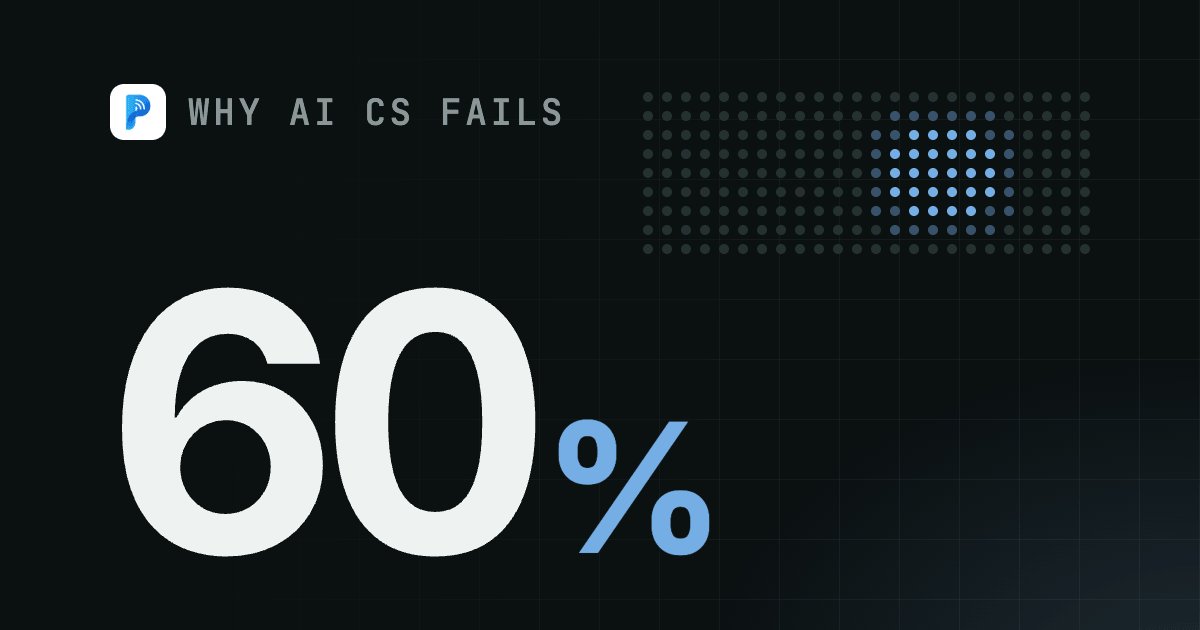
Here's a number that should concern every CTO in Taiwan: according to a 2024 Gartner survey, roughly 60% of AI customer service projects fail to meet their original objectives within the first 18 months. Not because the AI wasn't smart enough. Not because the vendor oversold. Most of the time, it's execution.
I've watched this pattern play out across dozens of enterprise deployments in the Taiwan market over the past three years. A company gets excited about AI customer service — maybe after a compelling demo, maybe after a board member reads an article — and then proceeds to make a series of avoidable mistakes that doom the project before it ever has a fair chance.
The frustrating part? These mistakes are predictable. They follow patterns. And they're almost always preventable if you know what to look for.
What follows are the seven most common failure modes we see in Taiwan enterprises implementing AI customer service. Some are universal to any AI deployment. Others are shaped by Taiwan's specific regulatory environment, cultural expectations, and market dynamics. All of them are fixable — but only if you address them before they compound.
Mistake 1: Starting Too Big — The 'Automate Everything' Trap
What it looks like: The project brief reads something like "deploy AI to handle 80% of all customer service inquiries within six months." The scope includes every channel, every topic, every customer segment. The timeline is aggressive. The expectations are sky-high.
A 2023 McKinsey study found that AI projects with narrowly defined initial scope are 3.2x more likely to reach production than those attempting broad automation from day one.
Why does this happen in Taiwan specifically? Two factors. First, enterprise decision-making often involves extensive internal consensus-building, so by the time a project gets approved, stakeholders have piled on requirements to justify the investment. Second, there's a cultural tendency toward comprehensive solutions — launching something small can feel insufficiently ambitious.
How to Avoid It
Start with a single, well-defined use case. The best candidates share three characteristics:
For most Taiwan enterprises, this means starting with one of these:
Get one use case working well. Measure the results. Then expand. A phased rollout that takes 12 months will outperform an ambitious launch that collapses in 6.
Mistake 2: Ignoring Data Quality — The Foundation Nobody Wants to Build
What it looks like: The team assumes existing customer service data — call logs, chat transcripts, FAQ documents — is ready for AI training. They dump it into the system and wonder why the AI gives nonsensical answers.
Data quality issues affect an estimated 73% of enterprise AI projects, according to IBM's Global AI Adoption Index. In customer service specifically, the problems are acute because interaction data is messy by nature.
In the Taiwan market, data quality challenges have an additional layer. Many enterprises maintain customer service records in a mix of Traditional Chinese, English, and occasionally Simplified Chinese. Call logs may include Mandarin, Taiwanese Hokkien, and Hakka. Transliteration inconsistencies are common. Internal jargon varies between departments.
What Good Data Preparation Looks Like
Before feeding anything into an AI system, enterprises need to:
This work is unglamorous. It takes 4-8 weeks for a mid-size operation. Nobody wants to budget for it. But skipping it is like building a house on sand — everything that follows will be unstable.
Mistake 3: No Clear Success Metrics Before Launch
What it looks like: The project launches with vague goals like "improve customer satisfaction" or "reduce call volume." Six months later, everyone has a different opinion on whether it's working.
Organizations that define specific KPIs before AI deployment are 2.5x more likely to report successful outcomes, per a Deloitte survey on enterprise AI initiatives.
This problem is particularly common in Taiwan's enterprise culture, where projects are often justified on qualitative grounds ("we need to be more innovative," "competitors are doing it") rather than quantitative targets. The result is that success becomes a matter of narrative rather than measurement.
The Metrics Framework That Works
Before deploying any AI customer service system, lock down these metrics with specific numerical targets:
| Metric | What It Measures | Example Target |
|---|---|---|
| Containment rate | % of inquiries resolved without human handoff | 40% within 3 months |
| First-contact resolution | % resolved in a single interaction | 70% for AI-handled inquiries |
| Average handling time | Duration of AI-managed interactions | Under 3 minutes |
| Customer satisfaction (CSAT) | Post-interaction survey scores | Maintain current baseline or improve |
| Escalation accuracy | % of escalations that truly needed human help | Above 85% |
| Cost per interaction | Total system cost divided by interactions handled | 30% below human-agent cost |
Set baselines before launch. Measure weekly. Report monthly. Adjust quarterly. This isn't optional — it's the difference between a project that improves over time and one that slowly drifts into irrelevance.
Mistake 4: Treating AI as a Cost-Cutting Tool Only
What it looks like: The business case is built entirely around headcount reduction. "We have 50 customer service agents. AI will replace 30 of them. Here's the ROI." The AI gets deployed, handles the easy calls, and the remaining agents are stuck with nothing but angry, complex cases all day. Morale craters. Turnover spikes. Customer experience drops.
A Forrester study found that companies framing AI as a customer experience investment see 34% higher returns than those framing it purely as cost reduction.
In Taiwan, where labor costs for customer service roles are lower than in the US or Europe, the pure cost-cutting argument is already weaker. A customer service agent in Taipei costs a fraction of one in San Francisco. The real value of AI in the Taiwan market is capability expansion: offering 24/7 service, supporting multiple languages, maintaining consistency, and freeing human agents to handle work that actually requires human judgment.
Reframing the Business Case
The most successful AI customer service deployments in Taiwan are justified on these grounds:
When you frame it this way, the headcount conversation changes. You're not replacing agents — you're upgrading what they do.
Mistake 5: Underestimating Change Management
What it looks like: The technology works. The integration is solid. But nobody uses it correctly. Agents don't trust the AI and override it constantly. Supervisors don't know how to interpret the dashboards. Customers are confused by the new system. Six months later, the team has quietly gone back to doing things the old way.
Research from Prosci indicates that projects with excellent change management are 6x more likely to meet objectives than those with poor change management. Yet in most AI deployments, change management gets roughly 5% of the budget and attention.
Taiwan's enterprise environment adds specific change management challenges. Hierarchical organizational structures can mean that frontline staff concerns don't reach decision-makers until frustration has calcified into resistance. The concept of "face" means that employees may not openly express confusion or disagreement with new systems. And union or labor committee considerations, while less prominent than in some markets, still require thoughtful navigation.
The Change Management Checklist
Budget at least 15-20% of your total project cost for change management. It's not overhead — it's the difference between a system that gets used and a system that gets abandoned.
Mistake 6: Choosing Based on Demo, Not Production Readiness
What it looks like: The vendor gives a dazzling demo. The AI handles every question perfectly. The voice sounds incredibly natural. The team is sold. They sign the contract. Three months into implementation, they discover that the demo was running on carefully curated data, the system can't handle their specific integrations, and the "natural" voice stumbles on industry-specific terminology.
According to a 2024 survey by CIO Magazine, 47% of enterprises reported significant gaps between vendor demo capabilities and production performance in their AI implementations.
Every AI vendor has a demo environment optimized for impressive first impressions. That's not deception — it's sales. The problem arises when buying decisions are made based on demos without rigorous production testing.
Due Diligence That Actually Works
Before selecting a vendor, insist on these evaluation steps:
Spend 4-6 weeks on evaluation. It will save you months of frustration later.
Mistake 7: No Plan for Continuous Improvement After Deployment
What it looks like: The system launches. There's a brief celebration. The implementation team moves on to other projects. The AI sits there, handling calls with the same knowledge base and the same conversation flows it had on day one. Six months later, customer complaints about the AI are rising, but nobody's looking at the data.
AI systems that receive regular tuning and updating show a 45% performance improvement over their first year, according to research from MIT Sloan Management Review. Systems that don't get updated show a performance decline of 15-20% over the same period as customer behavior, product offerings, and business processes change around them.
This is perhaps the most common mistake of all, and it's especially prevalent in Taiwan's enterprise landscape, where project-based budgeting makes it difficult to secure ongoing operational funding for a system that's technically "already launched."
Building the Continuous Improvement Engine
The minimum viable ongoing improvement program includes:
Staffing for Ongoing Success
Assign a dedicated owner — not as a side project for someone who has three other jobs. The role requires:
In Taiwan, this role often sits within the customer service organization rather than IT, which makes sense because the operational context matters more than the technical plumbing.
The Pattern Behind the Patterns
Look at these seven mistakes together and a theme emerges: most AI customer service failures are management failures, not technology failures. The AI itself is usually capable enough. What breaks is the organizational wrapper around it — the planning, the measurement, the change management, the ongoing investment.
Taiwan enterprises have some structural advantages in AI adoption. The market is compact enough to move quickly. The technology talent pool, while competitive, is strong. Customer expectations for service quality are high, which creates genuine motivation to improve.
The enterprises that succeed treat AI customer service as an ongoing operational capability rather than a one-time project. They start small, measure rigorously, invest in their people, and commit to continuous improvement.
For organizations evaluating AI customer service platforms, solutions like Pathors that offer built-in analytics, structured deployment methodologies, and ongoing optimization support can help avoid several of these pitfalls — but no technology alone is sufficient. The organizational commitment has to match the technological investment.
The 60% failure rate for AI customer service projects isn't inevitable. It reflects a pattern of avoidable mistakes — starting too big, neglecting data quality, skipping metrics, misframing the value proposition, ignoring change management, buying on demos, and failing to invest in continuous improvement.
Each of these mistakes has a straightforward antidote. None of the fixes are technically complex. They require discipline, realistic expectations, and a willingness to do the unglamorous groundwork that makes the technology shine.
For Taiwan enterprises, the opportunity is significant. The market is ready for AI-powered customer service. The customers expect it. The technology can deliver it. The question is whether organizations will invest the operational rigor to make it work — not just on launch day, but every day after.
Frequently Asked Questions
How long should a realistic AI customer service implementation timeline be for a mid-size Taiwan enterprise?
For a focused initial deployment covering one or two use cases, expect 3-4 months from project kickoff to production launch. This includes 4-6 weeks for data preparation and vendor evaluation, 4-6 weeks for configuration and integration, and 2-4 weeks for testing and supervised operation. Broader deployments covering multiple channels and use cases should be planned as phased rollouts over 9-12 months.
What budget should Taiwan enterprises allocate for an AI customer service project?
Total first-year costs typically range from NT$1.5 million to NT$5 million for mid-size deployments, depending on scope and integration complexity. This should include platform licensing (40-50% of budget), integration and customization (20-25%), change management and training (15-20%), and ongoing optimization (10-15%). The most common budgeting mistake is allocating everything to technology and nothing to the organizational change required.
Does Taiwan have specific regulations that affect AI customer service deployments?
Yes. Taiwan's Personal Data Protection Act governs how customer data is collected, stored, and used in AI systems. Financial services are additionally regulated by the FSC, which has specific guidelines on AI use in customer-facing applications. Healthcare and telecom sectors have their own regulatory layers. Enterprises should conduct a regulatory review specific to their industry before deployment and ensure their chosen platform supports compliance requirements.
How should enterprises handle the transition period when both AI and human agents are operating?
The hybrid period is critical and should be planned carefully. Start by routing only the simplest, highest-volume inquiries to AI while human agents handle everything else. Gradually expand the AI's scope as performance data confirms readiness. During this period, human agents should be trained in a new role — handling escalations from AI and providing feedback on AI performance. Clear escalation paths and handoff protocols need to be defined so customers never feel stuck between systems.
What's the most reliable indicator that an AI customer service project is going off track?
The single most reliable early warning sign is rising escalation rates without a corresponding increase in inquiry volume. If the AI is sending more and more interactions to human agents, it means the system isn't learning or adapting to real customer needs. Other red flags include declining CSAT scores for AI-handled interactions, increasing average handling time, and — perhaps most importantly — frontline staff losing confidence in the system and manually overriding it.