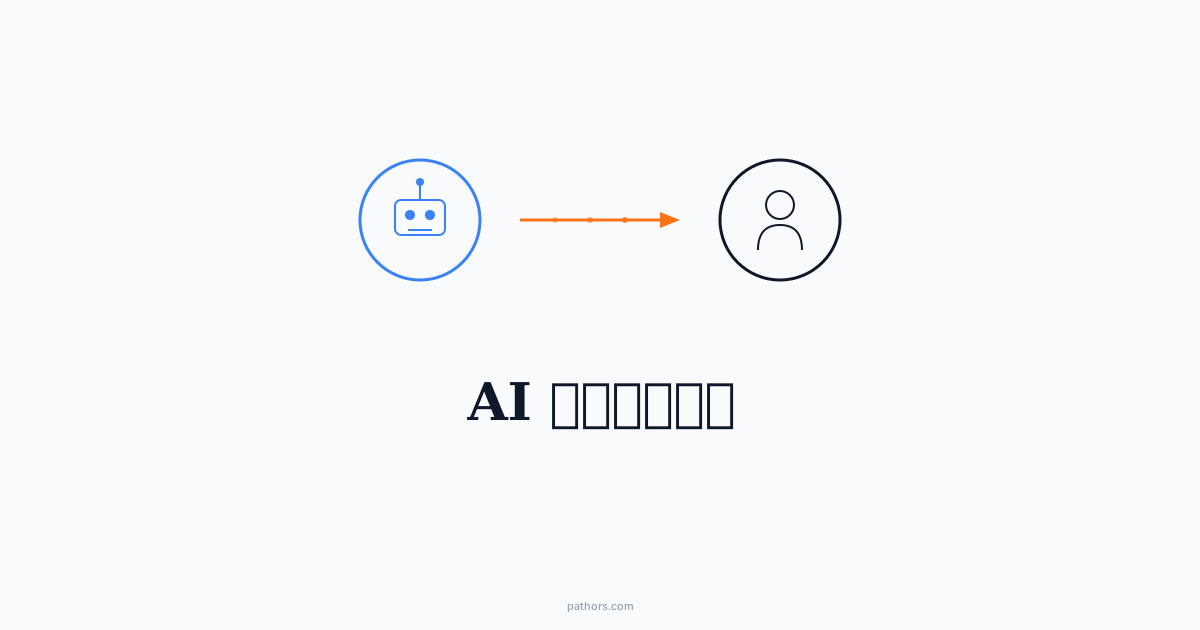
The customer has been talking to your AI for 90 seconds. The bot does not understand the question. Instead of escalating, it loops: "I'm sorry, could you repeat that?" Three loops later, the customer hangs up. AI-to-human handoff is where most voice AI implementations break down — not because the AI cannot handle common queries, but because no one designed what happens when it cannot.
The Four Escalation Triggers Every Voice AI Needs
Trigger 1: Confidence threshold
When the AI's confidence in its understanding drops below a set threshold (typically 60-70%), it should escalate rather than guess. This is the most straightforward trigger and catches most "the AI doesn't understand" scenarios.
Trigger 2: Sentiment detection
If the customer's tone shifts to frustration, anger, or distress, escalate immediately. Voice AI has an advantage here — prosody analysis (pitch, speed, volume changes) detects emotional shifts that text-based systems miss entirely.
Trigger 3: Explicit request
"Let me talk to a person" should always work. No exceptions, no friction, no "let me try to help you first." Blocking explicit escalation requests is the fastest way to destroy customer trust.
Trigger 4: Topic complexity
Some topics should never be handled by AI: legal disputes, safety incidents, complaints about discrimination, or any issue with potential regulatory implications. Maintain a topic blocklist that routes directly to specialized human agents.
Warm Handoff vs. Cold Handoff
Cold handoff
The AI transfers the call. The human agent starts from zero. The customer repeats everything. This is the default at most companies and it is terrible.
Warm handoff
The AI transfers the call with full context: conversation transcript, detected intent, customer sentiment score, account information already retrieved, and what the AI already tried. The agent picks up mid-conversation, not from scratch.
The implementation gap
Warm handoff sounds obvious but requires engineering investment:
1. Real-time transcript streaming to the agent's screen before they pick up
2. Structured summary generation — not a raw transcript, but key information extracted: customer name, issue category, what was attempted, emotional state
3. CRM pre-population — by the time the agent picks up, the customer's account is already on screen
4. AI-suggested next steps — the agent sees what the AI recommends as the resolution path
Designing the Transition Moment
The 5 seconds between AI and human are critical. Bad transitions feel like being hung up on and called back. Good transitions are invisible.
Best practices
How Pathors Handles Escalation
Pathors treats the handoff as a first-class product feature, not an edge case.
The Handoff Is the Product
Customers do not judge your AI by how well it handles easy questions. They judge it by what happens when it cannot help. A well-designed handoff turns a potential failure into a trust-building moment.
Invest in the handoff as much as you invest in the AI itself. The companies that get this right see higher CSAT on escalated calls than on AI-resolved ones — because the human agent arrives fully prepared. Learn more about Pathors' escalation design at pathors.com.