The short answer first: AI telemarketing is legal in Taiwan, and for telesales teams with big lists and thin headcount it solves a specific problem — not "replacing reps," but the fact that most rep time is burned on unproductive dialing. A telesales rep makes 80–120 effective dials a day, and often fewer than 20 turn into real conversations; the dead numbers, busy lines, no-answers, and instant hang-ups are pure time cost.
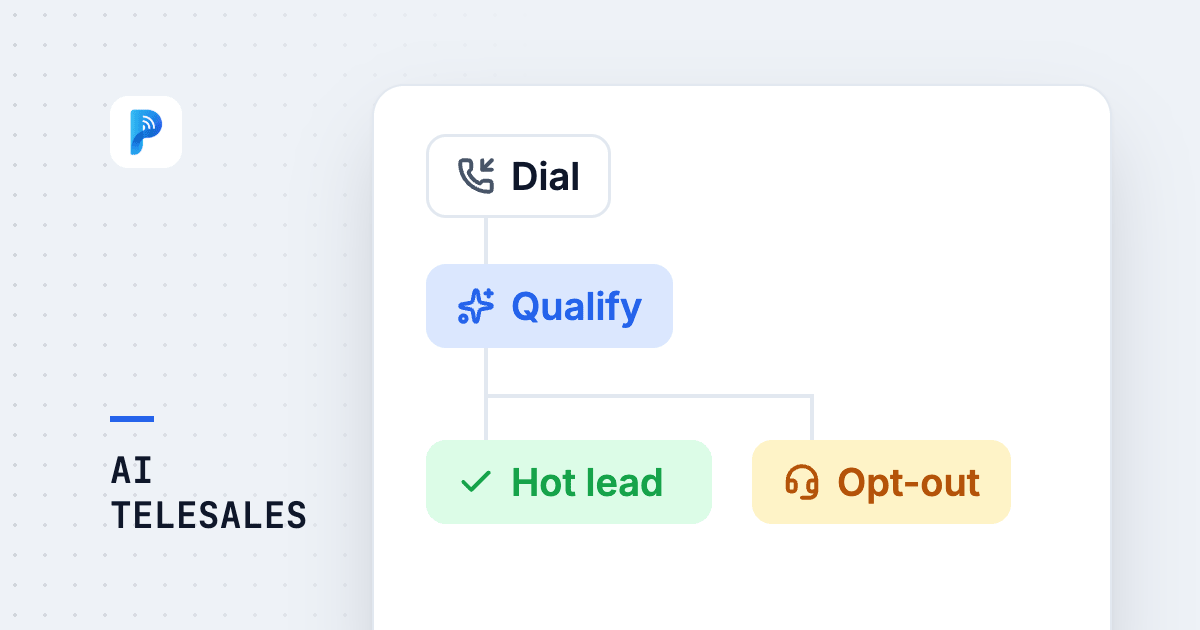
AI telemarketing automates exactly that draining front half: the AI dials concurrently, opens and screens with natural conversation, and hands human reps a labeled list of leads who are interested and worth the time. It is a fundamentally different thing from the pre-recorded robocalls you may have received — legally and technically. This guide covers the differences, legality, best-fit scenarios, deployment steps, and ROI in one place.
What Is AI Telemarketing — and How It Differs from Human Telesales and Robocalls
At least three very different products get sold under the "phone marketing automation" label in Taiwan, and confusing them is where most failed deployments start:
| Dimension | Human telesales | Pre-recorded robocall | Conversational AI telemarketing |
|---|---|---|---|
| Interaction | Live human conversation | One-way recorded playback | AI understands and responds in real time |
| List throughput | One line per rep, ~100 dials/day | Fast, but zero interaction | Concurrent dialing, thousands of calls/day |
| Personalization | High but inconsistent | None | Adapts to lead data and live responses |
| Customer perception | Depends on script and rep | Widely resented, frequently reported | Near-human, handles questions naturally |
| Record keeping | Manual entry, often missed | Dial logs only | Full transcript and intent labels written back to CRM |
The dividing line is whether the system can hold a conversation. A robocall is a broadcast that falls apart the moment the customer speaks; conversational AI can answer "who are you?" and "how much?", and grade intent from the response.
The Question Everyone Asks First: Is AI Telemarketing Legal in Taiwan?
Yes — with clear red lines, and those lines come from your list and your script, not from the use of AI itself:
For the full statutes, penalties, and a pre-launch checklist, see our article Is AI outbound calling legal in Taiwan? — worth a full read before going live.
Which Telesales Scenarios Suit AI Best?
Not all of them. In our deployments, the clearest wins are scenarios that are high-volume, fixed-process, and aimed at screening rather than closing:
Conversely, high-ticket, trust-heavy closing (policy planning, B2B contracts) remains a human game. AI's job is to free reps from the unproductive front half of the funnel.
Four Steps to Deploy — with Results Inside 90 Days
Step 1: Pick one scenario (weeks 1–2). Don't launch everything at once. Choose the scenario with the biggest list and the most fixed process — old-list rewashing is a common first pick.
Step 2: Port your scripts and SOP (weeks 2–4). Turn your best rep's openers, answers, and objection handling into a conversation flow. This step decides the outcome — AI is not a script reader. See our AI outbound script design guide.
Step 3: Small-batch trial plus compliance check (weeks 4–6). Dial 300–500 leads, review every transcript, fix what the AI can't handle, and confirm disclosure duties and the do-not-call mechanism are in place.
Step 4: Scale and write back to CRM (weeks 6–12). Once trial metrics stabilize, expand the list volume, and write intent labels and call summaries back to the CRM automatically — reps open the system each morning to a pre-sorted warm list.
Estimating ROI: A 10-Rep Telesales Team
Take a 10-rep team, 100 dials per rep per day, 30% connect rate:
| Metric | Human only | AI screening + human closing |
|---|---|---|
| Daily list throughput | ~1,000 dials | 3,000–5,000 dials (concurrent AI) |
| Where rep time goes | ~80% lost to dialing and dead calls | Almost entirely on interested leads |
| List rewash cycle | Months | Days |
| Cost per productive conversation | High (salary plus churn cost) | Substantially lower, scales elastically |
Real numbers vary widely with industry, list quality, and script maturity — run a small trial on your own list rather than trusting any vendor's slide. For the full methodology, see our AI outbound system ROI analysis.
The Four Common Failure Modes
One: forcing a bad list — AI speeds up throughput; it can't rescue leads that should never be called. Two: using conversational AI like a robocall — no dialog design, no objection handling, and the experience is as bad as a broadcast. Three: no human-handoff path — when a customer wants to talk now, a voicemail kills the moment. Four: neglecting the do-not-call list — re-dialing people who opted out is the main source of complaints and penalties.
AI telemarketing is no longer a whether question — it's a how question: pick the right scenario, invest in the script, validate small, then scale. Most telesales teams see a visible change in list throughput and productive-conversation volume within a quarter.
Further reading: Is AI outbound calling legal in Taiwan? (the pre-launch compliance checklist) and How to choose an AI auto-outbound system in 2026 (five dimensions of vendor selection). To see how Pathors runs telesales outbound end to end, visit the AI outbound calling for telesales page, or book a 30-minute demo and trial-dial your own list.
Frequently Asked Questions
Is AI telemarketing legal in Taiwan?
Yes. No Taiwanese law bans AI-driven telemarketing, but the PDPA (lawful lead sourcing, disclosure duties, opt-out rights), the Fair Trade Act (honest identity and purpose disclosure), and recording rules all apply — the same obligations as human telesales. The essentials: lawful lists, honest scripts, and a rigorously maintained do-not-call list.
Is AI telemarketing the same as an AI outbound system?
They overlap heavily but differ in viewpoint. An AI outbound system is the technical capability — auto-dialing plus AI conversation plus record write-back; telemarketing is one of its applications. The same system typically also handles payment reminders, appointment confirmations, and satisfaction follow-ups. Choose the system on technology; run telemarketing on script and list strategy.
Will customers resent it, hang up, or report us?
That depends on your script and list, not on whether AI is involved. One-way robocalls draw the most resentment; conversational AI that opens honestly, answers naturally, and genuinely stops when someone says no lands close to human telesales. The thing to avoid above all is re-dialing opted-out numbers — that's where complaints actually come from.
How is AI telemarketing priced?
Commonly per call minute or per call, plus one-off script design and system integration. Don't compare unit prices — compare cost per productive conversation against human dialing: divide the AI spend by the number of interested leads it surfaces, and it's usually far below the human unit cost.
Will AI replace telesales reps?
It replaces the dialing and screening, not the closing. Post-deployment teams typically keep similar headcount while per-rep closing volume rises, because rep time shifts entirely to leads worth talking to. What actually gets retired is the practice of grinding through lists by hand.