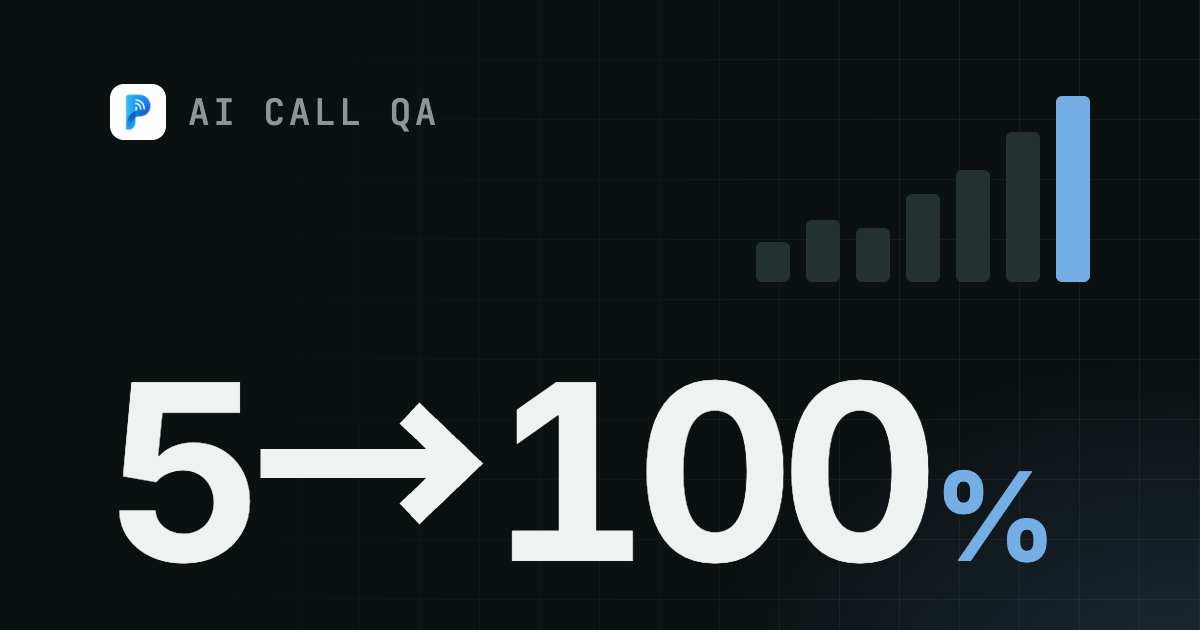
Call quality assurance in customer service and telesales teams has long depended on reviewers sampling recordings: each month they pick a small share of calls and score them one by one against a scorecard. The problem is simple arithmetic. If you sample 5% of calls, 95 out of every 100 are never heard by anyone.
AI quality assurance (also called auto QA or AI call scoring) answers this directly: AI transcribes every recording, scores it item by item against your own scorecard, and quotes the exact line behind each judgment. QA moves from sampling to full coverage, and managers spend their time on the exceptions AI surfaces instead of searching for them. Companies have already shared publicly that they moved from roughly 5% manual sampling to 100% AI-scored QA.
This guide explains how AI QA works, what it can check, where manual sampling falls short, and what to prepare before rolling it out.
First, which kind of AI QA
Searching for "AI quality inspection" returns two very different things:
| Item | AI QA for service and sales calls | AI quality inspection in manufacturing |
|---|---|---|
| What is checked | Call recordings and transcripts | Product images, parts on a line |
| Core technology | Speech recognition, language understanding, large language models | Machine vision, image recognition |
| Standard | QA scorecard, regulations, company policy | Defect specs, tolerances |
| Users | Contact center managers, QA analysts, compliance | Quality and production engineers |
This article is about the first: using AI to check the quality of inbound service calls and outbound sales calls.
Three blind spots of manual sampling
Blind spot 1: the sample is too small
Say a team handles 10,000 calls a month. Sampling 5% means 500 calls get reviewed and 9,500 do not.
Probability makes it clearer. If a violation happens 20 times a month and each call has a 5% chance of being sampled, the chance that none of the 20 is caught is 0.95 to the 20th power, about 36%. Roughly one month in three, the problem never shows up in the QA report at all.
Blind spot 2: different reviewers, different scores
Items such as "friendly tone" or "effectively confirmed the need" can score differently depending on who is listening. With a small sample and reviewer variance on top, it is hard to tell whether a score change means the agent got worse or the reviewer changed.
Blind spot 3: feedback is slow
Manual QA is usually compiled weekly or monthly. By the time the report arrives, the agent has handled hundreds more calls the same way.
How AI quality assurance works
| Step | What happens | Output |
|---|---|---|
| 1. Ingest | Recordings are uploaded in bulk or sent automatically from the phone system | One recording per call |
| 2. Transcribe | Speech recognition produces a transcript with agent and customer separated | Transcript |
| 3. Judge | Each scorecard item is judged: pass, fail or not applicable | Per-item results |
| 4. Cite | Each judgment quotes the line from the transcript it is based on | Evidence anyone can check |
| 5. Aggregate | Scores roll up by agent, team, line of business and time | Reports and trends |
| 6. Route | Low scores, failed critical items and banned phrases are flagged automatically | A review queue for managers |
Step 4 matters most. An AI QA tool that gives scores without quoting the transcript cannot be checked by managers and will not be trusted by agents. With the quote attached, the agent knows which sentence to change, and the manager can quickly confirm whether the AI got it right.
What AI QA can check
| Type | Example items |
|---|---|
| Process | Greeting and introduction, identity verification, confirming the need, offering a solution, closing thanks |
| Compliance | Recording disclosure, required disclosures, banned phrases, improper promises |
| Service quality | Interrupting the customer, answering the question asked, completeness of explanations |
| Risk signals | Customer threatens to complain or cancel, rising frustration |
| Opportunity signals | Customer asks about other plans, shows interest in upgrading or renewing |
Process and compliance items are the best place to start: the standard is clear and "was it said or not" maps directly to a line in the transcript. Service quality items are more subjective, so let AI and a senior reviewer score the same batch of calls first, align the standard, then go live. For how to write the scorecard itself, see the call QA scorecard design guide.
From sampling to full coverage: how a manager's work changes
QA analysts do not disappear. Their time moves from listening and scoring to reviewing AI judgments, calibrating the standard and coaching agents, which is work that needs their experience.
Five steps to roll out AI QA
1. Start from your current scorecard: rewrite each item as something you can hear and point to in a transcript.
2. Pick a representative batch of recordings: different lines of business, different agents, good and bad calls.
3. Score them by hand and by AI: compare, and rewrite the items where the two disagree.
4. Define routing rules: which scores and which failed critical items go to a manager.
5. Expand to every call: once the standard is stable, send all calls through AI QA.
Whatever tool you evaluate, test it with your own recordings. Accents, product names and audio quality differ from company to company, so someone else's demo numbers tell you little.
Buyer checklist
| Item | Question to ask |
|---|---|
| Scoring standard | Can we use our own scorecard, with custom items, weights and critical items? |
| Evidence | Does each judgment quote the transcript? Can managers check it? |
| Rule versions | When rules change, can past calls be rescored? |
| Integration | Do we need to change phone systems? How do recordings get in? |
| Language | How good are transcription and judgment on our own recordings? |
| Reporting | Can we slice by agent, team, line of business and time? |
| Data security | Where are recordings stored, for how long, and who can see them? |
For how the market has developed elsewhere, see AI call QA market analysis: how US and Chinese vendors differ.
The value of AI QA is not that "AI gives a score". It is that every call gets checked and every judgment can be traced back to the exact line. Moving from about 5% manual sampling to 100% coverage frees managers to spend their time on the calls and people that actually need attention.
Pathors Voxcal is built on that idea: AI scores every customer service recording against your own scorecard, quotes the line behind each judgment, and routes low scores and failed critical items to review, without changing your phone system.
Related reading:
Frequently Asked Questions
Is AI quality assurance the same as auto QA?
Yes. AI QA, auto QA, AI call scoring and speech analytics-based QA all describe using speech recognition and language models to check call quality automatically. Note that manufacturing also uses "AI quality inspection" for visual defect detection on production lines, which is a different technology and market.
Isn't sampling 5% of calls enough?
The lower the sampling rate, the more problems slip through. At 5%, a violation that happens 20 times a month has about a 36% chance of not being sampled even once. Full coverage means every call is checked and people only handle the exceptions AI surfaces.
Will AI QA replace QA analysts?
It changes their work rather than replacing them. Analysts move from listening and scoring to reviewing AI judgments, calibrating standards and coaching. Quoting the transcript behind every judgment is what makes fast human review possible.
Do we need to change phone systems to use AI QA?
Not necessarily. With Pathors Voxcal, for example, recordings can be uploaded in bulk or sent automatically from your existing system, with no phone system change and no need to import an agent roster first.
Is AI QA useful for telesales teams?
Yes. Beyond service quality, sales calls carry compliance risks such as required disclosures, banned phrases and improper promises. These items have clear standards, which makes them well suited to checking every call with AI and routing risky ones to managers first.