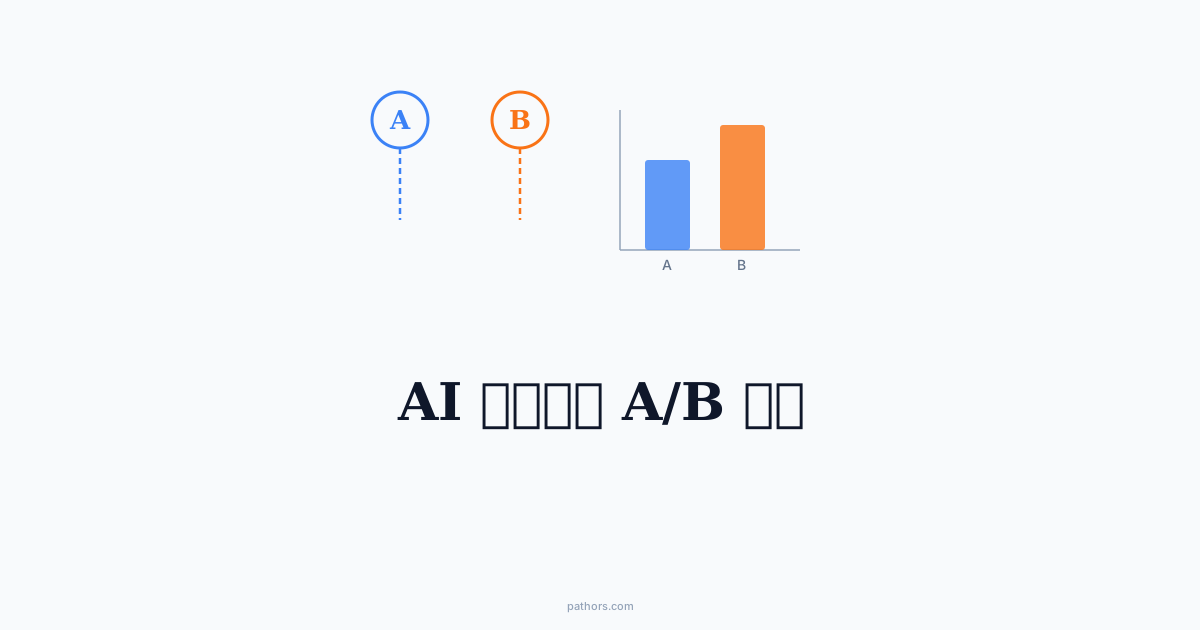
Your AI voice agent went live three months ago. Containment rate is 55%. CSAT hovers at 3.6 out of 5. Not bad, not great. The question every operations leader asks next: how do we make it better? The answer is not "buy a better model." It is systematic A/B testing and iterative optimization — the same discipline that made web conversion rates rise for two decades.
What to A/B Test in Voice AI
Voice AI has more testable surface area than most teams realize. Here are the highest-impact variables:
Greeting scripts
The first 5 seconds determine whether the caller engages or demands a human. Test variations:
Escalation trigger thresholds
Should the AI escalate after 2 failed understanding attempts or 3? Should the sentiment threshold be set at -0.3 or -0.5? Small changes here dramatically affect both containment rate and CSAT.
Response phrasing
The same information delivered differently produces different satisfaction scores. "Your order will arrive Thursday" vs. "Great news — your order is on track and will be there by Thursday" — same fact, different emotional impact.
TTS voice selection
Voice characteristics (speed, pitch, warmth) affect trust. Test different voice profiles and measure completion rates.
The Metrics That Matter
Not all metrics are created equal. Focus on these four:
| Metric | What It Measures | Target Range |
|---|---|---|
| Containment Rate | % of calls resolved without human | 60-80% |
| CSAT | Customer satisfaction post-call | 4.0+ / 5.0 |
| FCR (First Call Resolution) | % resolved in one interaction | 70-85% |
| AHT (Average Handle Time) | Total call duration | Context-dependent |
The metric tension
Containment rate and CSAT often pull in opposite directions. Aggressive containment (refusing to escalate) hurts satisfaction. Over-eager escalation kills containment. The optimization challenge is finding the sweet spot.
Building an Iteration Cycle
Week 1: Identify the biggest drop-off
Listen to 50 calls where the AI failed. Categorize failures: misunderstanding, wrong answer, customer frustration, missing capability. Find the single biggest category.
Week 2: Design and deploy the test
Create two variants targeting that failure category. Split traffic 50/50. Run for at least 500 calls per variant to reach statistical significance.
Week 3: Analyze and decide
Compare metrics across variants. If the winner is clear, promote it. If results are mixed, dig into the segments — the winning variant may work better for specific intents or customer profiles.
Week 4: Repeat
Move to the next biggest drop-off point. Continuous improvement, not one-time optimization.
How Pathors Enables Rapid Experimentation
Pathors is built for iterative optimization:
Optimization Is the Product
The difference between a mediocre voice AI and an excellent one is not the initial build — it is the iteration velocity afterward. Teams that run weekly A/B tests see 15-25% improvement in containment rate within the first quarter.
Start small, measure rigorously, iterate fast. Pathors gives you the infrastructure to experiment without risk. Visit pathors.com to see how.