Every unanswered call is revenue walking out the door. Research shows that roughly 67% of callers hang up when they reach voicemail, and nearly half won't call back. For businesses, this isn't just a customer experience issue — it's a direct hit to the bottom line.
The traditional fix was straightforward: hire more receptionists or outsource to a call center. But in 2026, there's a third option that's increasingly hard to ignore — AI-powered voice agents that can handle live calls end-to-end. This article offers a clear decision framework to help you determine which approach fits which scenario.
Where Human Answering Services Still Excel — And Where They Hit a Ceiling
Traditional human answering services come in two flavors: virtual receptionists (remote teams answering calls on your behalf) and full-scale call centers for higher volumes and more complex tasks.
The core strength of human services is emotional resonance and flexible judgment. When dealing with emotionally charged customers, sensitive complaints, or highly non-standard problems, a well-trained human agent still provides value that AI can't fully replicate.
But human services also have clear limitations:
AI Voice Technology in 2026: Far Beyond "Press 1 for Billing"
When many people hear "AI customer service," they still picture clunky IVR menus. The reality in 2026 is entirely different.
Modern AI voice agents work through a coordinated technology stack: Speech-to-Text (STT) transcribes speech in real time; Natural Language Understanding (NLU) interprets the caller's actual intent; an orchestration engine manages conversation flow while integrating with CRMs and calendars; Large Language Models generate natural, context-aware responses; Text-to-Speech delivers those responses in near-human voice quality.
This means AI can do far more than take messages. It can answer complex multi-turn questions, schedule appointments, qualify leads, and process transactions — all without human intervention.
Which Scenario Calls for Which Solution?
When AI Voice Agents Are the Better Fit
When You Still Need Human Agents
The Optimal Approach: Hybrid
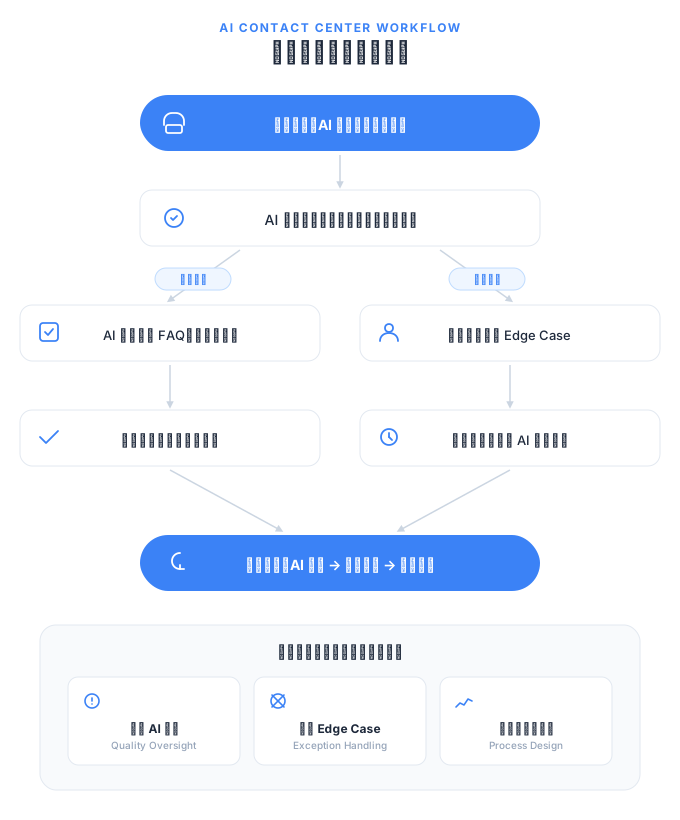
In practice, the most effective model is increasingly hybrid: AI handles frontline standardized conversations, while humans focus on complex cases that AI escalates. This isn't AI versus humans — it's leveraging each where they perform best.
Five Questions to Ask Before Adopting AI Voice Agents
Before making a decision, run a quick self-diagnostic:
1. What percentage of your calls are repetitive? If more than 60% of inbound calls ask similar questions, the ROI on AI will be immediately visible.
2. Is your service quality consistent? If quality varies significantly across shifts and agents, this is a pain point AI can address right away.
3. Are you losing information to manual processes? Call notes filled in by hand, customer data not synced to CRM in real time — these are low-hanging fruit for automation.
4. Can you extract insights from your call data? Most human answering services won't tell you why customers are calling, what the common issues are, or how satisfaction trends are moving.
5. Do you anticipate growth in call volume? If volumes could spike in the near term, AI's elastic scalability becomes a critical factor.
What We See at Pathors
The most successful AI deployments never start with "replace all humans with AI." They start with the most painful workflow.
For some businesses, the pain point is after-hours missed calls. For others, it's peak-hour wait times. For others still, it's the labor cost of post-call processing. Identify the most specific pain point, solve it with AI first, then expand incrementally. This approach carries far less risk than a full-scale replacement, and the results are easier to measure.
AI voice agents and human answering services aren't competing for the title of "objectively better." The technology is mature enough to handle a large share of real customer service conversations, but it isn't omnipotent — and it doesn't need to be.
The key is understanding what your customers are calling to solve, then choosing the solution that resolves it most effectively. Sometimes that's AI, sometimes it's a human, and most often it's a smart combination of both.