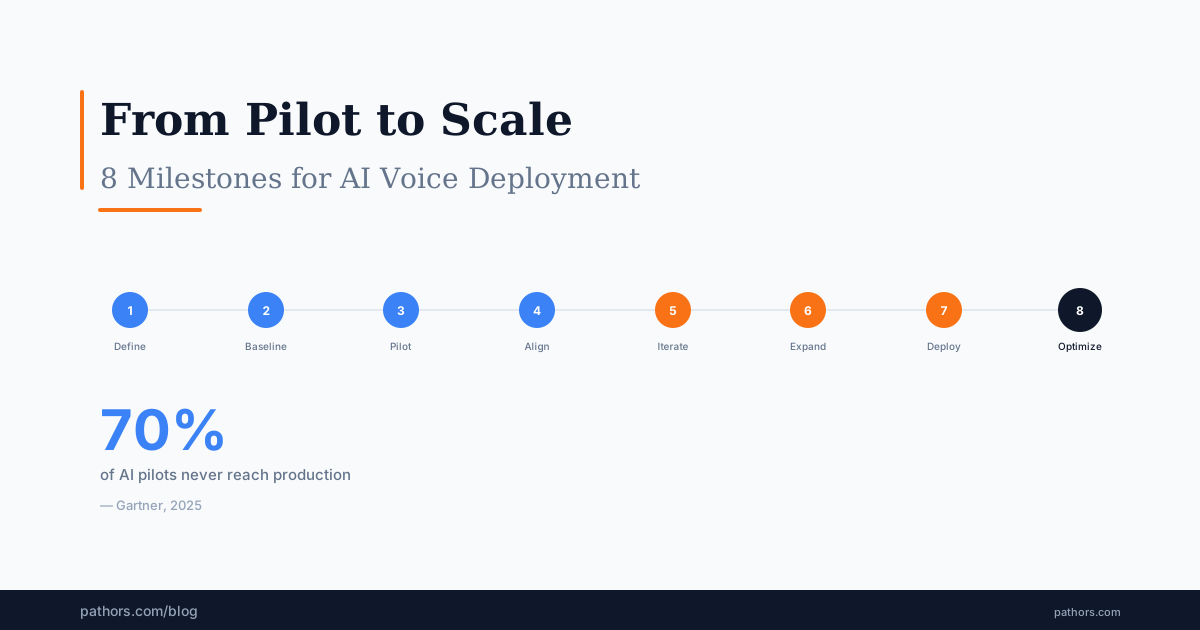
We have seen this pattern dozens of times: a company runs a promising AI voice pilot, the demo impresses leadership, and then... nothing. The project stalls somewhere between proof-of-concept and production. According to Gartner's 2024 research, roughly 70% of AI pilots never make it to full-scale deployment. The technology usually works fine. The failure happens in the space between a successful experiment and a reliable, organization-wide system. That space is where planning, process, and patience matter more than algorithms.
We built this guide around 8 milestones that we have watched successful deployments hit, in order, on their way from pilot to production. Skip one, and the odds of stalling increase dramatically. Hit all eight, and you give your AI voice deployment the structural foundation it needs to scale.
Milestone 1-2: Define Success Metrics Before You Start
The single most common mistake we see in AI voice deployments is launching a pilot without defining what success looks like. "We want to see if AI can handle calls" is not a success metric. It is a wish.
Milestone 1: Establish Your Baseline
Before any AI touches a single call, you need hard numbers on your current state. A 2024 ContactBabel report found that the average cost per inbound call in North American contact centers sits at $6.50, with average handle time at 6 minutes and 10 seconds. Your numbers will differ, but you need them documented.
Key baseline measurements to capture:
We recommend pulling at least 90 days of data to smooth out seasonal variations. If you only capture 30 days that happen to include a holiday rush, your baseline will be skewed.
Milestone 2: Set KPIs With Thresholds
With your baseline in hand, define specific, measurable KPIs for the pilot. We suggest three tiers:
According to Deloitte's 2024 Global Contact Center Survey, organizations that define clear KPIs before launching AI pilots are 2.3x more likely to reach full-scale deployment. The act of defining metrics forces alignment between stakeholders — and that alignment matters more than the specific numbers.
Milestone 3-4: The Controlled Pilot
Milestone 3: Select the Right Scope
Pilot scope selection is where ambition needs to meet pragmatism. We have seen companies try to pilot AI across their entire call volume on day one. That approach generates noise, not signal.
The ideal pilot scope has these characteristics:
A Forrester study from 2024 found that pilots scoped to 2-3 call categories with clear resolution paths reached production 40% faster than broadly scoped pilots.
Milestone 4: Align Your Team
A pilot is not just a technology test — it is an organizational test. Before launch, you need alignment from:
We recommend a 30-day pilot framework with weekly checkpoints. Each week has a specific focus:
| Week | Focus | Key Action |
|---|---|---|
| 1 | Stability | Monitor system uptime, call routing accuracy, basic containment |
| 2 | Quality | Review transcripts, measure resolution accuracy, identify failure patterns |
| 3 | Optimization | Tune conversation flows based on Week 2 findings, expand edge case handling |
| 4 | Assessment | Compile results against KPIs, prepare scale/no-scale recommendation |
Milestone 5-6: Iterate and Expand
Milestone 5: Analyze Pilot Data Ruthlessly
After 30 days, you should have enough data to make informed decisions. But the analysis needs to go beyond surface-level metrics. According to MIT Sloan Management Review's 2024 AI adoption study, teams that conducted root-cause analysis on failed AI interactions improved their containment rates by an average of 23% in the next iteration.
We recommend segmenting your pilot results into four quadrants:
The most important output of this milestone is a ranked list of what to fix before expanding.
Milestone 6: Expand Use Cases Methodically
With your pilot refined, expansion should follow a deliberate sequence. We recommend adding one new call category per iteration cycle (typically 2-3 weeks per cycle). Each new category goes through a mini-pilot of its own.
Edge case handling deserves special attention at this stage. In our experience, roughly 15-20% of calls in any category involve some variation that the initial training data did not cover. A 2024 Harvard Business Review analysis of enterprise AI deployments found that organizations which dedicated at least 30% of their iteration time to edge case handling achieved 35% higher long-term containment rates.
Practical edge case strategies:
Milestone 7-8: Full Production and Continuous Optimization
Milestone 7: Production Rollout Strategy
Full production does not mean flipping a switch. We recommend a phased rollout across three dimensions:
By time: Start with off-peak hours where call volumes are lower and the cost of failure is reduced. Accenture's 2024 contact center transformation report found that organizations using time-phased rollouts experienced 45% fewer critical incidents during their first month of production.
By channel: If you handle calls across multiple phone lines, regions, or brands, roll out one at a time.
By percentage: Use traffic splitting to gradually increase the percentage of calls the AI handles — 25%, then 50%, then 75%, then 100%. Each increase should be preceded by a stability check at the current level.
Your production monitoring dashboard should track these metrics in real-time:
Milestone 8: Continuous Optimization
Reaching production is not the finish line. According to McKinsey's 2024 State of AI report, organizations that maintain dedicated AI optimization teams after deployment see 20-30% improvement in system performance over the first 12 months, while those that move to maintenance-only mode see performance plateau or degrade.
We recommend establishing three feedback loops:
The monthly review should also include a "next horizon" discussion: what new capabilities, call types, or channels should be added to the AI system in the next quarter?
The Scale Checklist: Are You Ready?
Before moving from one milestone to the next, run through this checklist. Every item should be a confident "yes" before you proceed.
Pre-Pilot Readiness:
Post-Pilot, Pre-Scale:
Production Readiness:
According to a 2024 Bain & Company study of 200 enterprise AI projects, teams that used structured readiness checklists at each deployment stage were 3.1x more likely to reach full-scale production within 12 months.
Scaling AI voice deployment is a discipline, not a gamble. The 8 milestones we have outlined give your organization a repeatable framework for moving from experiment to production without the false starts and stalled projects that plague most AI initiatives.
Pathors provides guided pilot programs that walk your team through each milestone with hands-on support, from baseline measurement through continuous optimization. If you are planning an AI voice deployment or trying to rescue a stalled pilot, we can help you build the bridge from proof-of-concept to production.
Frequently Asked Questions
How long does it typically take to go from AI voice pilot to full-scale production?
Based on industry data and our experience, a well-structured deployment typically takes 4-6 months from pilot kickoff to full production. The pilot phase runs about 30 days, iteration and expansion takes 6-10 weeks, and the phased production rollout adds another 4-8 weeks. Organizations that skip milestones often take longer because they encounter problems that force them to backtrack.
What is a realistic containment rate to expect from an AI voice system?
For well-scoped call categories with clear resolution paths, mature AI voice systems typically achieve 70-85% containment rates. During the pilot phase, expect 50-65%. These numbers vary significantly by industry and call complexity — simple inquiry types like order status can reach 90%+, while complex troubleshooting scenarios may stay around 40-50% even in mature deployments.
How many calls do we need per week to run a meaningful pilot?
We recommend a minimum of 500 calls per week in your target categories. This gives you roughly 2,000 data points over a 30-day pilot, which is enough for statistically meaningful analysis. Fewer than 300 calls per week makes it difficult to identify patterns in failure cases and limits your ability to draw reliable conclusions about system performance.
Should we tell customers they are speaking with an AI during the pilot?
Yes. Transparency is both an ethical requirement and a practical advantage. Research from the University of Göttingen in 2023 showed that disclosed AI interactions had only a 4% lower satisfaction score than undisclosed ones, and the trust benefit of transparency outweighs that small gap. Several jurisdictions also have legal requirements for AI disclosure in customer interactions.
What happens to our human agents when we scale AI voice?
Scaling AI voice typically shifts agent roles rather than eliminating them. Agents move from handling routine calls to managing escalations, complex cases, and quality assurance. Most organizations we work with maintain 70-80% of their agent workforce post-deployment, with those agents handling higher-value interactions and contributing to AI system improvement through feedback loops.
How do we handle it if the pilot fails to meet minimum KPIs?
A pilot that misses minimum KPIs is not necessarily a failure — it is data. First, conduct a root-cause analysis on why specific interactions failed. Common culprits include poorly scoped call categories, insufficient training data, or integration issues with backend systems. We recommend a second 30-day iteration addressing identified issues before making a go/no-go decision. According to Gartner, 40% of ultimately successful AI deployments required at least one pilot iteration.