Every AI voice platform demo looks impressive. The voice sounds natural, the latency seems acceptable, and the salesperson has a slide showing 95%+ accuracy. Then you deploy it with real customers speaking Mandarin with Taiwanese accents at 3x your demo call volume, and the experience bears little resemblance to what you saw in the conference room.
Forrester's 2025 Voice AI Buyer Survey found that 61% of enterprises that purchased an AI voice platform in 2024 were dissatisfied with at least one critical aspect within six months. The most common complaint was not feature gaps — it was that the evaluation process did not test the dimensions that matter in production.
Why Traditional Vendor Evaluation Falls Short
The standard enterprise software evaluation process — feature checklist, reference calls, proof-of-concept — works reasonably well for most categories. For AI voice platforms, it misses critical dimensions because the technology's behavior depends heavily on real-world conditions that are difficult to simulate in an eval.
Gartner's 2025 Voice AI Market Guide recommends evaluating platforms across operational dimensions rather than feature lists. A platform with 50 features that cannot maintain sub-second latency at scale is worse than one with 20 features that works flawlessly under load.
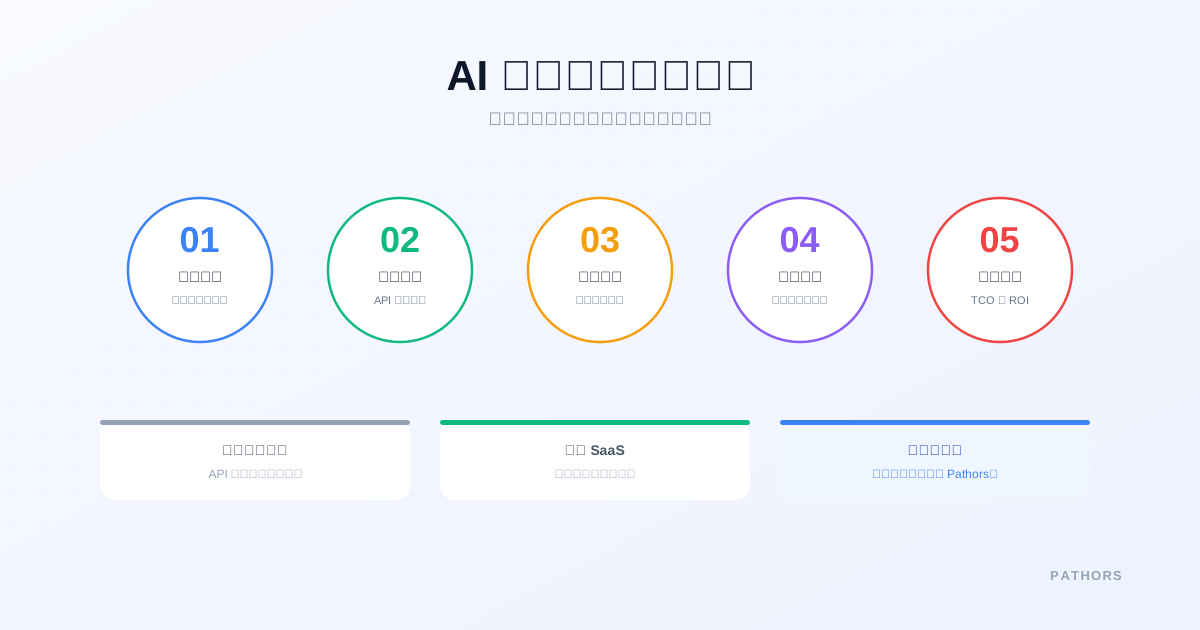
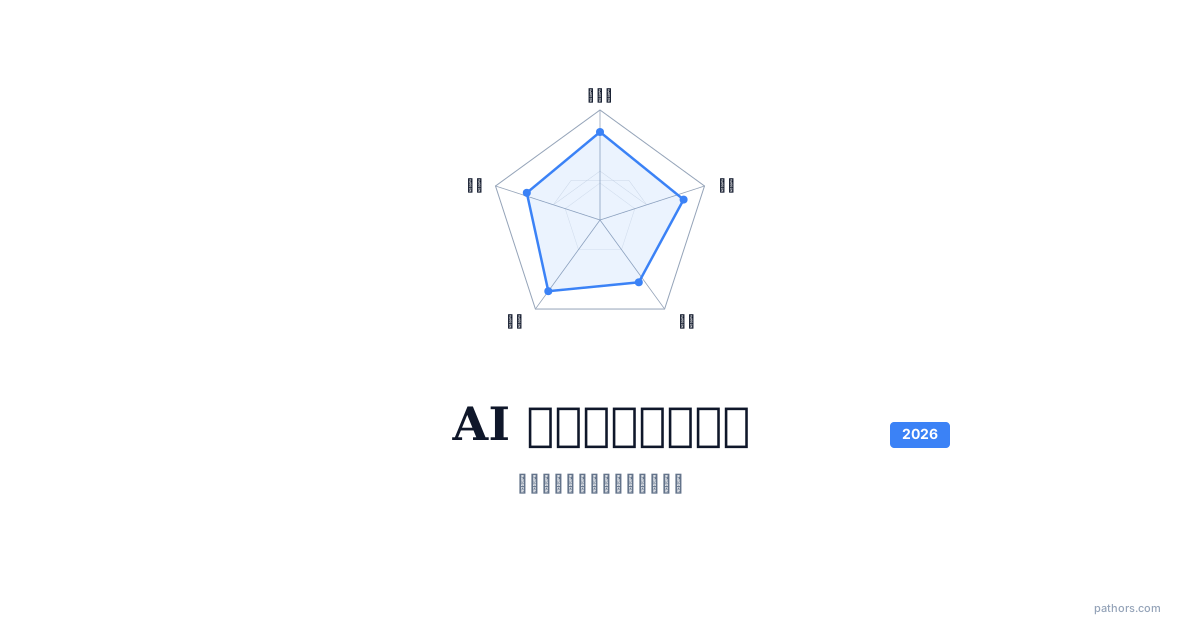
The 5-Dimension Evaluation Framework
Dimension 1: Language Quality Under Real Conditions
This is the dimension that breaks the most evaluations. Every vendor claims high accuracy, but the numbers are meaningless without specifying the testing conditions.
What to test: Word error rate on your actual customer conversations — not on clean studio recordings or standard benchmarks. For Mandarin in Taiwan, test with: Taiwanese-accented Mandarin, code-switching between Mandarin and English, industry-specific terminology, background noise from mobile callers, and elderly speakers.
Benchmark: Sub-8% word error rate on domain-specific Mandarin conversations is competitive. Sub-6% is excellent. Above 10% will create noticeable customer frustration. Pathors achieves 5.2% on business-domain Mandarin conversations with Taiwanese speakers.
Red flag: A vendor who cannot provide WER numbers for your specific language and domain is not testing rigorously.
Dimension 2: End-to-End Latency at Scale
Latency in voice conversations is not just a technical metric — it directly affects whether the interaction feels like a conversation or an interrogation. Users tolerate up to 800ms of response latency before the experience degrades noticeably.
What to test: End-to-end latency (user stops speaking → AI starts responding) at your expected concurrent session count, measured at p95 (not average). Test over PSTN, not just WebRTC. Test during peak hours when the vendor's other customers are also on the system.
Benchmark: p95 latency under 800ms on PSTN calls at 100+ concurrent sessions. Some platforms achieve sub-600ms, which creates noticeably more natural conversations.
Red flag: A vendor who quotes average latency instead of p95, or only tests with WebRTC connections, is hiding tail latency issues.
Dimension 3: Integration Depth
A voice AI platform that cannot connect to your CRM, calendar system, or knowledge base is just an expensive answering machine. Integration depth determines whether the AI can actually do useful work during a call.
What to evaluate: Native integrations (pre-built connectors to Salesforce, HubSpot, custom CRMs), API flexibility (REST/GraphQL/webhook support for custom systems), telephony options (SIP trunking, PSTN, WebRTC, call transfer to humans), and data sync latency (how quickly does a booking made by AI appear in your system?).
Benchmark: The AI should be able to read from and write to your core systems in real time during a call. Any integration that requires batch processing or manual sync defeats the purpose.
Dimension 4: Pricing Transparency
As covered in our pricing guide, AI voice pricing is a maze of per-minute rates, platform fees, telephony pass-through charges, and LLM token costs. The evaluation should focus on total cost predictability.
What to request: A detailed cost breakdown at 1x, 5x, and 10x your expected volume, including every possible charge. Ask specifically about telephony costs, LLM token pass-through, recording storage, and integration fees.
Benchmark: You should be able to predict your monthly bill within 10% accuracy given your call volume. If the vendor cannot give you that confidence, their pricing model is too complex or too opaque.
Dimension 5: Compliance and Data Sovereignty
For regulated industries (finance, healthcare, government) and for Taiwan-specific requirements (PDPA), this dimension is non-negotiable.
What to verify: Where call recordings are stored (data residency), encryption standards (at rest and in transit), audit trail completeness, ability to delete customer data on request (right to erasure), and regulatory certifications relevant to your industry.
Benchmark: The platform should support data residency within Taiwan for customers who require it, with complete audit trails for every customer interaction.
Putting It Together: A Scoring Matrix
| Dimension | Weight | Questions to Ask |
|---|---|---|
| Language Quality | 30% | WER on your domain data, multilingual support, accent handling |
| Latency at Scale | 25% | p95 at target concurrency, PSTN vs WebRTC, degradation under load |
| Integration Depth | 20% | Native CRM connectors, API flexibility, real-time sync |
| Pricing Transparency | 15% | Total cost at 1x/5x/10x, hidden charges, contract flexibility |
| Compliance | 10% | Data residency, audit trails, regulatory certifications |
Adjust weights based on your industry and priorities. Financial services may weight compliance at 25% and reduce integration depth. A startup may weight pricing transparency higher.
How Pathors Scores on This Framework
Pathors was built with these five dimensions as design constraints, not afterthoughts. The platform achieves sub-6% WER on Mandarin business conversations, maintains sub-600ms p95 latency on PSTN calls, offers native CRM integrations with real-time sync, uses all-inclusive per-minute pricing with no hidden charges, and supports Taiwan data residency with complete audit trails.
The AI voice platform you choose in 2026 will likely be the one you run for the next 3-5 years. Switching costs are real — retraining conversation flows, migrating integrations, and rebuilding analytics. The investment in a rigorous evaluation process, using dimensions that matter in production rather than features that look good in demos, pays for itself many times over. Ask the hard questions now so you do not have to explain the switch to your CFO in 18 months.
Frequently Asked Questions
How long should an AI voice platform evaluation take?
A thorough evaluation typically takes 4-6 weeks: 1 week for requirements definition, 1-2 weeks for vendor demos and initial screening, 1-2 weeks for proof-of-concept testing with real call data, and 1 week for scoring and decision. Rushing the POC phase is the most common mistake.
Should we test with real customer calls during evaluation?
Yes, if possible. The gap between demo performance and real-world performance is the biggest risk in AI voice platform selection. At minimum, test with recordings of actual customer calls that represent your typical scenarios, accents, and background noise levels.
How important is multilingual support for Taiwan businesses?
Critical for most Taiwan businesses. Even if your primary customer base speaks Mandarin, you will encounter Taiwanese-accented Mandarin, code-switching with English, and potentially Hokkien or Hakka speakers. A platform that only handles standard Mandarin will create friction for a significant portion of callers.
Can we negotiate AI voice platform pricing?
Yes. Most vendors have flexibility on per-minute rates, minimum commitments, and setup fees, especially for larger deployments. The most effective negotiation lever is a credible alternative — having evaluated multiple platforms gives you pricing benchmarks to reference.
What is the typical contract length for AI voice platforms?
Most platforms offer monthly, annual, and multi-year options. Annual contracts typically offer 15-25% discounts over monthly pricing. We recommend starting with a 3-6 month pilot before committing to an annual contract, to validate production performance.