Last quarter, an insurance company processing over 2 million calls per year came to us with a familiar story: their previous AI voice vendor had promised "99% uptime" in the SLA, which technically allowed nearly 7.3 hours of downtime per month. The outages consistently hit during the 9-to-11 AM peak window. The root cause was not technical failure but contractual ambiguity — the SLA never defined how uptime was measured or what happened when the vendor missed the target. We have heard variations of this story from at least a dozen enterprise teams. The difference between a useful SLA and a decorative one comes down to asking the right questions before the contract is signed.
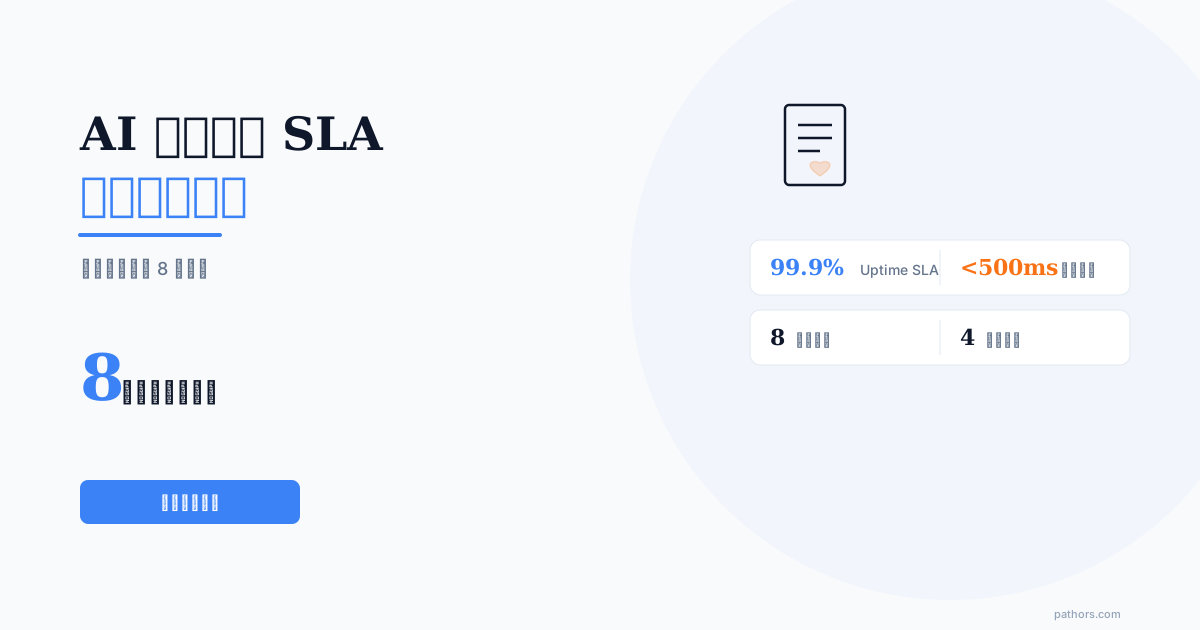
Clause 1: Uptime Definition and Calculation — The 8.7-Hour Gap Between 99% and 99.9%
Most vendor pitch decks proudly display "99.9% uptime," but that number is meaningless without three supporting details: the calculation period (monthly vs. quarterly), exclusion rules (does scheduled maintenance count as downtime?), and the measurement method (vendor self-reporting vs. independent monitoring). On a monthly basis, 99.9% allows roughly 43 minutes of downtime, while 99% allows about 7.3 hours — nearly a 10x difference. At Pathors, we provide a real-time dashboard so clients can see minute-by-minute uptime data with full transparency on calculation methodology.
Negotiation checklist:
Clause 2: Incident Response Tiers — The Critical 15-Minute Window for P1 Events
An effective SLA needs at least three incident tiers: P1 (complete service outage), P2 (core functionality degradation), and P3 (non-critical anomalies). Based on data from over 40 enterprise deployments, when P1 first-response time exceeds 15 minutes, call abandonment rates spike from an average of 4% to over 23%.
| Severity | Definition | Recommended First Response | Recommended Resolution |
|---|---|---|---|
| P1 | Complete service outage | ≤ 15 minutes | ≤ 2 hours |
| P2 | Core degradation (e.g., ASR accuracy drops > 20%) | ≤ 30 minutes | ≤ 8 hours |
| P3 | Non-critical anomaly | ≤ 4 hours | Next business day |
Pathors commits to a 10-minute first-response time for P1 incidents, with a contractually defined escalation path ensuring on-call engineers have the authority to act immediately.
Clause 3: Speech Recognition Accuracy — Why 85% Should Trigger Penalties
ASR accuracy is an SLA metric unique to AI voice services. It fluctuates with accent variation, background noise, and domain-specific terminology. The contract should define the test corpus scope, measurement frequency, and remediation process when targets are missed. Industry benchmarks for standard Mandarin conversational scenarios sit around 90%+, but financial product names or medical terminology require separately negotiated thresholds.
We recommend a quarterly audit mechanism: the vendor provides recognition reports from at least 1,000 randomly sampled calls each quarter. If accuracy falls below the agreed threshold for two consecutive quarters, the client can trigger an improvement plan or early termination.
Clause 4: Concurrency Limits and Elastic Scaling — The 3x Peak Capacity Rule
If your typical peak load is 500 concurrent calls, your SLA commitment should be at least 1,500 (3x). Marketing campaigns, breaking news, and natural disasters can cause call volumes to surge within minutes. During a typhoon warning in Taiwan in 2024, some financial service contact centers saw inbound volume spike by 470% within one hour.
Pathors uses an auto-scaling architecture that completes capacity expansion within 90 seconds. Our contracts explicitly document scaling triggers and pricing so there are no billing surprises.
Clause 5: Data Security and Compliance — ISO 27001 Is Just the Starting Line
Voice customer service involves sensitive data: voiceprints and conversation content both fall under personal data protection regulations. At minimum, the contract must address 5 items:
1. Data storage location (domestic vs. overseas)
2. Encryption standards (TLS 1.3 in transit, AES-256 at rest)
3. Data retention period and destruction procedures
4. Vendor employee access controls (principle of least privilege)
5. Annual third-party penetration test reports
In 2024, Taiwan's Financial Supervisory Commission published 12 penalty cases involving vendor data management failures. Pathors holds ISO 27001 certification and provides SOC 2 Type II reports for financial sector clients.
Clause 6: Exit Provisions — The 30-Day Data Migration Clause
Few teams think about leaving when they are signing up, but strong exit provisions preserve your negotiating leverage. Key elements include:
Pathors includes comprehensive exit provisions in our standard contract template. We believe clients should stay because the service is excellent, not because leaving is difficult.
Clause 7: Performance Reporting Frequency — Monthly Reports Are Not Enough
From our experience, teams relying solely on monthly reports detect performance anomalies an average of 11 days later than teams with real-time monitoring. The SLA should specify:
The Pathors client portal provides real-time monitoring with 24 months of historical data retention and API integration support for connecting to your own BI systems.
Clause 8: Pricing Structure and Breach Compensation — Credits vs. Cash
The most overlooked detail is compensation format. Many vendors offer "service credits applied to the next invoice" as breach compensation, but if you have decided to switch vendors, those credits are worthless. We recommend:
On pricing structure, watch for hidden costs: API call overage charges, voice minute rounding methods (6-second increments vs. 60-second increments can create an 18% cost difference annually), and scaling surcharges. Pathors uses transparent pricing with all rates itemized in the contract appendix.
Frequently Asked Questions
What is the real difference between 99% and 99.9% uptime in an AI voice SLA?
On a monthly basis, 99% uptime allows approximately 7.3 hours of downtime, while 99.9% allows only about 43 minutes. In a contact center environment, those extra hours of downtime tend to cluster during peak call periods, potentially leaving thousands of callers without service. Always insist on a precise uptime formula in the contract.
What data should we prepare before negotiating an SLA?
Gather at least 3 months of historical call data, including daily peak-hour call volumes, average handle times, and common inquiry type distributions. This baseline lets you negotiate concurrency commitments and ASR accuracy thresholds grounded in actual operational needs rather than accepting a generic package.
How is SLA breach compensation typically structured?
The industry standard is service credits ranging from 10% to 25% of the monthly fee, tiered by severity. However, we strongly recommend including a clause that converts credits to cash refunds after consecutive SLA misses, ensuring compensation retains value even if you decide to switch vendors.
How should ASR accuracy be audited under an SLA?
Use quarterly sampling audits with at least 1,000 randomly selected calls per cycle, evaluated by an independent team. The contract must define the test corpus scope, sampling methodology, and accuracy metric — character error rate (CER) versus sentence accuracy rate. Industry-specific terminology should have a dedicated test set.
Do SLA terms automatically scale when usage grows mid-contract?
This depends entirely on how the contract is written. Some SLAs scale proportionally with usage — for example, expanding from 500 to 1,000 concurrent calls while maintaining all response time commitments. Others require renegotiation above certain thresholds. Define scaling triggers and corresponding SLA adjustments explicitly to prevent service quality from degrading as your business grows.
What SLA commitments does Pathors offer?
Pathors standard SLAs cover five core metrics: 99.95% system uptime, P1 incident first-response within 10 minutes, ASR accuracy thresholds customized by industry, concurrent call capacity with 3x elastic headroom, and full data security compliance. All metrics are transparently monitored through a real-time dashboard with 24 months of historical data retention.
Negotiating an SLA is not about accumulating the most clauses — it is about ensuring every clause is enforceable. Use these 8 clauses as a checklist in your next vendor evaluation, and you will quickly see which providers can genuinely back their promises with contractual commitments. If you want to see what a Pathors standard SLA template looks like, reach out to our team. We are happy to walk through every clause with you.
Frequently Asked Questions
What is the real difference between 99% and 99.9% uptime in an AI voice SLA?
On a monthly basis, 99% uptime allows approximately 7.3 hours of downtime, while 99.9% allows only about 43 minutes. In a contact center environment, those extra hours of downtime tend to cluster during peak call periods, potentially leaving thousands of callers without service.
What data should we prepare before negotiating an SLA?
Gather at least 3 months of historical call data, including daily peak-hour call volumes, average handle times, and common inquiry type distributions. This baseline lets you negotiate concurrency commitments and ASR accuracy thresholds grounded in actual operational needs.
How is SLA breach compensation typically structured?
The industry standard is service credits ranging from 10% to 25% of the monthly fee, tiered by severity. We strongly recommend including a clause that converts credits to cash refunds after consecutive SLA misses.
How should ASR accuracy be audited under an SLA?
Use quarterly sampling audits with at least 1,000 randomly selected calls per cycle, evaluated by an independent team. The contract must define the test corpus scope, sampling methodology, and accuracy metric such as character error rate or sentence accuracy rate.
Do SLA terms automatically scale when usage grows mid-contract?
This depends entirely on how the contract is written. Some SLAs scale proportionally with usage while others require renegotiation above certain thresholds. Define scaling triggers and corresponding SLA adjustments explicitly in the contract.
What SLA commitments does Pathors offer?
Pathors standard SLAs cover five core metrics: 99.95% system uptime, P1 incident first-response within 10 minutes, ASR accuracy thresholds customized by industry, concurrent call capacity with 3x elastic headroom, and full data security compliance with real-time dashboard monitoring.