Here is something counterintuitive: a contact center can report 91% ASR accuracy and still see customer satisfaction drop after deploying a voice AI platform. We have seen this happen more than once across Asia-Pacific. The accuracy number is real — it is just measured against a test set of standard Mandarin read by a native Beijing speaker. The moment real customers in Taiwan, Malaysia, or Singapore start calling in with regional accents, mixed-language sentences, and the natural rhythm of actual service conversations, that 91% quietly becomes something much lower. Nobody measures the delta. Nobody reports it. The CSAT drop gets blamed on change management.
Aircall built an excellent product for European and North American SMB sales teams. Seamless CRM integrations, clean UI, fast provisioning — for those teams, it delivers. But the Asia-Pacific market operates on different assumptions: tonal languages with significant regional accent variation, data residency requirements tied to local privacy regulations, pricing models that need to flex with seasonal traffic spikes that can reach plus or minus 40%, and — critically — the need for voice AI that actually understands how your customers talk, not how a benchmark dataset assumes they do.
In 2026, the Voice AI platform decision is no longer a telephony choice. It is a language infrastructure choice. This guide evaluates the alternatives available to APAC teams across four dimensions that actually matter in this region, and gives you a decision framework grounded in how these deployments actually unfold — not how vendors describe them in pitch decks.
Why APAC Teams Are Moving Beyond Aircall
The question is not whether Aircall works. It is whether it was designed for your context.
Aircall's architecture assumes a relatively stable team of agents primarily handling voice conversations in English or major Western European languages, with data comfortably residing in EU or US infrastructure. For the use cases it was built for, that works well. But three patterns keep surfacing when we talk to APAC teams who have started evaluating alternatives:
Language and accent gaps create invisible failure modes. Aircall does not operate its own ASR — it routes audio through underlying speech-to-text services. Those services range from adequate to poor for Traditional Chinese, and virtually none have been specifically tuned for Taiwanese Mandarin accents, Cantonese-inflected speech, or the code-switching patterns common in Malaysia and Singapore, where a caller might say my order has not arrived yet in mixed Malay and English in the same breath as an account number. A financial services firm we spoke with saw their IVR self-service completion rate fall from 64% to 39% after deploying a Western voice AI platform — not because the technology failed, but because it was never tested against the right language distribution.
Per-seat pricing does not map to APAC traffic patterns. E-commerce, insurance, and travel are among the largest contact center verticals across Taiwan, Thailand, and Vietnam. All three share a structural characteristic: call volume during peak season can be 3-4x the off-peak baseline. A per-seat model means either over-provisioning year-round or scrambling to add seats during peaks. According to data from the Contact Center Association of Asia Pacific, APAC contact centers report an average seasonal volume variance of 43% — nearly double the 24% variance reported by their North American counterparts.
Data residency is a compliance prerequisite, not a preference. Taiwan's Personal Data Protection Act, Singapore's PDPA, Thailand's PDPA, and Vietnam's Decree 13 all impose constraints on cross-border personal data transfers. Taiwan's Financial Supervisory Commission issued updated guidance in 2025 specifically requiring that voice interaction audit trails for financial institutions be retainable within Taiwan's borders. When your voice data is sitting on overseas servers by default, that is not a technical inconvenience — it is a regulatory exposure.
What to Look for in an Aircall Alternative
Evaluating a platform is easier when you know which questions to ask first.
Four dimensions consistently separate platforms that work in APAC from platforms that work in demos:
Language depth, not language breadth
Most platforms will tell you they support Mandarin Chinese. The more useful questions: Has the ASR model been fine-tuned on Traditional Chinese conversational data? Does it handle Taiwan accent variance? Can the NLU parse code-switched sentences? What is the measured Word Error Rate on a realistic sample of your actual call recordings — not a read-speech benchmark?
The difference between a generic multilingual ASR and one tuned for your customer base typically runs 15-25 percentage points on real calls. At 500 calls per day, that gap translates to hundreds of misrouted or failed self-service interactions every single day.
Pricing structure and cost predictability
| Model | Best fit | Risk |
|---|---|---|
| Per seat (monthly) | Stable volume, full-time agent teams | Idle cost during off-peak; low elasticity |
| Per minute / per call | E-commerce, seasonal verticals | Cost spikes during volume surges |
| Hybrid (base + usage) | Most mid-market teams | Requires accurate baseline estimate |
For APAC teams with significant seasonal variance, a pure per-seat model is structurally inefficient. Hybrid pricing with a reasonable baseline gives budget predictability without paying for capacity that sits idle eight months of the year.
Compliance and data architecture
The evaluation checklist should include: Where are voice recordings stored by default? Is local in-country storage or private cloud deployment available? Can audit logs be exported to customer-controlled infrastructure? What certifications does the platform carry, such as ISO 27001 or SOC 2?
These are not due diligence box-checks. They determine whether your legal team will sign off on deployment, and whether you will need to re-platform in 18 months when a regulator asks uncomfortable questions.
Deployment complexity and time-to-value
The metric that matters here is not feature count — it is days from contract signature to first live production call. Platforms that require engineering resources to write API integrations before the system does anything useful are effectively inaccessible to SMBs without dedicated technical teams. Out-of-box deployment is not a compromise on capability; it is a recognition that most businesses need working systems faster than they need maximum configurability.
Top Alternatives to Aircall for APAC Teams
Not all Asia-Pacific ready platforms are equally ready for Asia-Pacific.
Pathors
Pathors is a Voice AI platform built specifically for the APAC market, with particular depth in Traditional Chinese and Taiwanese Mandarin. The architecture was designed from the ground up for this language environment — not localized after the fact.
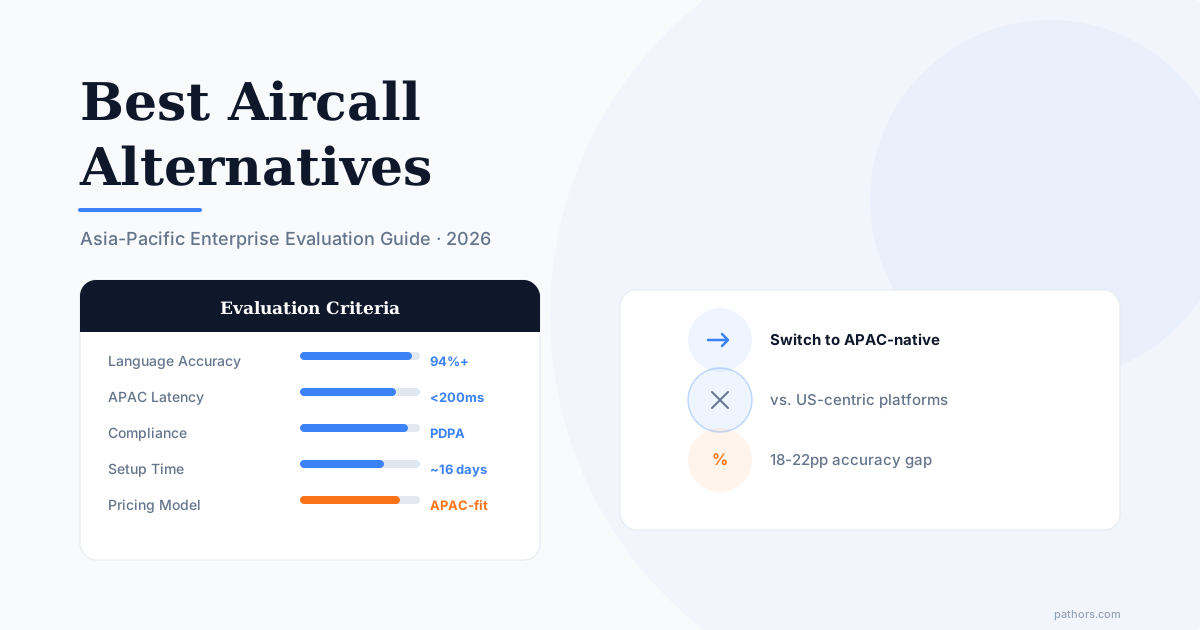
ASR accuracy for Traditional Chinese and Taiwanese Mandarin: In internal benchmarks conducted in Q4 2025 using real customer service call recordings (de-identified), Pathors' ASR achieved 18-22 percentage points higher accuracy than general-purpose speech engines on the same audio. This translates directly to IVR self-service completion rates: Pathors customers see an average 28% improvement in self-service resolution after deployment.
Taiwan server option: Voice data and recordings can be stored entirely within Taiwan, satisfying FSC guidance for financial institutions and PDPA cross-border transfer restrictions. This removes the legal exposure that comes with default overseas storage, without requiring customers to manage their own infrastructure.
Out-of-box deployment: No API coding required to go live. Conversation flows are designed through a visual tool, and the platform handles integration with major CRM and ticketing systems through pre-built connectors. The median time from contract signature to first live production call for Pathors customers is 16 days — compared to the 60-90 day average for platforms requiring custom API integration.
Taiwan-based support team: Technical support is staffed locally, operating during APAC business hours, communicating in Mandarin or English, and escalating through a short chain. When a production issue surfaces during a campaign peak, the difference between a local team and a US-hours support queue is the difference between a 20-minute resolution and a sleepless night.
APAC-friendly pricing: Hybrid billing model with a base monthly fee and usage-based components, allowing volume to flex without proportional cost spikes. Designed for the traffic patterns of APAC e-commerce, insurance, and financial services — not for Western SMB sales teams with predictable monthly call volumes.
Low latency in Asia-Pacific: Infrastructure optimized for APAC routing means voice quality and response latency are consistent for callers in Taiwan, Southeast Asia, and Northeast Asia — without the degradation that comes from routing through US or European data centers.
LLM-native conversation platforms (Western-founded)
Several platforms built on large language model architectures have seen rapid adoption in North American and European markets. They offer sophisticated conversation design, flexible API ecosystems, and strong developer tooling. For teams with in-house engineering resources building primarily English-language experiences, they can be compelling.
The APAC constraints are real, though. Chinese ASR in these platforms typically relies on third-party integrations that have not been tuned for Taiwan accent variation. Data defaults to US or EU storage. Deployment requires engineering resources, with typical implementation timelines of 2-4 months. Pricing in USD creates currency exposure for APAC teams budgeting in TWD, THB, or MYR. Local support for APAC time zones is limited or unavailable.
Enterprise CCaaS from major cloud or telecom providers
Several large cloud infrastructure providers and global telecoms offer comprehensive Contact Center as a Service suites. For large enterprises with existing vendor relationships, global infrastructure requirements, and dedicated IT teams to manage implementation, these platforms offer breadth of capability and enterprise-grade SLA commitments.
The limitations for mid-market APAC teams are consistent: Voice AI modules are typically bolt-on additions to legacy telephony architecture, with integration complexity that rarely shrinks in practice. Taiwan accent performance on Mandarin ASR is generally below what specialized platforms deliver. Licensing typically starts at seat volumes that exceed most APAC SMB deployments. Local Taiwan support is limited, and escalation paths run through global support queues with significant time-zone friction.
Regional APAC-focused platforms
A small number of platforms have been built for Southeast Asian language markets — Bahasa Indonesia, Thai, Vietnamese, Tagalog. Within their target language scope, some deliver strong results. For teams whose primary customer base communicates in Traditional Chinese or Taiwanese Mandarin, the language model depth typically is not there, and the compliance and support infrastructure for Taiwan specifically is limited.
How to Choose the Right Platform
The right platform is not the one with the longest feature list. It is the one that reaches your performance target at the lowest total cost under your actual constraints.
Define your top three call types first. Voice AI platforms perform very differently depending on what they are handling. A high-volume, low-complexity order status flow has different requirements than a nuanced insurance pre-qualification conversation. Map your actual call distribution before you evaluate — then test each platform against those specific scenarios, not generic demos.
Run a language stress test with real recordings. Ask vendors to run their ASR against de-identified samples of your actual call audio. Request Word Error Rate or sentence-level accuracy numbers. This test takes about two business days but can save months of post-deployment troubleshooting. Any vendor confident in their language performance for your market will do this without hesitation.
Treat compliance as a gate, not a criterion. If your industry or jurisdiction has data residency requirements, eliminate non-compliant platforms in round one. Do not negotiate compliance into a contract with a platform that cannot structurally meet your requirements — the legal and operational risk compounds over time.
Calculate total cost of ownership, not just platform fees. Implementation engineering, conversation design time, ongoing maintenance, cross-timezone support overhead — these typically run 3-5x the annual platform subscription for complex deployments on platforms requiring API-level customization. A platform with a slightly higher monthly fee but a 16-day deployment and local support often represents lower TCO over a 24-month contract horizon.
Demand contractual SLAs, not verbal commitments. Uptime guarantees, voice quality commitments, and breach remedies in the contract signal vendor confidence in their own product. Ask specifically what happens when they miss their SLA — and whether the answer is satisfying.
The Voice AI market in Asia-Pacific is moving faster than most procurement cycles can track. By the time an RFP goes out, collects responses, and clears legal review, the competitive landscape has shifted. What does not change is the underlying logic: a platform that accurately understands how your customers actually speak — with their real accents, in their real language mix, at their real conversational pace — will outperform a platform with more features but worse language fit every single time. The 18-22 percentage point ASR accuracy gap for Taiwanese Mandarin is not an abstract technical metric. It is the difference between a customer who resolves their issue in 90 seconds and one who gets transferred twice and calls back tomorrow. Multiply that by your daily call volume, and the platform choice becomes a customer experience choice. Make it deliberately.
Frequently Asked Questions
Does Aircall support Traditional Chinese voice recognition?
Aircall does not operate its own ASR — it relies on underlying speech-to-text integrations. Those services vary significantly in Traditional Chinese support quality and have generally not been fine-tuned for Taiwanese Mandarin accents or the code-switching patterns common in APAC customer service contexts. If ASR accuracy for Traditional Chinese is a core requirement, request a benchmark test using your actual de-identified call recordings before committing to any platform.
What data compliance requirements should Taiwan businesses consider when choosing a voice AI platform?
Taiwan's Personal Data Protection Act requires clear consent mechanisms for collecting and processing personal data, with restrictions on cross-border transfers. Financial institutions are additionally subject to FSC guidance updated in 2025, which requires voice interaction audit trails to be retainable within Taiwan's borders. Evaluate platforms on whether they offer in-Taiwan storage options, can export audit logs to customer-controlled infrastructure, and hold relevant certifications such as ISO 27001 or SOC 2.
How long does it typically take to deploy a voice AI platform?
Implementation timelines vary from 2 weeks to 6 months depending on platform architecture and deployment complexity. Platforms requiring custom API integration typically run 60-90 days from contract to first live call. Out-of-box platforms with visual conversation design tools and pre-built CRM connectors can deploy in 2-4 weeks. Key variables include conversation flow complexity, existing system integrations required, and whether local technical support is available to accelerate onboarding.
Is per-seat pricing or usage-based pricing better for APAC contact centers?
It depends on your call volume stability. APAC contact centers report an average seasonal volume variance of 43% — nearly double the North American average. For verticals with high seasonality such as e-commerce, insurance, and travel, per-seat pricing generates significant idle cost during off-peak periods. Usage-based or hybrid pricing models generally produce better total cost of ownership for these use cases. Provide your last 12 months of monthly call volume data to vendors and ask them to model annual cost under each pricing structure.
Can small businesses without engineering teams deploy a voice AI platform?
Yes, if they choose the right platform architecture. Platforms that require engineers to write API integrations before the system functions are effectively inaccessible to teams without technical resources. Look for platforms offering out-of-box deployment with visual conversation design, pre-built system connectors, and locally available onboarding support. These capabilities are not compromises — they are deliberately designed for organizations that need operational systems faster than they need maximum configurability.
What makes Pathors different from other voice AI platforms for APAC teams?
Three substantive differences: ASR accuracy for Traditional Chinese and Taiwanese Mandarin that runs 18-22 percentage points higher than general-purpose speech engines in comparable scenarios; a Taiwan server option that satisfies PDPA and FSC data residency requirements without requiring customers to manage their own infrastructure; and out-of-box deployment with a median time-to-production of 16 days, requiring no API coding. Combined, these mean lower deployment friction, better language performance, and full regulatory compliance for Taiwan-based and broader APAC operations.