A mid-size Taiwanese e-commerce company spent three months setting up Amazon Connect last year. They got it working — technically. But the Mandarin speech recognition misidentified one in four caller intents, the per-minute pricing was calibrated for US call volumes they'd never reach, and their ops team needed AWS Solutions Architect help just to change a call flow. They're not alone. Across the Asia-Pacific, businesses that signed up for what they assumed was a plug-and-play cloud contact center are discovering that the world's largest cloud contact center wasn't really built with them in mind. The gap between "supports your region" and "designed for your region" turns out to be expensive.
What to Look for in an Amazon Connect Alternative
Amazon Connect is powerful infrastructure. But infrastructure and solution are different things, and APAC businesses evaluating cloud contact centers need to ask a different set of questions than what US-centric review sites suggest.
Gartner's 2025 Contact Center as a Service report found that 58% of APAC enterprises cited "localization gaps" as the primary friction point with US-origin platforms — ahead of pricing and feature gaps. That number tells you where to start looking. The evaluation criteria that matter most in this region look nothing like what a North American buyer would prioritize.
Language & Speech Recognition Accuracy
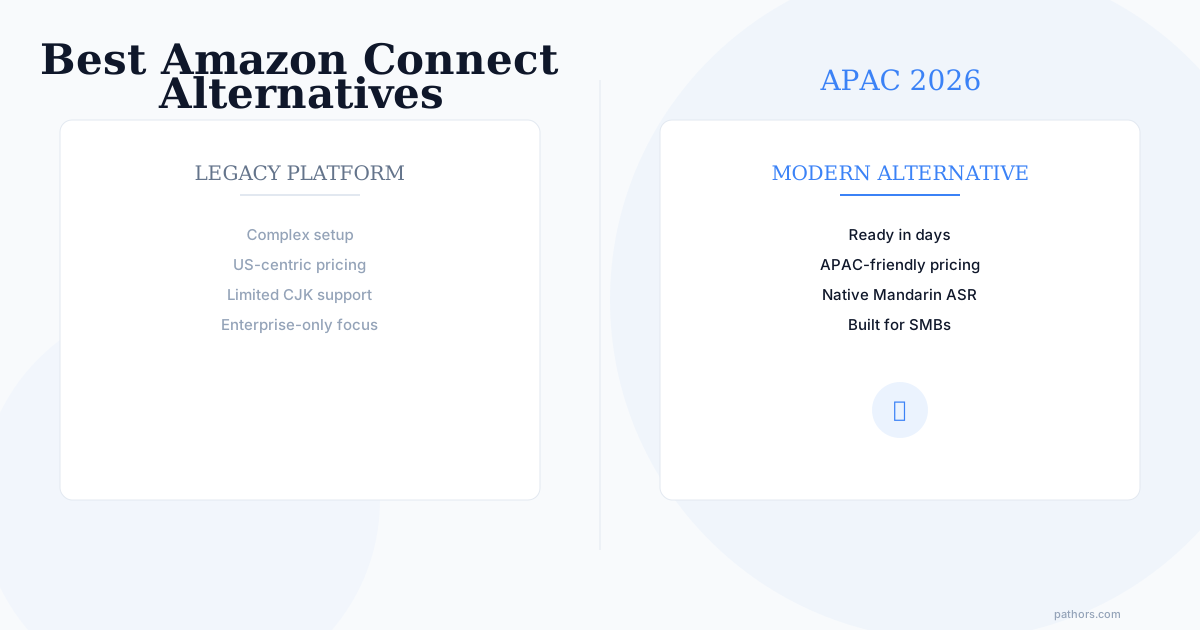
For any business handling Mandarin, Cantonese, Japanese, or mixed-language calls, ASR accuracy is the single highest-impact criterion. Amazon Connect's built-in speech recognition relies on Amazon Transcribe, which achieves roughly 82-85% accuracy on Mandarin — serviceable for transcription, but below the 92%+ threshold where AI voice agents can reliably act on caller intent without constant fallback to human agents.
The practical implication: at 83% accuracy, roughly one in six caller intents gets misclassified. For a support line handling 500 calls a day, that's 80+ calls routed incorrectly or requiring human intervention to recover. The compounding effect on customer satisfaction and agent workload is substantial. Platforms with Mandarin-first ASR models close this gap significantly, especially for Taiwan-accented Mandarin and the Mandarin-Hokkien code-switching that's common in everyday conversations.
Deployment Complexity
Amazon Connect requires significant AWS ecosystem knowledge. You'll need to configure Lambda functions, set up DynamoDB tables, integrate Amazon Lex for NLU, and manage IAM policies — all before your first call routes correctly. For enterprises with dedicated cloud teams, this is manageable. For the 85% of APAC businesses with fewer than 500 employees (IDC Asia-Pacific SMB Survey, 2025), it's a barrier that translates directly into months of delayed deployment and consultant fees.
One pattern we see repeatedly: a company budgets 4 weeks for Connect setup, discovers at week 3 that their Lex bot doesn't handle Mandarin intent classification well, pivots to building custom Lambda functions for intent routing, and ends up 3 months past their original timeline. The platform itself isn't broken — it just wasn't designed for a team that doesn't live inside the AWS ecosystem daily.
Pricing Structure
Connect's per-minute pricing starts low on paper (USD $0.018/min for inbound voice), but the real cost includes Lex charges for each NLU interaction, Lambda invocations, Transcribe usage, and data transfer. One Taiwanese financial services firm reported all-in costs of USD $0.08-0.12 per minute — 4-6x the headline rate. At 10,000 monthly call minutes, that's the difference between a $180 budget expectation and a $1,200 reality.
Platforms designed for APAC markets often offer bundled pricing that makes total cost predictable. When your CFO asks "what will this cost next month?", the answer shouldn't require a spreadsheet model with eight variable inputs.
Compliance & Data Residency
Taiwan's PDPA, Japan's APPI, and Singapore's PDPA all have data residency implications. Amazon Connect operates from limited APAC regions (Tokyo, Seoul, Singapore), and routing data through the nearest region doesn't automatically satisfy local compliance requirements. Voice recordings, call metadata, and customer PII all need to land in the right jurisdiction — and "nearest available region" isn't always the right one. Some alternatives offer on-premise or local-cloud deployment options that simplify the compliance conversation from a legal review into a checkbox.
Top Alternatives to Amazon Connect for APAC
1. Pathors — Purpose-Built for APAC Voice AI
Pathors approaches the problem from the opposite direction: instead of providing infrastructure you assemble yourself, it delivers a complete AI voice agent platform that works out of the box. Mandarin ASR accuracy sits at 94%+ (including Taiwanese accent optimization), and the platform handles intent recognition, call routing, outbound campaigns, and CRM integration without requiring any AWS knowledge.
Deployment typically takes days rather than months. The pricing model is designed for APAC business scales — no surprise charges from a dozen underlying AWS services. For businesses that need a contact center solution rather than a contact center construction kit, the difference is significant.
Pathors also provides a local support team in Taiwan with Mandarin-speaking engineers, which matters more than most vendor comparison sheets acknowledge. When your call flow breaks at 10 PM on a Friday, the timezone of your support team is a feature, not a nice-to-have.
Key differentiators: native Taiwanese Mandarin and Hokkien support, sub-week deployment, predictable bundled pricing for SMB volumes, and local PDPA-compliant data handling. For APAC businesses specifically, these aren't edge features — they're table stakes that most US-origin platforms treat as afterthoughts.
2. Cloud-Native CCaaS Platforms
Several global CCaaS providers offer more turnkey experiences than Connect, with pre-built integrations and visual flow builders that don't require coding. These platforms work well for voice and digital channels combined, though their AI capabilities for Asian languages typically rely on the same underlying speech models as Connect, limiting the accuracy advantage. Deployment is faster than building on Connect, but customization for APAC-specific workflows (LINE integration, local payment callbacks, Mandarin intent classification) often requires professional services engagement.
3. Regional Telecom-Backed Solutions
APAC telecom operators increasingly offer bundled contact center platforms, leveraging their existing voice network infrastructure. The advantage is local phone number provisioning and in-country voice routing with minimal latency. The trade-off is that AI and automation capabilities tend to lag 12-18 months behind pure-play platforms, and customization options are limited. If your primary need is reliable voice routing rather than AI-powered automation, this category delivers.
4. Open-Source Frameworks with Managed Hosting
For engineering-heavy teams that want full control, open-source voice AI frameworks provide maximum flexibility. The trade-off is obvious: you're building and maintaining the platform yourself. Total cost of ownership often exceeds commercial alternatives once you factor in engineering time, infrastructure management, and the ongoing burden of keeping speech models current. But for businesses with very specific requirements or regulatory constraints that prohibit third-party voice data processing, it can be the right choice.
How to Choose the Right Platform
The decision framework comes down to three variables: your team's technical depth, your primary caller languages, and your timeline.
If you have AWS-certified engineers on staff and your callers speak primarily English, Amazon Connect remains a capable choice — it's genuinely powerful infrastructure for teams that can harness it. If you're serving Mandarin, Cantonese, or Japanese callers and need to be operational within weeks rather than quarters, the calculus shifts sharply toward platforms built for that context.
McKinsey's 2025 APAC Digital Infrastructure report noted that businesses adopting region-specific SaaS tools achieved 40% faster time-to-value compared to those adapting US-centric platforms. In contact center terms, that's the difference between answering calls with AI this quarter versus next year. For a business losing customers to hold-time frustration right now, "next year" isn't a timeline — it's a cost.
Frequently Asked Questions
Is Amazon Connect available in Taiwan?
Amazon Connect can route calls to Taiwan, but there is no AWS region physically located in Taiwan. The nearest regions are Tokyo and Singapore. This means voice data traverses international links, adding 30-80ms of latency and raising PDPA data residency questions that your legal team will want to examine before committing.
How much does Amazon Connect actually cost per call?
The headline rate is USD $0.018/min for inbound, but real-world all-in costs (including Lex, Lambda, Transcribe, and data transfer) typically land at $0.06-0.12 per minute for AI-enabled calls. A 5-minute call costs $0.30-0.60, which at 10,000 monthly calls becomes $3,000-6,000/month before agent licensing.
Can Amazon Connect handle Mandarin speech recognition?
Amazon Transcribe supports Mandarin (zh-CN and zh-TW), but accuracy for Taiwanese Mandarin with local accent patterns and code-switching is typically 82-85%. Platforms with Mandarin-first ASR models achieve 92-95%, which materially impacts whether AI agents can reliably resolve calls without human escalation.
What's the typical deployment time for Amazon Connect vs. alternatives?
A basic Amazon Connect setup takes 2-4 weeks. Adding AI capabilities (Lex bots, Lambda integrations, custom speech models) typically extends this to 2-4 months. Purpose-built platforms like Pathors can deploy functional AI voice agents within 3-7 business days, because the AI layer is integrated rather than assembled from separate services.
Do I need AWS expertise to run Amazon Connect?
Yes. Amazon Connect is deeply integrated with the AWS ecosystem. Routine operations like modifying call flows, updating bot intents, or troubleshooting routing issues require familiarity with the AWS console, CloudWatch logs, and often Lambda function debugging. Teams without AWS experience should budget for training or ongoing external consulting.
Is Amazon Connect suitable for small businesses in Asia-Pacific?
Connect's pay-per-use model can work for low volumes, but the operational overhead makes it impractical for most SMBs. The platform was designed for enterprises with dedicated cloud operations teams. APAC SMBs with fewer than 50 agents typically achieve better outcomes with turnkey platforms that include built-in AI, local language support, and bundled pricing.
Amazon Connect is excellent infrastructure — for organizations with the engineering capacity to turn infrastructure into a solution. For the majority of APAC businesses, the question isn't whether Connect is powerful enough. It's whether your team should be spending months assembling a contact center from AWS primitives when there are platforms that already speak your callers' language, price for your market's scale, and deploy before your next board meeting.
Frequently Asked Questions
Is Amazon Connect available in Taiwan?
Amazon Connect can route calls to Taiwan, but there is no AWS region physically located in Taiwan. The nearest regions are Tokyo and Singapore. This means voice data traverses international links, adding 30-80ms of latency and raising PDPA data residency questions that your legal team will want to examine.
How much does Amazon Connect actually cost per call?
The headline rate is USD $0.018/min for inbound, but real-world all-in costs (including Lex, Lambda, Transcribe, and data transfer) typically land at $0.06-0.12 per minute for AI-enabled calls. A 5-minute call costs $0.30-0.60, which at 10,000 monthly calls becomes $3,000-6,000/month before agent licensing.
Can Amazon Connect handle Mandarin speech recognition?
Amazon Transcribe supports Mandarin (zh-CN and zh-TW), but accuracy for Taiwanese Mandarin with local accent patterns and code-switching is typically 82-85%. Platforms with Mandarin-first ASR models achieve 92-95%, which materially impacts whether AI agents can reliably resolve calls without human escalation.
What's the typical deployment time for Amazon Connect vs. alternatives?
A basic Amazon Connect setup takes 2-4 weeks. Adding AI capabilities (Lex bots, Lambda integrations, custom speech models) typically extends this to 2-4 months. Purpose-built platforms like Pathors can deploy functional AI voice agents within 3-7 business days.
Do I need AWS expertise to run Amazon Connect?
Yes. Amazon Connect is deeply integrated with the AWS ecosystem. Routine operations like modifying call flows, updating bot intents, or troubleshooting routing issues require familiarity with the AWS console, CloudWatch logs, and often Lambda function debugging.
Is Amazon Connect suitable for small businesses in Asia-Pacific?
Connect's pay-per-use model can work for low volumes, but the operational overhead makes it impractical for most SMBs. The platform was designed for enterprises with dedicated cloud operations teams. APAC SMBs with fewer than 50 agents typically achieve better outcomes with turnkey platforms that include built-in AI, local language support, and bundled pricing.