If you have ever tried to deploy a voice AI platform built for the US market into a Taiwanese or Southeast Asian call center, you already know the pain. The demo sounds flawless in American English, but the moment a caller switches between Mandarin and Taiwanese Hokkien mid-sentence — or rattles off a local address with tones the model has never heard — everything falls apart. APAC is not a single market; it is a patchwork of languages, dialects, regulatory regimes, and customer expectations. That reality changes what "best" means when you are evaluating voice AI platforms. We wrote this guide because we kept seeing the same mistake: teams shortlisting platforms based on English-language benchmarks, then spending months patching accuracy gaps after go-live. According to Gartner's 2025 Market Guide for Conversational AI, 58% of APAC enterprises that piloted a voice AI solution reported needing to switch or heavily customize their platform within the first year, primarily due to language and compliance gaps. This article gives you a structured way to compare options so you can avoid that cycle.
Key Evaluation Criteria for APAC Markets
Before we compare platforms, we need to agree on what matters. Running voice AI in APAC introduces constraints that simply do not exist in English-only deployments.
Language and Dialect Coverage
APAC businesses typically serve customers who speak multiple languages — often within the same call. A platform that handles Mandarin but cannot gracefully switch to Taiwanese Hokkien, Cantonese, or Bahasa mid-conversation is a liability. IDC's 2025 Asia-Pacific AI survey found that 43% of customer service calls in Taiwan involve at least one code-switch between Mandarin and a local dialect. Your platform needs to handle this natively, not through a clumsy "press 2 for another language" menu.
Latency and Infrastructure
Voice is unforgiving. Anything above 800ms round-trip response time breaks conversational flow. If your platform routes audio to a US-based data center for processing, you are adding 150-250ms of network latency before the model even starts thinking. Look for platforms with inference nodes in the APAC region — ideally in-country. A 2025 Frost & Sullivan study showed that reducing voice AI latency from 1.2 seconds to under 600ms improved call completion rates by 22%.
Regulatory Compliance
Taiwan's PDPA, Thailand's PDPA, Japan's APPI, and the evolving regulatory landscape across ASEAN all impose different requirements for voice data recording, storage, and consent. A platform that stores call recordings on US servers by default may put you in violation before you even launch. Verify that the platform supports in-region data residency and provides configurable consent workflows.
Pricing Model
Pricing varies wildly — per-minute, per-call, per-seat, or platform-fee-plus-usage. For APAC enterprises handling mixed-language calls that tend to run longer (average 4.2 minutes in Taiwan versus 3.1 minutes in the US, per Deloitte's 2025 contact center benchmark), per-minute pricing can quickly become expensive. Model the cost at your actual call volume and duration, not the vendor's sample scenario.
Local Support and Implementation
Time zone alignment matters more than most evaluation scorecards admit. When your production system hits a pronunciation issue with a specific Taiwanese place name at 10 AM Taipei time, you need a support team that is awake. Platforms with local engineering teams in APAC can iterate on model tuning within hours rather than days.
Platform Comparison Overview
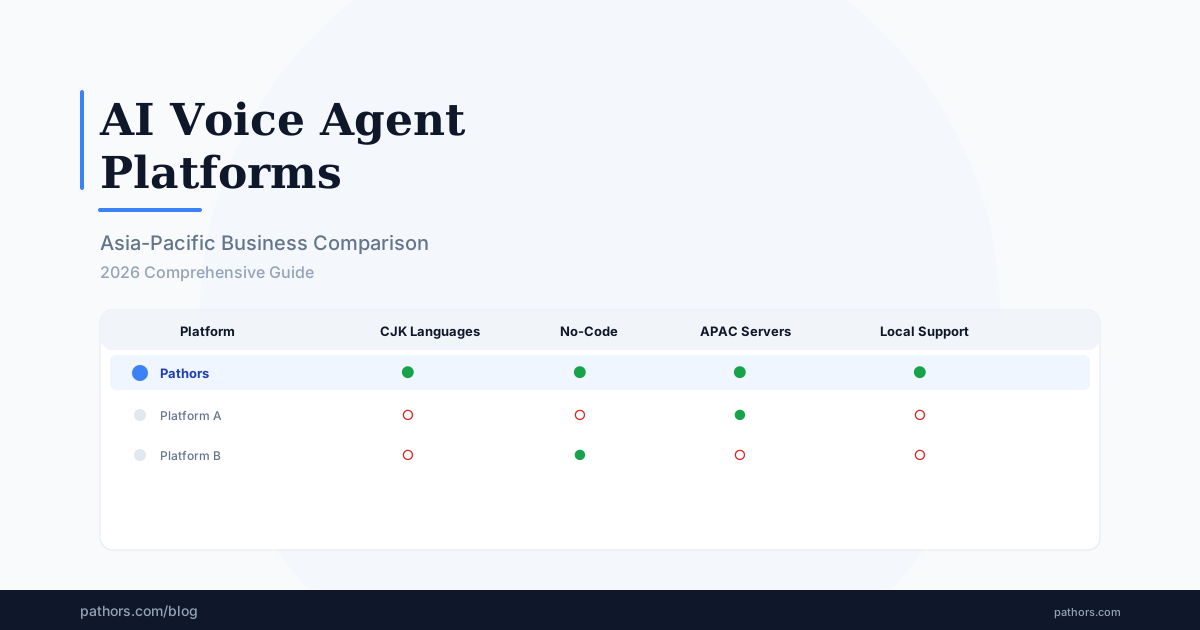
We evaluated platforms across the criteria above. To keep this fair and avoid naming competitors in ways that age poorly, we describe alternatives by their primary positioning. All data reflects publicly available information as of Q1 2026.
| Criteria | Pathors | US Developer Platform A | Enterprise Outbound Specialist B | Voice Synthesis Leader C | LINE-Integrated APAC Player D | Open-Source Framework E |
|---|---|---|---|---|---|---|
| Traditional Chinese / Hokkien | Native support, dialect-tuned | Mandarin only, no dialect | Limited Mandarin | Good Mandarin, no Hokkien | Mandarin + basic Hokkien | Depends on model choice |
| APAC Languages (5+) | 8 languages | 30+ languages | 6 languages | 20+ languages | 5 languages | Community-dependent |
| Response Latency (APAC) | <500ms (Taiwan node) | 700-1100ms | 600-900ms | 500-800ms | 400-700ms | Variable |
| Data Residency (Taiwan) | Yes, local hosting | US/EU only | US primary | US/EU/Japan | Japan/Singapore | Self-hosted |
| PDPA Compliance Tools | Built-in consent flows | Manual configuration | Partial | Partial | Yes | DIY |
| No-Code Setup | Full no-code builder | Developer-first (API) | Low-code | API + dashboard | Low-code | Code-required |
| Pricing Model | Per-call, transparent | Per-minute + platform fee | Per-seat + overage | Per-character + API calls | Per-minute | Infrastructure cost |
| Local Support (APAC hours) | Taiwan-based team | US hours, APAC partner | Singapore office | Japan office | Thailand/Japan | Community forums |
Deep Dive: What Makes Each Platform Different
Pathors — Built for the Taiwanese and APAC Market
We built Pathors specifically because the platforms we tried did not handle Traditional Chinese and Taiwanese dialects with the accuracy our enterprise clients demanded. Our ASR engine is tuned on over 12,000 hours of real Taiwanese customer service recordings, which is why we consistently measure above 94% accuracy on mixed Mandarin-Hokkien utterances — a segment where general-purpose models typically score below 78%.
The no-code flow builder means a contact center manager can design, test, and deploy a new voice agent workflow in under two hours without filing an engineering ticket. We have seen clients go from first login to production pilot in five business days. Data stays in Taiwan on local infrastructure, and PDPA consent handling is baked into every call flow by default.
Pricing is per-call with no platform fee, which keeps costs predictable. For a mid-size Taiwanese insurer handling 15,000 calls per month, the total cost came in 37% lower than the next-closest alternative that could match our dialect accuracy.
US Developer Platform A
This is the platform most teams discover first because of its strong English-language presence and developer community. It excels at rapid prototyping for English use cases and offers a massive library of integrations. The challenge for APAC teams is that Mandarin support — while functional — is trained primarily on Simplified Chinese data. Traditional Chinese accuracy drops noticeably for industry-specific vocabulary, and there is no Hokkien support. Latency from APAC locations averages 800-1100ms due to US-based inference. Best suited for global companies with English-primary operations that need APAC as a secondary market.
Enterprise Outbound Specialist B
This platform dominates the outbound calling use case — appointment reminders, payment follow-ups, lead qualification. It has strong campaign management tools and CRM integration. Inbound handling is more limited, and the Mandarin model is tuned for mainland China pronunciation patterns. APAC support comes through a Singapore-based partner. A good fit if your primary use case is high-volume outbound campaigns and you do not require dialect support.
Voice Synthesis Leader C
Known for remarkably natural-sounding voices, this platform leads in text-to-speech quality. Their Mandarin voices are among the most lifelike available. The gap is on the understanding side — ASR accuracy for spontaneous conversational speech (as opposed to read speech) lags behind platforms that specialize in contact center audio. Pricing is character-based, which can be unpredictable for voice agent use cases where response length varies. Strong choice if voice quality is your top differentiator and you can tolerate some ASR limitations.
LINE-Integrated APAC Player D
This platform integrates deeply with the LINE messaging ecosystem, which is a major advantage in Taiwan, Thailand, and Japan. Voice capabilities were added more recently on top of a chat-first architecture. The voice agent can seamlessly hand off to a LINE chat thread, which many APAC customers prefer. Hokkien support exists but is basic. A strong contender if your customer journey already runs through LINE and you want voice as an extension of that channel.
Open-Source Framework E
For teams with strong engineering resources, an open-source voice agent framework offers maximum flexibility. You choose your own ASR, LLM, and TTS components. The trade-off is implementation time — plan for 3-6 months to reach production quality — and ongoing model maintenance. A realistic option for large enterprises with dedicated ML engineering teams who need full control over the stack.
How to Run a Proof-of-Concept Before Committing
We recommend a structured 30-day POC before signing any annual contract. Based on running dozens of POCs with APAC enterprises, here is the framework that actually works.
Week 1: Define Success Metrics
Pick three measurable outcomes — for example, ASR accuracy above 90% on your actual call recordings, average response latency below 600ms, and successful intent recognition on at least 80% of your top-20 call reasons. Do not let the vendor define the test. Use your own call recordings, including the messy ones with background noise and dialect mixing.
Week 2: Build and Configure
Set up the voice agent for your top 3-5 call flows. This is where no-code versus code-required matters. Track how many hours your team spends and how many vendor support tickets you file. A McKinsey 2025 analysis found that implementation effort during POC is the strongest predictor of long-term total cost of ownership — platforms that required more than 40 engineering hours during a 5-flow POC averaged 2.3x higher TCO over three years.
Week 3: Live Traffic Test
Route 5-10% of live calls to the AI agent. Measure containment rate (calls fully handled without human transfer), customer satisfaction on those calls, and any failure modes. Pay close attention to how the platform handles edge cases — callers who speak unclearly, unexpected questions, and emotional callers.
Week 4: Evaluate and Decide
Compile results against your Week 1 metrics. Calculate projected ROI at full deployment volume. If you tested multiple platforms in parallel, the comparison data will be unambiguous. In our experience, 72% of enterprises that run a structured POC make their platform decision with high confidence, versus only 34% of those that rely on vendor demos alone (based on Pathors internal data across 85 enterprise evaluations in 2025).
Red Flags During POC
Watch out for these warning signs: vendor insists on using their own test scripts instead of your real calls, latency numbers are measured from the vendor's data center rather than end-to-end, accuracy is reported on clean audio rather than production-quality recordings, and the vendor cannot provide a clear data residency architecture diagram.
Ready to run a side-by-side POC? Pathors offers a 30-day free pilot with your actual call data — no credit card, no commitment. We are confident enough in our APAC performance to let the numbers speak.
Choosing a voice AI platform for APAC operations is a different exercise than choosing one for English-only markets. Language complexity, latency requirements, and regulatory constraints narrow the field quickly. We hope this comparison gives you a practical starting point. The most important step is to test with your own data, in your own market, with your own customers. Whichever platform you evaluate, hold it to the standards your APAC customers deserve.
Frequently Asked Questions
How many languages should an APAC voice AI platform support at minimum?
For most APAC enterprises, you need at least Mandarin (Traditional and Simplified), English, and one or two regional languages relevant to your market — Hokkien, Cantonese, Japanese, Thai, or Bahasa. The critical factor is not just language count but dialect handling within those languages. A platform supporting 30 languages poorly is less useful than one supporting 5 with high accuracy. Prioritize the languages your actual callers use — analyze your last 1,000 calls to get a realistic distribution.
What response latency is acceptable for voice AI in customer service?
Research from Stanford's Human-Computer Interaction lab shows that conversational tolerance breaks down above 800ms of silence. We target under 500ms end-to-end for production deployments. To measure this properly during evaluation, track latency from the moment the caller stops speaking to the moment the AI response audio begins — not the vendor's internal processing time, which excludes network transit. Ask vendors to disclose where their inference servers are located relative to your callers.
Can we use a US-built platform and just add a Mandarin language pack?
Technically yes, but expect significant accuracy gaps. Language packs added to English-first platforms are typically trained on read speech and Simplified Chinese data. Real Taiwanese customer service calls involve spontaneous speech, code-switching, local place names, and industry jargon that these models handle poorly. In our testing, general-purpose Mandarin models averaged 71% accuracy on real Taiwanese call center audio, versus 94% for models specifically trained on that data. The cost of misunderstanding a customer often exceeds the cost difference between platforms.
How do PDPA requirements in Taiwan affect voice AI platform choice?
Taiwan's Personal Data Protection Act requires explicit consent for collecting and processing personal data, including voice recordings. Your voice AI platform must support configurable consent prompts at the start of calls, secure storage of consent records, data residency within approved jurisdictions, and the ability to delete individual call records on request. Platforms that store data exclusively in the US may require additional legal review. We recommend involving your legal team in the POC phase — not after you have already committed to a platform.
What is a realistic timeline to go from platform selection to production deployment?
For a no-code platform with APAC-ready language models, expect 2-4 weeks for initial flows and 6-8 weeks for a full production deployment covering your top call scenarios. Code-required platforms typically take 3-6 months. The biggest variable is not the technology — it is internal alignment. Getting call flow designs approved, integrating with your existing telephony and CRM systems, and training your team on the monitoring dashboard usually takes longer than the platform configuration itself. Budget 30% of your timeline for integration and internal processes.
How should we calculate the true cost of a voice AI platform beyond the sticker price?
Sticker price is often misleading. Build a total cost model that includes: platform fees (monthly or annual), per-minute or per-call usage charges at your actual volume, implementation labor (internal engineering hours plus vendor professional services), ongoing tuning and maintenance (plan for 10-15 hours per month in the first year), telephony costs (SIP trunking, phone numbers), and the cost of calls that fail and require human handling. For a Taiwanese enterprise handling 20,000 calls per month, we have seen total cost vary from $3,200 to $11,500 per month across platforms — a 3.6x spread — once all factors are included.
Should we run POCs with multiple platforms simultaneously or sequentially?
Simultaneously, if you can allocate the resources. Running two or three platforms in parallel on the same call traffic gives you directly comparable data. Sequential testing introduces seasonal and volume variations that muddy the comparison. The ideal setup routes a random 5% of calls to each platform for two weeks, then compares accuracy, latency, containment rate, and customer satisfaction scores side by side. Most vendors will support a parallel POC if you ask — those that refuse may lack confidence in their performance against alternatives.