Bland AI has carved out a position in the voice AI market with its clean interface and rapid deployment capabilities. But if your organization operates in a heavily regulated industry — financial services, healthcare, insurance — you've likely encountered some concerning gaps during evaluation. Does the call recording retention policy meet your regulator's requirements? Has the data processing pipeline achieved SOC 2 Type II certification? Is data stored within your required jurisdiction? PwC's 2025 global fintech survey found that 82% of APAC financial institutions rank "vendor compliance capability" as their top AI procurement criterion, ahead of both price and functionality.
Unique Challenges of Voice AI in Regulated Industries
Data Sovereignty and Residency Requirements
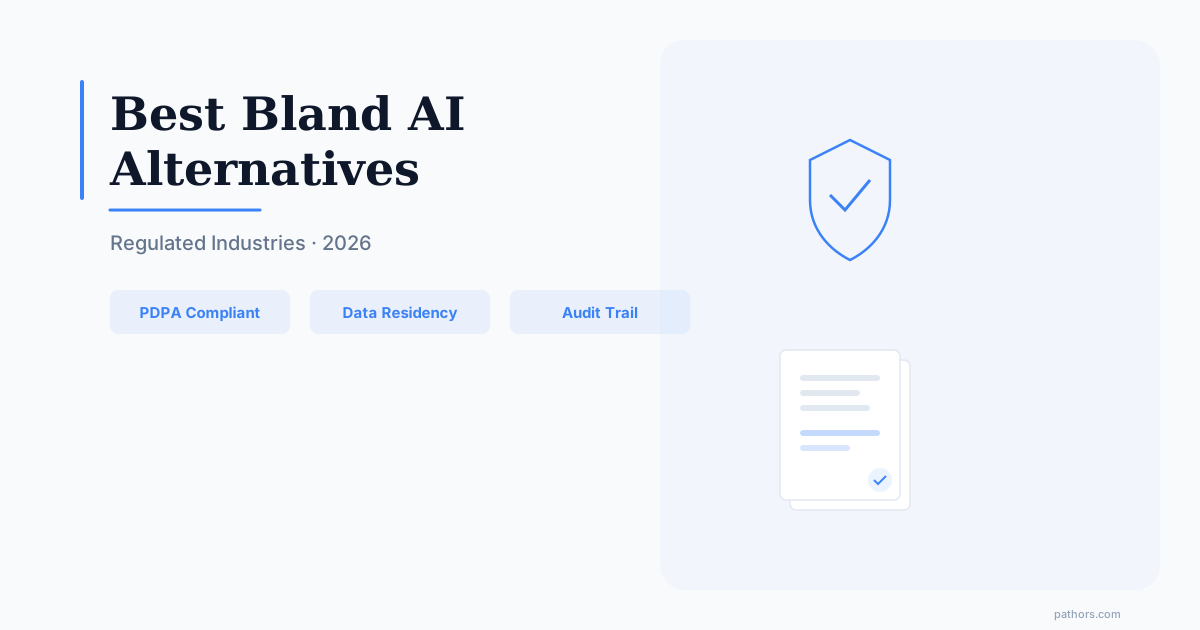
Regulated industries face strict rules about where customer data is processed and stored. Taiwan's Personal Data Protection Act (PDPA) requires a lawful basis for the collection, processing, and use of personal data. For financial and healthcare institutions, call content constitutes sensitive personal data with explicit geographic and security requirements.
Bland AI's data centers are primarily located in the United States. While it offers encrypted transmission, this creates a structural limitation for organizations requiring data residency in Taiwan or the broader APAC region. Taiwan's Financial Supervisory Commission (FSC) updated its outsourcing regulations in 2025, requiring explicit disclosure of cloud storage locations and granting regulators the right to audit. KPMG's 2025 survey found that 67% of Taiwanese financial institutions have rejected overseas AI vendors specifically due to data residency concerns.
Call Recording and Audit Trails
Regulated industries must maintain complete customer interaction records. Financial services typically require 5-7 years of call recording retention; healthcare-related calls may need to be preserved even longer. AI voice platforms need not only to record but to provide tamper-proof audit trails, timestamps, and rapid retrieval capabilities for regulatory examinations.
Bland AI offers basic call logging, but lacks enterprise-grade audit trail management. For financial institutions, this means building an additional compliance recording layer, adding integration complexity and cost.
Real-Time Sensitive Information Masking
In financial customer service scenarios, callers may disclose identification numbers, account numbers, and card details. AI voice platforms need real-time masking capabilities to ensure sensitive information isn't stored in plaintext or transmitted to unauthorized destinations. IBM's 2025 Cost of a Data Breach report puts the average breach cost for APAC financial services at $5.2 million, 18% above the global average.
Evaluation Criteria for Regulated Industry Voice AI
Certifications and Compliance Documentation
Request from vendors: SOC 2 Type II reports, Data Protection Impact Assessments (DPIA), and compliance statements specific to your industry's regulations. If a vendor can't provide these documents within 48 hours, that's a red flag in itself. According to Gartner's 2025 vendor assessment guide, 73% of compliance-related deployment delays trace back to insufficient vendor documentation.
Data Processing Architecture Transparency
Understand the complete data lifecycle within the platform: from voice signal reception, speech-to-text processing, LLM inference, through to final storage and deletion. Each stage requires confirmation of data geographic location and security measures.
Role-Based Access Control
Regulated industries need strict least-privilege access. Customer service agents should only access data relevant to their function. Managers can view reports but shouldn't access raw recordings without authorization. Auditors need access to complete logs without the ability to modify any records.
Best Bland AI Alternatives for Regulated Industries
#1: Pathors
Pathors offers several critical advantages for compliance-oriented voice AI deployment:
A regional bank in Taiwan deployed Pathors and saw its AI voice assistant handle 64% of routine service calls (balance inquiries, transfer confirmations, card loss reports) while passing the FSC's information security audit.
#2: A Compliance-Focused Conversational AI Platform
This platform has strong adoption among financial institutions in North America and Europe, with comprehensive GDPR compliance features and SOC 2 certification. However, its APAC support is limited — no Taiwan data center, and Mandarin speech recognition accuracy falls below APAC-focused platforms. Deployment typically requires 6-10 weeks, with pricing suited to large financial institutions. Forrester's 2025 assessment ranks it among the top three for European and American compliance scenarios, but less competitive in APAC markets.
#3: A Financial Services Voice Analytics Platform
This platform specializes in call analysis and compliance monitoring for financial services, automatically detecting compliance risks in conversations (such as mis-selling behavior). However, its core capability is post-call analysis rather than real-time AI voice service. It's best positioned as a compliance monitoring tool for human agents rather than an agent replacement.
#4: A Hybrid Cloud Deployment Platform
This platform's distinguishing feature is hybrid cloud deployment — organizations can keep sensitive data on local servers while running non-sensitive processing in the cloud. This architecture appeals to institutions with extreme data sovereignty requirements. However, deployment and maintenance complexity is significantly higher, requiring dedicated IT support, and AI conversation quality is constrained by on-premises hardware capabilities.
Compliance-First Deployment Strategy
Regulated industries should follow this approach when implementing AI voice:
| Criteria | Pathors | Platform B | Platform C | Platform D |
|---|---|---|---|---|
| Taiwan Data Residency | Yes | No | No | Optional |
| SOC 2 Type II | Yes | Yes | Yes | In Progress |
| Real-Time Data Masking | Yes | Yes | No | Partial |
| Mandarin Accuracy (Finance) | 93%+ | 79% | N/A | 81% |
| Deployment Timeline | 1-2 weeks | 6-10 weeks | 3-4 weeks | 8-12 weeks |
In regulated industries, the criteria for selecting an AI voice platform differ fundamentally from general business use cases. Compliance must be built into the system architecture from day one — it cannot be retrofitted. Bland AI serves general business scenarios adequately, but for Taiwan's financial and healthcare institutions, gaps in data residency, audit trails, and local compliance support represent material risk. Pathors provides an alternative designed for compliance from the architecture level. Schedule a compliance-focused technical walkthrough — our team can provide specific recommendations tailored to your industry's regulatory requirements.
Frequently Asked Questions
Does Bland AI have SOC 2 certification?
As of early 2026, Bland AI's public documentation does not include SOC 2 Type II certification. For regulated industries, this is a significant gap. We recommend requesting the latest security certification documents directly from Bland AI during your evaluation.
What regulations restrict Taiwan financial firms from using overseas AI voice platforms?
Key restrictions come from the FSC's outsourcing regulations and Taiwan's PDPA. Core requirements include: explicit disclosure of data storage locations, lawful basis for cross-border data transfers, regulatory right to audit all customer interaction records, and vendor cooperation with regulatory examinations. Using a platform with Taiwan-based data centers significantly simplifies compliance.
Where are Bland AI's data centers located?
Bland AI's data centers are primarily in the United States. For organizations requiring data residency in Taiwan or APAC, this means call data crosses international borders, potentially triggering additional compliance requirements. Pathors' data centers are located in Taiwan, keeping all data within the jurisdiction.
How long does it take to deploy AI voice in a regulated industry?
Deployment in regulated industries typically takes longer than general industries due to compliance review processes. With Pathors, technical deployment takes about 1-2 weeks, but compliance review and internal approvals may add 2-4 weeks. We recommend involving your compliance team from the project start.
Is AI voice safe for handling financial transactions?
Safety depends on platform design. Critical elements include end-to-end encryption, real-time sensitive data masking, multi-factor authentication, and complete audit trails. Pathors provides all of these and supports additional security verification steps for transaction-related calls. We recommend starting with non-transaction calls and gradually expanding to transaction scenarios.
Can Bland AI meet APAC healthcare data regulations?
Bland AI's current compliance framework is primarily aligned with US regulations (HIPAA). APAC healthcare data regulations vary by jurisdiction and often require local data residency. For Taiwan healthcare organizations, Pathors' local data center and PDPA-compliant architecture provide a more straightforward compliance path.