You're planning to deploy AI customer service. The first decision you need to make: text or voice?
Chatbots (text-based customer service bots) are already standard for many businesses — the dialog box in the bottom corner of websites, auto-replies on LINE official accounts, in-app customer service chat. Voice bots (AI voice assistants) are a newer option that has only become mainstream in the past two years as voice AI technology matured.
Both automate customer service, but they apply to completely different scenarios, customer segments, and cost structures. Choose wrong, and you're either wasting money or degrading the customer experience.
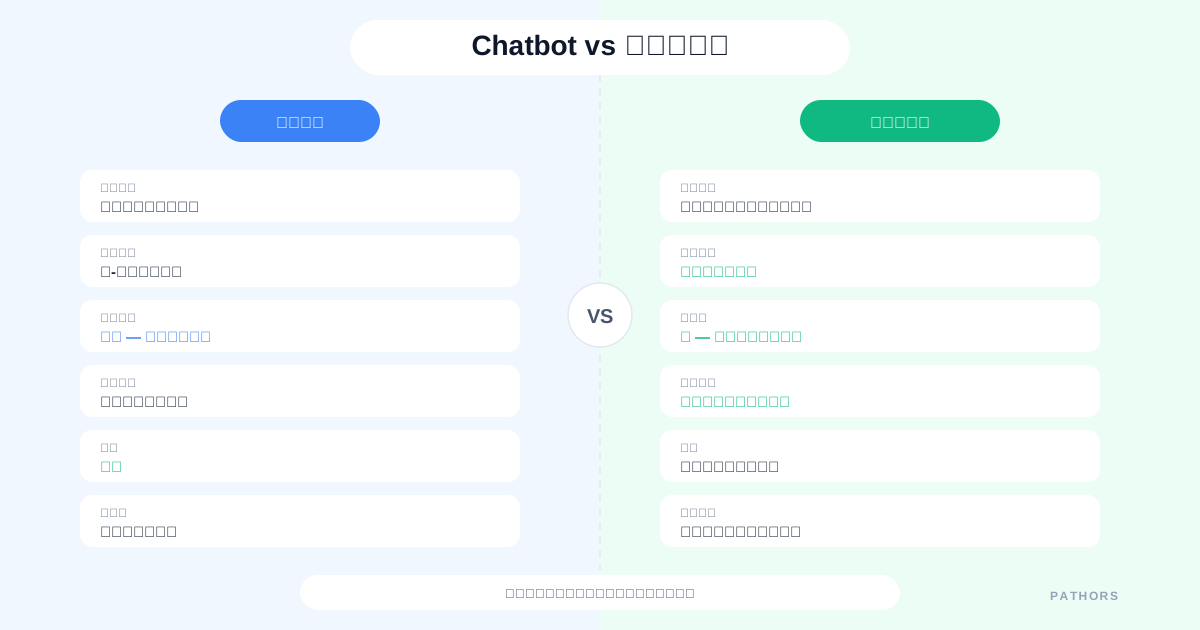
Text vs. Voice Customer Service: Six Dimensions Compared
Dimension 1: Customer Usage Habits
This is the most fundamental deciding factor. Do your customers prefer typing or calling?
Younger demographics (ages 20–35) lean toward text communication — they chat on LINE, type in apps, and find making phone calls requires a certain amount of effort. Older demographics (45+) lean toward voice communication — they find typing inconvenient, the text is too small to read easily, and picking up the phone to talk directly is faster.
In Taiwan, this divide is especially pronounced. If your primary customer base includes older adults (healthcare, insurance, finance), blue-collar workers (logistics, maintenance), or people too busy to type (restaurant owners, real estate agents), voice is the more natural contact channel.
Dimension 2: Problem Urgency
Text customer service has one natural limitation: asynchronous communication. After a customer sends a message, they might wait a few seconds to a few minutes for a response. For non-urgent matters (checking policies, learning about plans, requesting materials), this is completely acceptable.
But for urgent problems (order errors, flight cancellations, system failures), customers need real-time back-and-forth dialogue, not a series of text exchanges. Voice calls are inherently synchronous — AI responds immediately, processes immediately, confirms immediately.
Dimension 3: Information Complexity
Text customer service has an advantage when presenting structured information: comparison tables, numbered steps, links and images — these are much clearer in text format than read aloud by voice.
But voice is more natural when handling unstructured descriptions. "The white machine in my house with the red button on top stopped working" — painful to type out, takes a few seconds to say.
Dimension 4: Handling Efficiency
A text chatbot can have simultaneous conversations with hundreds of customers. A voice bot can only have one conversation at a time per line (though you can run multiple lines simultaneously).
However, the first-call resolution rate for voice is typically higher than text. Text conversations often require multiple exchanges to clarify the issue; voice calls, being real-time interactions, typically resolve a standard problem in 2–3 minutes.
Dimension 5: Cost Structure
Text chatbot costs are relatively low: mainly API call fees and platform monthly fees, no telephone line needed. Voice bot cost structure adds three layers: speech recognition (ASR), speech synthesis (TTS), and telephone lines (SIP trunk).
But if your scenario involves customers who were already going to call — meaning telephone line costs already exist and human agent costs already exist — then the incremental cost of a voice bot is mainly ASR and TTS, which is typically cost-effective compared to the human labor saved.
Dimension 6: Reach
Text customer service is passive — customers must proactively come to your website, app, or LINE account to find you. Voice bots can proactively reach out — outbound calls, expiration reminders, satisfaction follow-ups, delivery notifications.
If your needs extend beyond "catching customers who come to ask" to "proactively reaching out to customers," voice is the only option. No one is going to open a chatbot to confirm tomorrow's appointment — but a phone call can.
Summary Comparison
| Dimension | Chatbot (Text) | Voice Bot (Voice) |
|---|---|---|
| Best Customer Fit | Young, comfortable typing | Middle-aged/elderly, busy, uncomfortable typing |
| Urgency | Low–medium (async) | High (real-time sync) |
| Information Type | Structured (tables, links, images) | Unstructured (descriptions, narratives) |
| Concurrency | Very high (hundreds simultaneously) | Medium (multi-line but each line is exclusive) |
| First-Call Resolution | Medium (multiple exchanges) | High (real-time interaction) |
| Cost | Lower | Higher (but saves labor) |
| Reach Method | Passive (wait for customer) | Active + passive (can dial outbound) |
The Best Answer: Not a Binary Choice
For most businesses, the optimal strategy isn't choosing between chatbot and voice bot — it's deploying both based on scenario.
Simple queries, younger customers, non-urgent issues → Chatbot. Urgent problems, older customers, real-time interaction needed, outbound calling needed → Voice bot.
Pathors' AI customer service platform supports unified management of voice and text channels, letting you define handling flows for different scenarios on a single platform without managing two separate systems.
Want to understand how chatbot and voice bot work together most effectively in your scenario? Book a free Demo.