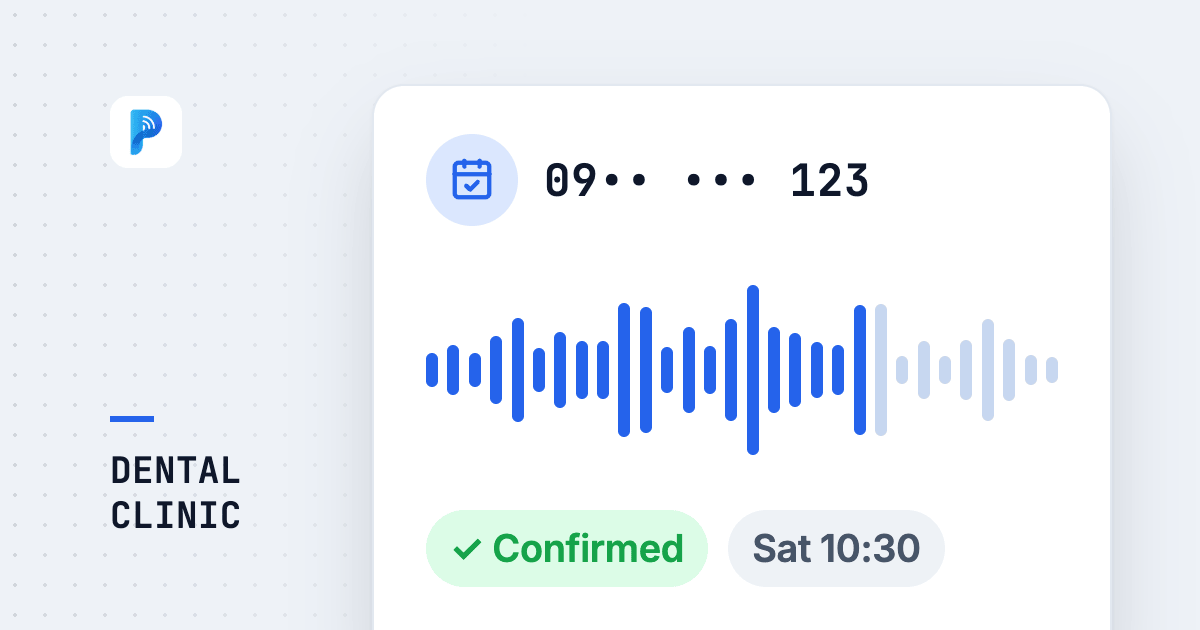
Picture a dental clinic on a Monday morning. Suppose that between 8am and 10am, the first two hours of the week, the front desk receives 47 inbound calls and answers 29 of them. Of the 18 unanswered, many have not called back by end of day, and a few have moved to LINE. Meanwhile the registration assistant spends more than an hour dialing out to patients whose 6-month cleaning recall is due. Two hours on a Monday is the single most expensive window of the week, and every one of those 18 unanswered calls was either a lost booking or a patient quietly drifting to another clinic. This is the operational wall that dental practices across Taiwan keep hitting, and it is the reason AI voice assistants have moved from novelty to table-stakes infrastructure in the last 18 months.
Three Front-Desk Failure Modes an AI Voice Assistant Removes
Dental clinics share a structural pattern that makes the front desk uniquely stressed. A patient arrives, and the receptionist has to simultaneously register them, hand off paperwork, take a phone call about next week's appointment, and remember to dial back the 2pm missed call. The cognitive load compounds, and it compounds predictably — in patterns that can be measured and automated.
Peak-Hour Call Abandonment
In Taiwan dental practices, a substantial share of peak-hour calls are abandoned before being answered. Peak hours cluster around three windows: 8-10am Monday, 5-7pm weekdays, and Saturday morning before the 11am cutoff. Those are the same hours your front desk is handling walk-in registration and treatment prep, so the collision is structural, not a staffing gap.
Recall Campaign Decay
A well-run dental recall program on 6-month cleaning intervals depends on timely outbound reminders 4 and 2 weeks before the due date. Without systematic reminders, recall campaign conversion drops noticeably, which translates directly into lost preventive bookings, and into treatment complications that only surface six months later when the patient reappears with problems that a clean would have avoided. For example, if a clinic with 800 active patients on recall loses 20 points of recall conversion, that is roughly 160 more missed preventive visits per recall cycle.
Post-Treatment Follow-up Gaps
Implants, endodontics, and orthodontic adjustments benefit from a 24-to-48-hour check-in call — partly for clinical monitoring, partly because the call is a retention signal the patient notices. Front desks rarely have time to run this consistently; practices without automation often leave follow-up incomplete, while those who have built it into a scheduled workflow carry it out far more reliably. The retention delta shows up in 12-month repeat booking rates.
How Clinics Actually Deploy AI Voice Assistants
Dental practices typically deploy in three distinct workflow layers, and the sequencing matters. Teams that try to deploy all three simultaneously usually stall on change management. Teams that sequence them gain confidence on the first layer before expanding.
Layer One: Appointment Reminder Calls
This is the first workflow almost every dental clinic automates, and for good reason — the intent is narrow, the conversation is short, and the failure mode is visible. A well-designed reminder call confirms the appointment, offers a reschedule option if the patient cannot make it, and logs the outcome back into the clinic's scheduling system. Once the reminder flow is running, no-show rates usually drop noticeably, with the steepest improvement on Saturday morning slots where the no-show cost is highest. The conversation design that works in Taiwan tends to open with the dentist's name rather than the clinic name, because patients recognize their doctor before they recognize the brand.
Layer Two: Recall Campaign Automation
Once the reminder layer is trusted, most clinics expand to recall campaigns — the outbound call that reminds a patient their 6-month cleaning is due. This is a harder conversation than a reminder because it is not transactional. The patient is not expecting your call. The flows that perform well in Taiwanese dental practice open with a soft, relational sentence — often a reference to the patient's last visit — and offer a live booking option immediately rather than asking the patient to call back. The key operational detail: the AI voice assistant should not insist. If the patient declines, the call ends gracefully and the patient is logged for a 30-day follow-up rather than being re-contacted immediately.
Layer Three: Missed-call Callback
This is the workflow that surprises clinic directors the most. Every missed call during peak hours is a potential lost booking. An AI voice assistant that detects the missed call, waits 15 to 30 minutes, and returns the call can win back a good share of those bookings. The conversation opens with clear identification — "This is an automated callback from Dr. X's clinic, we noticed you called us earlier" — and offers to book, answer a question, or transfer to the front desk. The transparency matters. Patients do not resent the automation when it is disclosed up front; they resent feeling tricked.
The Integration Points That Actually Matter
Three integration points determine whether the AI voice assistant becomes part of the clinic's operational muscle memory or stays a bolt-on tool.
Scheduling System Write-Back
The AI voice assistant must write booking and reschedule outcomes directly into the practice management system — not a separate queue that someone has to re-enter. For clinics on DentalVision, Aeris, or custom EMR stacks, a documented API integration path is non-negotiable. Without it, the AI assistant creates parallel data that someone has to reconcile, and the reconciliation overhead exceeds the automation gain within three months.
LINE Channel Handoff
Taiwanese patients increasingly default to LINE for clinic communication. A credible AI voice assistant deployment in Taiwan needs to read and respect the LINE channel — know when a patient has already asked the same question on LINE, offer to continue the booking on LINE if the voice call is inconvenient, and log the interaction in the same patient record. Clinics that treat voice and LINE as separate silos end up with duplicate bookings and irritated patients.
Clinical Escalation Logic
Some calls are not appropriate for full automation. A patient calling about post-extraction bleeding, a severe toothache outside office hours, or an orthodontic wire injury needs a human on the line fast. The escalation logic should detect these intents and either transfer to the on-call dentist's mobile or push an SMS to the clinic's emergency channel with transcript context. Escalation accuracy — measured as correctly routed emergency intents — should sit above 95 percent before the assistant goes live; below that threshold, the risk profile is unacceptable.
What to Measure in the First 90 Days
The metrics that predict whether the deployment sticks are simpler than most RFPs make them. Track four numbers weekly: reminder confirmation rate, recall booking conversion, missed-call recovery rate, and clinical escalation accuracy. The first three should trend up in the first four weeks and stabilize by week eight. The fourth should sit flat near 100 percent; any drift is a signal that the intent taxonomy needs tuning.
Practice owners who track these four numbers usually stop asking whether the AI voice assistant is "working" by week six. The question shifts to which workflow to add next.
Dental practices carry a specific kind of patient relationship — long, repeated, often generational — and the assumption that automation erodes that relationship is worth examining. In practice, it is often closer to the opposite. When the front desk is not drowning in simultaneity, the five minutes spent with the patient at check-in gets better, not worse. The AI voice assistant does not replace the warmth of a good front desk; it removes the friction that makes warmth impossible during the 8am Monday rush. That is the operational shift worth measuring, and it is the one that shows up in the twelve-month retention numbers six to nine months after go-live.
Frequently Asked Questions
How long does it take to deploy an AI voice assistant in a dental clinic?
Deployment timelines depend on scope and integration depth. The appointment reminder workflow alone is fastest, especially when the practice management system exposes a scheduling API or can accept a CSV bridge. Adding the recall campaign layer takes longer because the conversation design is more nuanced and the cohort list needs cleanup. Clinics that try to compress the timeline usually accept rougher conversation quality early on and tune in production.
Will patients accept an AI voice assistant, or will they feel the clinic is impersonal?
The retention data says the opposite of what most clinic directors fear. Disclosed automation — where the AI introduces itself clearly as an automated assistant from the dentist's clinic — usually does not reduce patient satisfaction scores. What does reduce satisfaction is undisclosed automation, or an assistant that pretends to be human and fails the pretense mid-conversation. The design rule is simple: open with transparency, offer a clear path to a human, and keep the conversation short. Patients who receive a 45-second reminder call that confirms or reschedules their appointment almost never report dissatisfaction; patients who are trapped in a 4-minute automated IVR tree do.
How much does an AI voice assistant for a dental clinic cost in Taiwan?
Pricing depends on call volume and integration scope; you can get a quote when you book a demo. When evaluating, compare it against the recovered booking value rather than against the list price of the old manual process.
What happens when the AI voice assistant cannot understand the patient?
The fallback behavior is one of the most important design decisions. A well-configured assistant detects low-confidence exchanges within two turns and offers one of three paths: repeat the question in simpler language, offer to continue on LINE or SMS, or transfer to the front desk with a transcript of the conversation so far. The transfer-with-context path is the one that matters — it preserves the patient's time and signals that the clinic respects the patient's effort. Assistants that simply hang up or loop the menu are the ones that generate complaints.
Can an AI voice assistant handle post-treatment clinical questions?
Partially, and with clear boundaries. A well-scoped assistant can answer logistical and aftercare questions — expected pain duration, when to resume normal eating, when to remove gauze — drawn from the dentist's own approved aftercare protocols. What the assistant should not do is diagnose. Any call that touches bleeding, unusual swelling, severe pain, or a displaced restoration should route to clinical escalation within 30 seconds. The design principle: the assistant is allowed to answer questions the dentist has already written answers for; it is not allowed to improvise in a clinical context.
How does Pathors handle AI voice deployment for dental clinics in Taiwan?
A Pathors deployment can cover reminder calls, recall campaigns, and missed-call callback, and can connect to existing systems through an API. The language model is tuned for the Taiwanese Mandarin and code-switched speech patterns that Taiwan patients actually use. Deployment timelines depend on scope and integration depth, and the clinical escalation design follows the practice's own on-call protocol. Most practices start with reminder calls and then expand into the other two layers.