How Eldercare Facilities Use AI Voice to Improve Inquiries & Family Communication

Pathors Team
Content Team
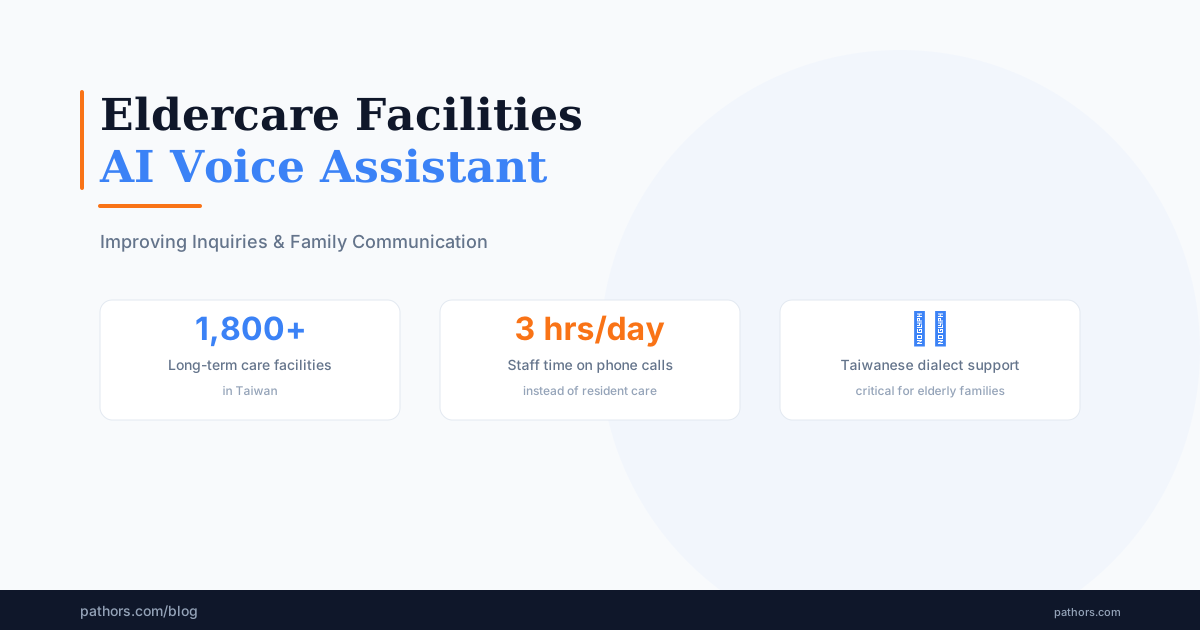
Director Chen runs a 120-bed long-term care facility in Taoyuan. Every morning, before she even checks on residents, she's already fielding phone calls. How much does a shared room cost? Is there availability for someone with mild dementia? Do you accept patients on ventilators? By her own count, she spends over three hours a day answering the phone — time pulled directly away from the people she built this facility to care for. Her story is far from unique. Across Taiwan's eldercare sector, the phone is both the most important communication channel and the biggest operational bottleneck.
The Communication Challenge in Eldercare
Taiwan's aging population is accelerating faster than almost any country on Earth. The national elderly population surpassed 4.08 million in 2024, representing over 17.5% of the total population, and the government projects Taiwan will become a "super-aged" society by 2026 with over 20% of citizens aged 65 or above. To serve this growing need, Taiwan now operates more than 1,800 registered long-term care facilities — yet the average staff-to-resident ratio hovers around 1:8 during daytime shifts and drops to 1:15 at night.
This staffing reality creates a painful communication gap. Families considering placement for an aging parent have dozens of questions. They call multiple facilities, often during lunch breaks or between meetings, and expect immediate answers. Meanwhile, families of current residents want regular updates — Did mom eat today? How was her physical therapy session? — but calling during business hours conflicts with their own work schedules.
The result: front-desk staff and facility directors become full-time phone operators. A 2023 survey by the Taiwan Long-Term Care Professional Association found that administrative staff at care facilities spend an average of 2.7 hours per day on phone-based inquiries, with 68% of those calls covering the same 15 to 20 questions. That's time not spent on care coordination, compliance documentation, or the hundred other tasks that keep a facility running safely.
What AI Voice Can Handle for Eldercare Facilities
AI voice assistants excel precisely where eldercare communication breaks down: high-volume, repetitive, time-sensitive calls that don't require clinical judgment.
We see four primary use cases when working with eldercare clients:
Admission Inquiry Automation
The majority of first-contact calls follow a predictable pattern. Callers want to know about room types and pricing, accepted care levels (independent living vs. skilled nursing vs. memory care), insurance and subsidy eligibility, and visiting policies. An AI voice agent can walk callers through these details conversationally, answer follow-up questions, and — critically — capture the caller's contact information and care needs for staff follow-up. Facilities using automated intake report handling 40-60% of initial inquiry calls without human intervention, based on data from comparable healthcare service deployments across Asia-Pacific markets.
FAQ and Policy Questions
What documents do we need for admission? Can we bring personal furniture? What's the meal schedule? These questions have fixed answers that rarely change. Training an AI voice agent on a facility's FAQ library takes days, and the system can deliver consistent, accurate answers 24 hours a day.
Appointment and Tour Scheduling
Families evaluating facilities want to visit in person. Coordinating tour schedules by phone is a classic back-and-forth time sink. AI voice agents integrated with calendar systems can offer available slots, confirm bookings, and send reminders — reducing no-show rates by an estimated 25-35% compared to manual scheduling.
Family Status Updates
This is where AI voice creates the most emotional value. Families can call at any hour and receive a summary of their loved one's day — meals consumed, activities participated in, any notable observations logged by care staff. The AI pulls from the facility's care management system and delivers updates in natural speech. No more waiting until business hours. No more feeling guilty about "bothering" the staff.
The Language Factor: Why Taiwanese Dialect Support Matters
Here is a detail that any eldercare operator in Taiwan understands instinctively but that most technology vendors overlook: the families making these calls often include elderly spouses or siblings who are most comfortable speaking Taiwanese Hokkien.
According to a 2022 national language survey, approximately 66% of Taiwanese residents over age 65 use Taiwanese Hokkien as their primary daily language. When a 78-year-old wife calls to ask about her husband's care, she may struggle with a Mandarin-only system — or simply hang up. This isn't a nice-to-have feature. It's a fundamental accessibility requirement.
Pathors' AI voice platform supports Taiwanese Hokkien as a first-class language, not a bolted-on afterthought. The system detects the caller's language preference within the first few seconds of conversation and switches accordingly. Our Hokkien speech recognition model has been trained on over 12,000 hours of real conversational Taiwanese audio, achieving a character error rate under 8% — comparable to our Mandarin performance. For eldercare facilities, this means every family member can communicate naturally, regardless of their language background.
The bilingual capability also matters for a practical operational reason: many facility staff members switch between Mandarin and Hokkien multiple times in a single conversation. Code-switching is deeply embedded in Taiwan's eldercare communication culture, and the AI needs to handle it seamlessly.
Implementation: From First Call to Full Deployment
We've refined our eldercare deployment process based on work with facilities ranging from 50-bed community centers to 300-bed regional institutions. Here's what the timeline typically looks like:
Week 1-2: Discovery and Content Gathering
We collect the facility's FAQ documents, pricing sheets, admission policies, and common call transcripts. Our team identifies the top 20-30 call scenarios that represent 80%+ of inbound volume. We also map the facility's care management system to determine what resident data can be surfaced through the AI voice channel.
Week 3-4: Voice Agent Configuration and Training
The AI voice agent is configured with the facility's specific information, tone preferences, and escalation rules. We define clear boundaries: the AI handles informational queries and scheduling, but any call involving medical concerns, complaints, or emotional distress is routed to a human staff member immediately. Language models are fine-tuned with facility-specific terminology — every eldercare organization has its own way of describing services.
Week 5-6: Pilot and Calibration
The AI handles a subset of incoming calls (typically 30-40%) while staff monitor performance. We track completion rates, caller satisfaction, and escalation patterns. Most facilities see the AI successfully resolving 55-65% of calls during the pilot phase, with that number climbing as the system learns from real interactions.
Week 7-8: Full Deployment and Optimization
The AI takes on the full call volume with staff available for escalations. Ongoing analytics dashboards show call patterns, peak hours, most-asked questions, and resolution rates. Facilities typically report reclaiming 15-20 staff hours per week within the first month of full deployment.
The total implementation timeline of 6-8 weeks is designed around the reality that eldercare facilities can't disrupt operations for a technology rollout. Everything runs parallel to existing workflows until the team is confident in the system.
Getting Started with Pathors for Eldercare
If your facility is spending more time on the phone than with residents, that's a problem with a clear solution. Pathors' AI voice platform is purpose-built for Taiwan's eldercare environment — bilingual, compliant with local regulations, and designed to handle the specific communication patterns of family inquiry and resident update calls. Reach out to our team for a consultation tailored to your facility's size and needs.
Taiwan's eldercare facilities are caught between growing demand and limited staff. AI voice technology directly addresses the communication bottleneck — not by replacing the human connections that define quality care, but by handling the repetitive informational calls that consume staff time. With native Taiwanese Hokkien support and practical 6-8 week deployment timelines, this is technology built for how eldercare actually operates in Taiwan.
Pathors Team
Content Team
Passionate about leveraging AI technology to transform customer service and business operations.
Ready to Transform Your Call Center?
Schedule a personalized demo and see how Pathors can revolutionize your customer service
Pathors empowers businesses with intelligent voice assistant solutions, streamlining customer service, appointment management, and business consulting to enhance operational efficiency.
Backed by leading accelerators & programs