"AI is going to replace junior engineers" has been the tech industry's favorite anxiety narrative for the past year. But when we pull back from the panic and look at actual hiring data, the story is far more nuanced. Entry-level positions aren't vanishing — they're being fundamentally reshaped.
This article explores what companies are actually looking for in early-career talent now that AI handles much of the repetitive execution work, and what that shift means for engineers just starting out.
What the Data Actually Shows: Entry-Level Hiring Is Growing
A few signals worth paying attention to. According to advisory firm Teneo, 67% of global CEOs say AI is increasing entry-level headcount, not reducing it. IBM has announced plans to triple its US entry-level hiring in 2026. McKinsey is planning a 12% increase in North American hiring. IT consulting firm Cognizant is expanding early-career recruitment to include more liberal arts and non-STEM graduates.
Research from Yale's Budget Lab suggests that fears about AI displacing today's workforce remain largely speculative at this stage. And data from Citadel Securities shows software engineering job postings are up 11% year over year.
None of this means AI isn't impacting employment. The impact isn't a simple story of replacement — it's a story of transformation.
From Task Execution to Systems Understanding
IBM's VP of Global Talent Acquisition captured this shift well: as AI takes over routine coding and documentation, entry-level professionals are increasingly expected to think holistically — understanding systems end-to-end and validating AI outputs for quality and bias.
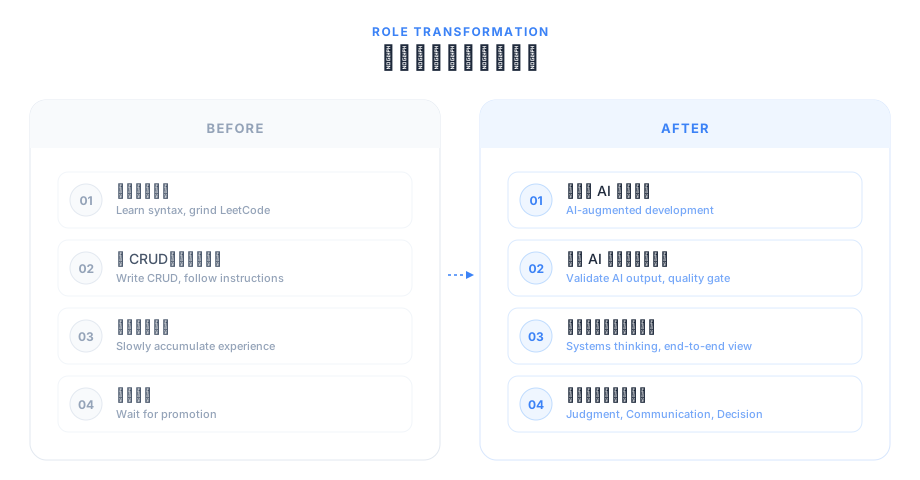
Entry-level roles are shifting from "pure task executors" to "AI collaborators and supervisors."
The skills companies now prioritize in early-career hires:
IBM CHRO Nickle LaMoreaux made a compelling point: "If we don't continue to invest in entry-level hires, what happens in 3-5 years? There's no pipeline; the well simply dries up." Companies don't need fewer junior hires — they need differently skilled junior hires.
What This Means for Engineers Starting Their Careers
The traditional career path was fairly linear: learn syntax, grind through coding challenges, get hired, write CRUD operations, and gradually accumulate experience. But when AI can generate most boilerplate code in seconds, being able to write code alone is no longer a competitive advantage.
The new starting playbook looks more like this:
1. Learn to collaborate with AI in development. This goes beyond knowing how to use Copilot or Claude Code. It means understanding when to delegate to AI, when to do things yourself, and how to validate AI output. Think of AI as a fast but unreliable teammate — your value lies in judgment and quality control.
2. Build system-level understanding earlier. With AI lowering the execution barrier, there's now an opportunity to engage with the full system picture much sooner. Actively seek to understand where your code fits in the larger system, not just the slice you're assigned.
3. Invest in soft skills sooner. Communication, problem decomposition, cross-team collaboration — capabilities that used to be considered "senior-level" are now expected earlier. When AI handles the bulk of execution work, human value concentrates in understanding requirements, making decisions, and coordinating with others.
The Same Shift Is Happening in Customer Service
An identical structural transformation is underway in the customer service industry. Traditional contact centers relied heavily on entry-level staff to handle repetitive calls and tickets. As AI voice assistants manage frontline standardized conversations, the role of customer service agents is evolving — from "answer the phone and follow the script" to "handle complex cases AI can't resolve, monitor AI conversation quality, and design better dialogue flows."
After adopting AI, companies don't stop needing service agents — they need agents with different capabilities. Understanding AI decision logic, identifying edge cases where AI fails, and finding process optimization opportunities from data — these are the core competencies for customer service professionals in the AI era.
AI's impact on entry-level roles is real, but the direction isn't elimination — it's transformation. Rather than anxiously asking "will AI take my job," a more constructive question is: in a world where AI can do more and more, what value can I provide that AI cannot?
The answer probably isn't "write faster code." It's "make better judgments."