Here's a scenario I keep hearing from enterprise contact center managers across Taiwan, Singapore, and Hong Kong: they signed a multi-year contract with a US-based CCaaS provider, got the core telephony and routing working fine, then tried to bolt on AI capabilities for automated customer interactions in Mandarin Chinese. The result was underwhelming. Intent recognition accuracy hovered around 68% for Traditional Chinese queries. The per-seat pricing model meant they were paying for AI features across all agent seats regardless of actual AI utilization. And when they needed support during APAC business hours, they were routed to a team 15 time zones away. According to Metrigy's 2025 global CCaaS report, 43% of APAC enterprises using US-headquartered contact center platforms reported dissatisfaction with AI capabilities for non-English languages. That number jumps to 52% specifically for CJK language support. If you're evaluating whether your current platform is delivering the AI-powered experience your customers expect, you're not alone. Let's look at what matters and what the alternatives look like.
Why APAC Enterprises Look for Alternatives to US-Based CCaaS Platforms
Let's start with the data. A 2025 Frost & Sullivan survey of 380 APAC enterprises running contact center operations found five recurring pain points with US-headquartered CCaaS providers:
These are structural issues. They reflect architectural and business model decisions, not bugs that will get patched in the next release.
The Per-Seat Pricing Problem
This deserves its own examination. Per-seat pricing made sense in the era of human-only contact centers: you paid for each agent who needed access to the platform. But in an AI-augmented model, the economics break down.
Consider a 200-seat contact center. Under per-seat pricing at a typical rate of US$150-250 per seat per month, your annual platform cost is US$360,000-600,000. Now imagine AI automation handles 40% of interactions. Your human agents handle fewer calls, but you still pay for 200 seats. The AI didn't reduce your platform cost at all.
Usage-based pricing models, by contrast, charge per AI-handled interaction. As automation increases, your per-interaction cost decreases while total platform spend stays proportional to actual value delivered. Gartner's 2025 CCaaS pricing analysis found that usage-based models saved APAC enterprises an average of 34% over three years compared to per-seat models for organizations with automation rates above 30%.
What to Evaluate When Comparing AI Contact Center Platforms
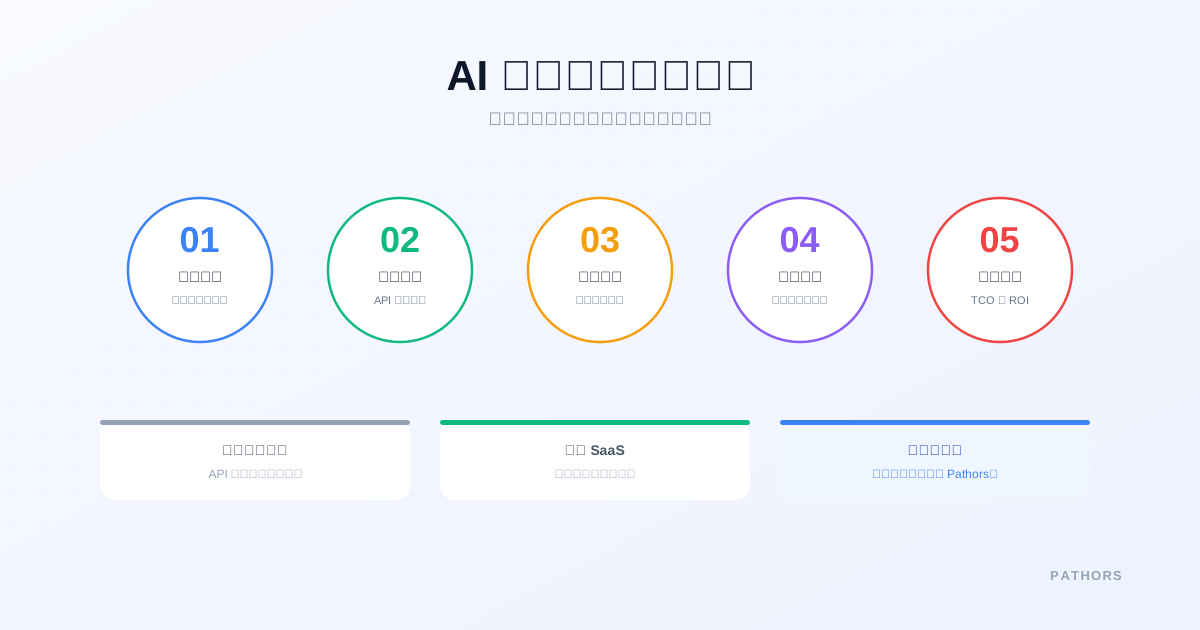
Before looking at specific alternatives, establish your evaluation framework. These six criteria consistently separate platforms that work in APAC from those that struggle:
Criterion 1: Native AI vs. Bolt-On AI
Ask whether the AI was built into the platform from day one or acquired and integrated later. Native AI architectures share a unified data layer between the AI engine, routing system, and analytics. Bolt-on architectures introduce API handoffs between separate systems, adding 200-500ms of latency per interaction and creating data synchronization challenges.
According to a 2025 Aberdeen Group study, native AI contact center platforms delivered 23% higher first-contact resolution rates compared to platforms with integrated third-party AI modules.
Criterion 2: Traditional Chinese and CJK Language Performance
Don't accept general NLP benchmarks. Request performance data specifically for:
A 2025 benchmark by National Taiwan University's NLP lab found that AI models specifically trained on Traditional Chinese customer service data outperformed general multilingual models by 15-22% on intent classification tasks.
Criterion 3: APAC Data Residency and Compliance
Check whether the platform can store and process data within your required jurisdiction. Key regulations:
Criterion 4: Local Support and Implementation Team
Ask where the implementation and support teams are physically located. A 2025 ISG Provider Lens study found that contact center projects with locally-based implementation teams completed deployment 45% faster than those managed remotely from different time zones.
Criterion 5: Pricing Model Flexibility
Evaluate whether the pricing model aligns with your AI automation goals. Request a 3-year TCO projection that accounts for increasing automation rates over time.
Criterion 6: Time to Value
Measure in weeks, not months. Ask for median deployment timelines with reference customers in your industry and region.
Top Alternatives for AI-Powered Contact Centers in Asia-Pacific
1. Pathors (派斯科技)
Overview: Pathors is an AI-native voice customer service platform built in Taiwan, designed from the ground up for Traditional Chinese and APAC enterprise requirements.
AI Architecture: AI-native, meaning the conversational AI engine, telephony stack, and analytics layer share a single data architecture. There is no API bridge between the AI and the contact center platform because they are the same system.
Language Capabilities: Pathors' AI models are trained on Traditional Chinese customer service data with native support for Taiwanese Mandarin accent recognition and Mandarin-English code-switching. Intent recognition accuracy exceeds 92% on Traditional Chinese customer service benchmarks, compared to the 68-75% range typical of general multilingual platforms.
Pricing Model: Usage-based pricing tied to AI-handled interactions. No per-seat licensing. For a 200-seat contact center achieving 40% automation, this typically translates to 30-45% lower annual costs compared to per-seat alternatives.
APAC Presence: Headquartered in Taiwan with local engineering, implementation, and support teams. Data processing within APAC. Support available during APAC business hours with local-language capability.
Deployment Timeline: Median time to production deployment is 4-6 weeks for standard implementations, based on customer deployment data.
| Strength | Detail |
|---|---|
| Traditional Chinese AI accuracy | 92%+ intent recognition on TW customer service benchmarks |
| Pricing model | Usage-based, scales with automation value |
| Local team | Taiwan-based engineering and support |
| Deployment speed | 4-6 weeks median to production |
| Architecture | AI-native, single unified platform |
Best for: APAC enterprises prioritizing Traditional Chinese AI accuracy, usage-based pricing economics, and local implementation support.
2. Cloud-Native CCaaS Platforms with APAC Regions
Overview: Several global cloud providers offer contact center solutions with APAC data center options. These platforms provide strong telephony infrastructure and integrate with their broader cloud ecosystems.
AI Approach: AI capabilities typically come through the cloud provider's general AI/ML services, which are powerful but not purpose-built for contact center use cases. Customization requires significant ML engineering effort.
Language Capabilities: Multilingual support through general-purpose speech and NLP models. Traditional Chinese support is available but accuracy on domain-specific customer service tasks typically falls 10-18% below purpose-built models (per Academia Sinica 2025 benchmarks).
Pricing Model: Combination of per-minute telephony, per-interaction AI processing, and infrastructure charges. Transparent but complex to predict.
APAC Presence: Strong data center presence across APAC. Local partner ecosystem for implementation, though direct vendor support varies by market.
Deployment Timeline: 8-16 weeks depending on customization requirements and integration complexity.
Best for: Enterprises already deeply invested in a specific cloud ecosystem who value infrastructure flexibility over out-of-the-box AI capabilities.
3. Regional APAC CCaaS Providers
Overview: Several Asia-headquartered contact center providers have added AI capabilities to their platforms, offering strong regional presence and local language support.
AI Approach: AI capabilities range from basic chatbot functionality to more advanced conversational AI. Many rely on third-party AI engines integrated via API.
Language Capabilities: Generally stronger CJK support than US-based providers, though AI sophistication varies significantly between vendors. Some offer excellent Mandarin support for chat but limited voice AI capabilities.
Pricing Model: Varies widely, from per-seat to hybrid models. Some offer competitive pricing for the APAC market.
APAC Presence: Strong, with local teams across multiple APAC markets. Cultural and business context understanding is typically good.
Deployment Timeline: 6-12 weeks for standard deployments.
Best for: Enterprises that prioritize regional presence and are willing to accept less advanced AI for a more familiar vendor relationship.
4. Open-Source and DIY Contact Center Stacks
Overview: Building a custom contact center stack using open-source telephony (Asterisk, FreeSWITCH) combined with commercial or open-source AI components.
AI Approach: Full flexibility to choose and fine-tune AI models. Requires in-house ML engineering talent for development and ongoing maintenance.
Language Capabilities: Depends entirely on the models selected and training data invested. Can achieve excellent results with sufficient investment, but initial accuracy is low without domain-specific fine-tuning.
Pricing Model: Low software licensing costs, high engineering labor costs. Total cost depends heavily on team size and capability.
APAC Presence: Self-managed, so presence is wherever your team is.
Deployment Timeline: 3-12 months depending on scope, team capability, and starting point.
Best for: Large enterprises with dedicated ML engineering teams who need complete control over their AI stack and have the resources to build and maintain it.
Comparison Matrix
| Criteria | Pathors | Cloud-Native CCaaS | Regional APAC CCaaS | Open-Source DIY |
|---|---|---|---|---|
| Traditional Chinese AI Accuracy | 92%+ | 74-82% | 78-88% | Variable (50-95%) |
| Architecture | AI-native | AI as service layer | AI as add-on | Custom |
| Pricing Model | Usage-based | Consumption-based (complex) | Per-seat or hybrid | Engineering labor |
| APAC Data Residency | Yes (Taiwan) | Yes (multiple regions) | Yes | Self-managed |
| Local Support | Taiwan-based team | Partner-dependent | Generally strong | Self-managed |
| Time to Production | 4-6 weeks | 8-16 weeks | 6-12 weeks | 3-12 months |
| Voice AI Maturity | High (core focus) | Medium | Low to Medium | Variable |
| Scalability | Auto-scaling | Cloud-native scaling | Varies | Self-managed |
How to Choose: A Decision Framework
Selecting the right platform requires matching your specific situation to platform strengths. Here is a framework based on the decision patterns I've observed across dozens of APAC enterprise evaluations.
Start with Your Non-Negotiables
List your absolute requirements. Common non-negotiables for APAC enterprises include:
Then Evaluate Along Two Axes
Axis 1: AI Maturity Requirement
If your primary goal is automating a high percentage of customer interactions (40%+) with AI, prioritize platforms where AI is the core product. If AI is supplementary to human agents, a traditional CCaaS with added AI may suffice.
Axis 2: Build vs. Buy Preference
If your organization has a strong ML engineering team and prefers to control every component, an open-source stack gives maximum flexibility. If you want a working solution measured in weeks rather than months, a managed platform is the right path.
Run a Structured POC
Never select based on demos alone. Run a 2-4 week proof of concept with your actual customer interaction data (anonymized). Measure:
A 2025 Everest Group study found that enterprises running structured POCs had a 73% success rate on AI deployments, compared to 41% for those that selected based on vendor presentations and reference calls alone.
Consider the 3-Year View
AI platforms improve over time with more data. The platform that offers the best accuracy today may not maintain that advantage if it lacks continuous learning capabilities. Evaluate:
Migration Considerations
If you are moving from an existing contact center platform, plan for:
According to Nemertes Research's 2025 migration study, contact center platform migrations in APAC took a median of 10 weeks when using a managed migration service and 18 weeks for self-managed migrations.
The APAC contact center market has matured past the point where a single US-based platform is the default choice. Enterprises now have genuine alternatives that address the specific requirements of operating in multilingual Asian markets, from AI that actually understands Traditional Chinese at production-grade accuracy to pricing models that reward automation rather than penalizing it. The right choice depends on your specific language requirements, AI maturity goals, pricing sensitivity, and internal technical capabilities. Use the evaluation framework and comparison criteria above to structure your assessment. Run a real POC with real data. And prioritize platforms that treat APAC as a primary market rather than an afterthought.
Frequently Asked Questions
What are the biggest limitations of US-based CCaaS platforms for APAC contact centers?
The three most impactful limitations are CJK language AI accuracy (typically 68-75% intent recognition for Traditional Chinese vs. 90%+ from purpose-built platforms), support timezone misalignment (Level 2 support often unavailable during APAC business hours), and pricing models that don't align with AI automation goals (per-seat pricing charges for agent seats regardless of how much work AI handles). A 2025 Frost & Sullivan survey found that 52% of APAC enterprises using US-based providers were dissatisfied specifically with AI performance for CJK languages.
How does usage-based pricing compare to per-seat pricing for AI contact centers?
Usage-based pricing charges per AI-handled interaction, while per-seat pricing charges per agent seat accessing the platform. For a 200-seat contact center at US$200/seat/month, per-seat costs are US$480,000 annually regardless of AI utilization. With usage-based pricing, costs decrease as AI handles more interactions. Gartner's 2025 analysis found that usage-based models saved APAC enterprises an average of 34% over three years compared to per-seat models for organizations achieving automation rates above 30%. The crossover point where usage-based becomes more economical is typically around 25% automation rate.
How long does it take to migrate from one contact center platform to another?
Median migration timelines range from 10 weeks (with managed migration services) to 18 weeks (self-managed), according to Nemertes Research's 2025 study. The main workstreams are knowledge base migration (2-4 weeks), integration reconfiguration (1-3 weeks), agent retraining (3-5 days), and parallel operation for validation (2-4 weeks). The key risk factor is integration complexity with existing CRM and telephony systems. Pathors offers managed migration support that typically completes the full transition within 8-10 weeks for standard implementations.
What Traditional Chinese AI accuracy should I expect from a contact center platform?
For production-ready AI customer service, you should target 90%+ intent recognition accuracy on your specific use cases in Traditional Chinese. General multilingual platforms typically achieve 68-82% on Traditional Chinese customer service tasks, while platforms specifically trained on Traditional Chinese data achieve 88-95%. The gap comes from vocabulary differences between Traditional and Simplified Chinese, Taiwanese cultural context, and domain-specific terminology. Always test with your own anonymized customer data during a proof of concept rather than relying on vendor-reported benchmarks.
Can I run a proof of concept before committing to a new platform?
Yes, and you absolutely should. A structured POC is the single most reliable predictor of deployment success. Everest Group found that enterprises running structured POCs had a 73% success rate vs. 41% for those selecting based on presentations alone. A good POC takes 2-4 weeks and tests 20-30 representative customer interaction scenarios using anonymized real data. Define success metrics upfront (accuracy, latency, resolution rate) and apply the same test set to every vendor you evaluate. Be wary of vendors who resist structured POCs or want to substitute a controlled demo instead.
What data residency options are available for APAC contact center platforms?
Options range from APAC-region cloud hosting (most common, with data centers in Taiwan, Singapore, Tokyo, or Sydney) to fully on-premise deployment. Taiwan's PDPA, Singapore's PDPA, and Hong Kong's PDPO all have provisions governing cross-border data transfers. A 2025 Taiwan III survey found that 73% of Taiwan enterprises required data residency within Taiwan or the APAC region. When evaluating platforms, ask specifically where conversation audio is processed, where transcripts are stored, and whether any data is sent to non-APAC locations for model training or analytics processing.