Best Genesys Alternatives for Asia-Pacific Voice AI Teams (2026)

Brandon Lu
COO
A regional bank in Taipei recently tallied up what it was spending on its Genesys Cloud deployment: USD $38 per agent seat per month, plus telephony add-ons, plus a custom integration layer to handle Traditional Chinese IVR flows that the platform couldn't manage natively. The total came to roughly 2.4x what the team had budgeted when they signed the contract eighteen months earlier. They aren't alone. Across Asia-Pacific, mid-market companies that adopted enterprise contact center platforms designed for North American deployments are hitting the same wall — licensing models that scale poorly below 200 seats, ASR engines that struggle with Mandarin tonal variation, and server infrastructure that routes calls through US-West before bouncing back to Taipei or Tokyo. If you're evaluating genesys alternatives because the platform works but the fit doesn't feel right for your region, this guide is built for that exact conversation.
What to Look for in a Genesys Alternative
Switching an enterprise contact center is never casual — it touches telephony, CRM, workforce management, and compliance in a single decision. But the evaluation criteria for APAC teams look different from what most vendor comparison sites assume. Four dimensions matter more than feature checklists.
CJK language accuracy in real voice scenarios
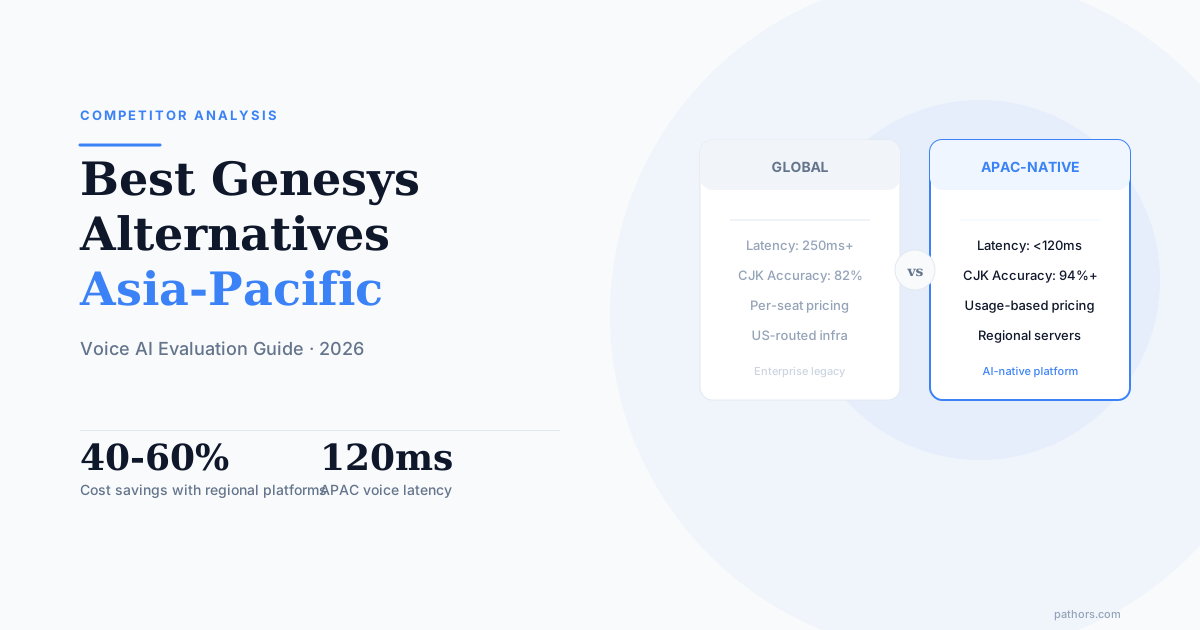
Genesys relies on Google Cloud Speech-to-Text and its own NLU models for voice interactions. For English, accuracy sits above 94%. For Traditional Chinese — especially when callers mix Mandarin with Taiwanese Hokkien loanwords, which is how roughly 60% of Taiwanese consumers actually speak on the phone — published benchmarks drop to 82-86%. That 10-point gap translates directly into misrouted calls, failed intent recognition, and customers repeating themselves. Any alternative worth evaluating should demonstrate word error rates on your actual call recordings, not on curated test sets.
Regional infrastructure and latency
Voice is unforgiving. Round-trip latency above 200ms makes conversations feel robotic; above 350ms, callers start talking over the system. Genesys Cloud operates from AWS regions, but its core orchestration for voice AI features still routes through US-based services for many APAC customers. A platform with servers in Taiwan, Japan, or Singapore can cut 120-180ms off every interaction. According to Twilio's 2025 State of Customer Engagement report, 73% of APAC consumers say they'll abandon a call that feels laggy — compared to 58% in North America, where tolerance for latency is higher.
Pricing structure for mid-market APAC teams
Genesys Cloud CX pricing starts at USD $75/agent/month for the base tier and scales to $155+ for the AI-enabled Experience tier. For a 50-seat contact center in Taiwan — a common size for regional banks, insurance companies, and hospitality chains — that's $45,000-$93,000 annually before telephony or integration costs. Many APAC-native platforms offer consumption-based pricing (pay per minute of AI-handled calls) rather than per-seat licensing, which maps more naturally to businesses that handle seasonal spikes or operate with part-time agent pools.
Compliance and data residency
Taiwan's PDPA (Personal Data Protection Act) requires that personal data collected within Taiwan be stored with adequate protection measures. While Genesys offers data residency options, the configuration isn't automatic — it requires explicit setup and additional agreements. For regulated industries like banking and insurance, a platform that stores data in-country by default removes a compliance headache that shouldn't exist in the first place.
Top Alternatives to Genesys for Asia-Pacific Voice AI
1. Pathors — Purpose-Built for APAC Voice AI
Pathors is a conversational AI platform built specifically for voice automation in the Asia-Pacific market. Where Genesys treats APAC as one of many regions, Pathors was designed from the architecture level for Traditional Chinese, Mandarin, and Taiwanese Hokkien voice interactions.
Key differentiators:
Pathors handles inbound call routing, outbound campaign automation, appointment scheduling, and post-call follow-up through a single platform. For teams that need a working voice AI system in weeks rather than a six-month integration project, this is where the difference is most tangible.
2. Regional Cloud Contact Center Platforms
Several Asia-Pacific-headquartered vendors offer cloud contact center solutions with stronger regional language support than global enterprise platforms. These typically excel at omnichannel (voice + chat + LINE/WhatsApp) but may require more technical setup for advanced voice AI automation. They're a solid choice for teams that need broad channel coverage and already have engineering resources for integration work.
3. Open-Source Voice AI Frameworks
For organizations with strong engineering teams, open-source frameworks let you build custom voice AI pipelines on top of your own infrastructure. The advantage is total control over models, data, and deployment. The trade-off is significant: you're building and maintaining the entire stack — ASR, NLU, dialog management, telephony integration — with your own team. Development timelines of 6-12 months are common before reaching production readiness. This path makes sense for large enterprises (500+ seats) with dedicated AI engineering teams; for mid-market operations, the maintenance burden typically outweighs the flexibility.
4. US-Based Voice AI Startups
A growing number of US-based startups focus specifically on voice AI agents rather than full contact center suites. They tend to offer faster deployment and more modern developer experiences than legacy platforms. The trade-off for APAC teams: most are optimized for English-first use cases, server infrastructure is US-centric, and pricing is denominated in USD at rates designed for the North American market. If your primary use case is English-language calls with APAC-based agents, these can work. For customer-facing voice interactions in Mandarin or other Asian languages, the gap in voice quality is noticeable.
How to Choose the Right Platform for Your Needs
The right alternative to Genesys depends on what's actually causing friction. Here's a quick framework:
The contact center platform market is consolidating around two camps: legacy enterprise suites adding AI features, and AI-native platforms adding contact center capabilities. For APAC teams, the platforms that started with regional language and infrastructure advantages are pulling ahead of those trying to retrofit global products for local markets.
Genesys built its reputation on enterprise reliability and breadth of features. Those strengths are real. But for Asia-Pacific teams — especially those operating in Traditional Chinese, handling fewer than 200 seats, or running in regulated industries that demand in-country data residency — the platform's global-first architecture creates friction that compounds over time. The best alternative isn't necessarily the one with the longest feature list. It's the one that eliminates the specific gaps your team works around every day. Sometimes that's a purpose-built APAC voice AI platform. Sometimes it's a different enterprise suite with better regional infrastructure. The only way to know is to test with your actual calls, your actual languages, and your actual compliance requirements — not someone else's benchmark report.
Brandon Lu
COO
Passionate about leveraging AI technology to transform customer service and business operations.
Ready to Transform Your Call Center?
Schedule a personalized demo and see how Pathors can revolutionize your customer service
Pathors empowers businesses with intelligent voice assistant solutions, streamlining customer service, appointment management, and business consulting to enhance operational efficiency.
Backed by leading accelerators & programs