How Hotels Use AI Voice Assistants for Booking Inquiries, Check-in Updates, and Guest Follow-ups

Brandon Lu
COO
It's 2 PM on a Friday at a 120-room hotel in Taichung. The front desk phone has been ringing non-stop since noon — a mix of guests asking about weekend availability, corporate travel managers confirming group bookings, and a couple who checked out yesterday wanting to know if they left a charger behind. The front desk team of three is simultaneously checking in early arrivals, handling a billing dispute, and trying to answer calls between guests standing right in front of them. By 5 PM, the call log shows 47 incoming calls. Fourteen went to voicemail. Nobody will call back those fourteen voicemails tonight, and by Monday, those potential guests will have booked somewhere else. This is the arithmetic of hotel front desk operations — and it's where AI voice assistants are starting to change the math.
The Three Phone Calls Hotels Can't Afford to Miss
Not every call to a hotel front desk carries the same commercial weight. Three categories account for roughly 75% of revenue-impacting calls, and each has a different automation profile.
Booking inquiries and availability checks
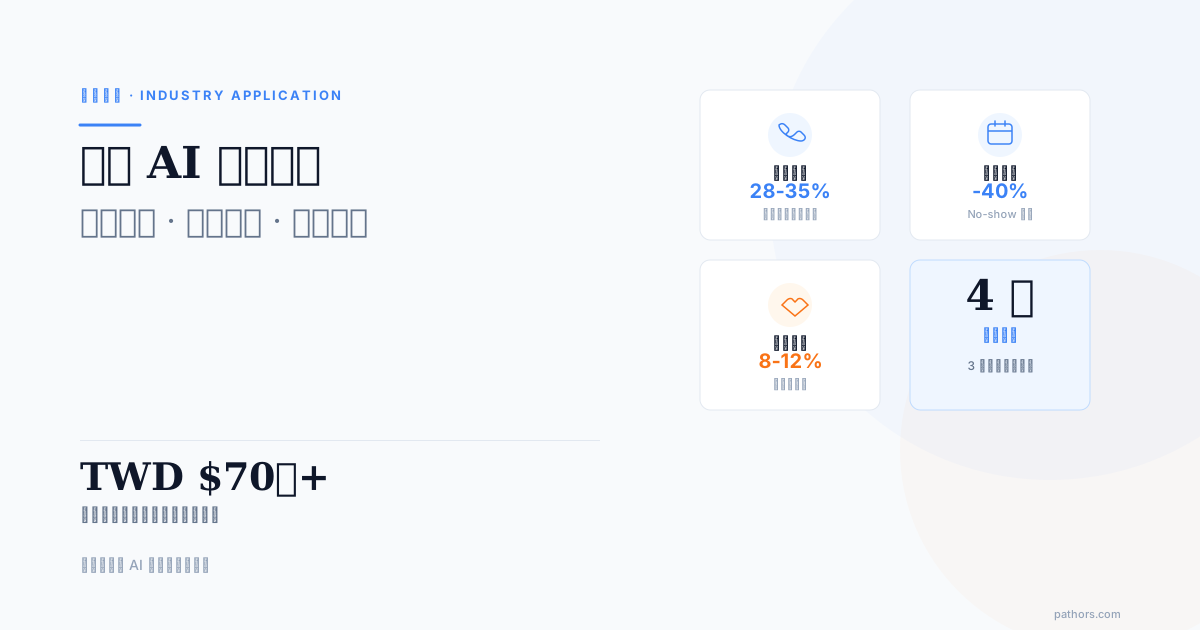
According to STR's 2025 Asia-Pacific Hotel Performance data, direct phone bookings still account for 28-35% of reservations for independent and regional chain hotels in Taiwan — a number that's actually increased since 2023 as travelers push back against OTA fees. Each booking inquiry call that goes unanswered or hits voicemail has a direct revenue cost. A 120-room hotel with an average daily rate of TWD $4,500 losing just 3 bookings per week to missed calls is leaving roughly TWD $700,000 per year on the table. More than the revenue, though, is the timing. A guest calling to ask about next weekend's availability is making a decision right now. If the answer comes four hours later via a returned voicemail, the window has closed.
An AI voice assistant handles this interaction in real-time: it checks the property management system for availability, confirms room types and rates, and can either complete the booking or transfer to a human agent for complex requests — all while the front desk team focuses on guests who are physically present.
Pre-arrival confirmation and check-in coordination
No-shows cost the Taiwan hospitality industry an estimated TWD $2.8 billion annually, according to the Taiwan Hotel Association's 2025 industry report. For individual properties, no-show rates typically range from 5-12%, with higher rates during holiday periods when guests book multiple hotels as backup. A pre-arrival confirmation call 24-48 hours before check-in reduces no-shows by 35-45% — but most hotels don't make these calls consistently because the front desk simply doesn't have the bandwidth.
AI voice assistants excel at this kind of systematic outbound communication. The system calls confirmed guests, verifies their arrival plans, collects check-in preferences (early check-in requests, bedding configurations, airport transfer needs), and flags cancellations so the revenue team can resell rooms before the booking window closes. One boutique hotel chain in Hualien reported that implementing automated pre-arrival calls reduced their no-show rate from 11% to 4.2% within the first quarter — recovering approximately TWD $180,000 per month in rooms that would otherwise have gone empty.
Post-stay follow-up and guest recovery
The 48 hours after checkout are the highest-leverage window for guest relationship management, but almost no mid-tier hotel in Taiwan systematically contacts guests after departure. A post-stay call that asks about the experience, handles any unresolved issues, and mentions the loyalty program or a return-stay offer converts at 8-12% for repeat bookings — compared to 2-3% for email follow-ups that get buried in inboxes. For a hotel averaging 70% occupancy, that difference in conversion rate translates to 15-25 additional direct bookings per month.
AI voice assistants make this economically viable by automating the calls entirely. The system reaches out 24-48 hours after checkout, conducts a brief satisfaction check, routes complaints to the guest relations team for immediate resolution, and delivers a personalized return offer. The key insight is that guests who receive a post-stay call — even an automated one — rate their overall experience 0.4 points higher on review platforms than those who don't. In an industry where a 0.1-point rating difference on Google Maps affects booking conversion by 5-9%, that's not a courtesy call — it's a revenue strategy.
What a Hotel AI Voice System Actually Handles
The practical scope of hotel voice AI goes beyond answering phones. Here's what a configured system manages across the guest lifecycle:
The common pattern: AI handles the structured, repetitive interactions that consume front desk bandwidth. Humans handle the exceptions, the relationship-building, and the complex problem-solving that guests actually want a person for.
Implementation: What It Takes to Go Live
Hotel voice AI implementation isn't a six-month IT project. For a focused deployment covering the top three use cases (booking, pre-arrival, post-stay), the typical timeline looks like this:
Week 1-2: Connect to the property management system (PMS) and configure availability/booking logic. Most modern cloud-based PMS platforms (the ones used by 70% of Taiwan's independent hotels, according to a 2025 TTHA survey) offer API access that the AI platform can integrate with directly.
Week 3: Script the conversation flows. This is where domain knowledge matters — a hotel booking conversation has different branching logic than a clinic appointment. Room type availability, rate tiers, cancellation policies, and add-on services all need to be mapped. Pathors provides pre-built hotel conversation templates that cover 80% of standard scenarios, with customization for property-specific policies.
Week 4: Test with real calls (staff calling in with common guest scenarios), adjust response patterns, and go live with a parallel system — AI handles calls during off-peak hours first, then gradually expands to peak coverage as confidence builds.
The investment math for a 100-room hotel typically looks like: current front desk phone handling costs TWD $85,000-$120,000 per month (1.5-2 FTE dedicated to phones), AI voice system costs TWD $15,000-$30,000 per month depending on call volume. Payback period is usually under 3 months, with the real ROI coming from recovered missed calls and reduced no-shows rather than headcount reduction.
Hotel front desks have been solving a math problem that doesn't have a human-only solution — handling 200+ calls per day with a team sized for 50. The interesting shift isn't that AI can answer phones. It's that AI can handle the three specific call types (booking, confirmation, follow-up) that have the most direct impact on revenue, while freeing the front desk team to do what they're actually best at: making guests feel welcomed when they walk through the door. The hotels that figure this out first won't just save on labor costs. They'll book more rooms, have fewer no-shows, and build guest relationships that OTAs can't replicate — because they actually called back.
Brandon Lu
COO
Passionate about leveraging AI technology to transform customer service and business operations.
Ready to Transform Your Call Center?
Schedule a personalized demo and see how Pathors can revolutionize your customer service
Pathors empowers businesses with intelligent voice assistant solutions, streamlining customer service, appointment management, and business consulting to enhance operational efficiency.
Backed by leading accelerators & programs