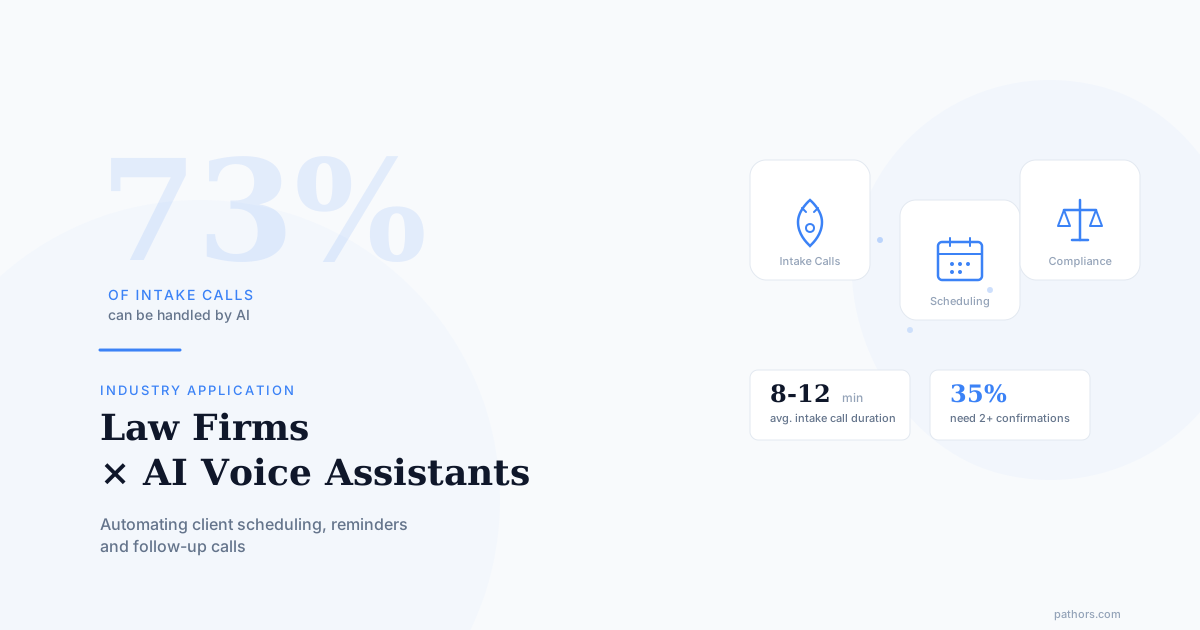
It's 6:47 PM on a Tuesday. A potential client — let's call her Sarah — has just been served divorce papers. She's distressed, she needs legal help, and she picks up her phone to call the first family law firm that appears in her search results. The phone rings six times. No answer. She moves on to the next listing. For thousands of small and mid-size law firms across the United States, Canada, and Australia, this scenario plays out dozens of times every week. The problem isn't indifference — it's economics. Hiring a dedicated intake coordinator costs between $45,000 and $65,000 annually, and even the best front-desk staff can only handle one call at a time. The average legal intake call runs 8 to 12 minutes, covering conflict checks, appointment scheduling, and basic case information. An AI voice assistant responds in under two seconds, around the clock, every day of the year — and it never puts a prospective client on hold.
The Real Cost of Answering Phones at a Law Firm
Front-desk staffing is one of the most underexamined cost centers in legal practice management. A typical small-to-mid-size law firm with three to eight attorneys fields between 40 and 90 inbound calls per day, spanning everything from new client inquiries to scheduling changes, document status checks, and billing questions. When you break down where those calls go, the picture becomes expensive quickly.
According to a 2023 legal operations survey by the Legal Executive Institute, 35% of initial consultation bookings require two or more confirmation rounds before the appointment is actually locked in — a back-and-forth that consumes receptionist time, creates scheduling errors, and frustrates prospective clients who expected a faster resolution. Each of those confirmation cycles averages an additional 4 to 6 minutes of staff time.
The math compounds further when you account for after-hours inquiries. Studies consistently show that 42% of legal service searches happen outside standard business hours — evenings and weekends, precisely when potential clients have time to address personal legal matters. A firm without after-hours coverage is invisible during those windows, handing those leads directly to competitors who have solved the availability problem.
Beyond staffing costs, there is a measurable conversion impact. Legal intake research suggests that firms responding to a new inquiry within five minutes are 21 times more likely to qualify that lead than firms that respond after 30 minutes. When the response window stretches to the next business day — as it often does for after-hours calls — conversion rates drop precipitously.
For a firm billing at $300 to $500 per hour, a single lost client engagement can represent $3,000 to $15,000 or more in lost revenue over the life of the matter. The front desk, often treated as an administrative overhead line, is in practice a direct revenue gate.
How AI Voice Assistants Fit Into Law Firm Workflows
The most effective implementations of AI voice technology in legal settings are not about replacing human judgment — they are about eliminating the repetitive, schedulable, and confirmable tasks that consume disproportionate amounts of staff time. There are four primary workflow categories where AI voice assistants deliver consistent value.
Initial Consultation Booking
When a prospective client calls, the AI voice assistant can handle the full intake sequence: greeting the caller, confirming the nature of their legal matter (family law, personal injury, estate planning, etc.), checking available attorney slots in real time, offering two or three specific appointment times, and confirming the booking — all within three to five minutes. The caller receives an immediate SMS or email confirmation, and the appointment appears directly on the attorney's calendar. No message-taking. No callbacks. No scheduling lag.
This single application alone can recapture 15 to 20 hours of receptionist time per month in a firm fielding 50 or more daily calls, time that can be redirected toward higher-value client-facing tasks.
Consultation Reminders and Confirmation Outreach
No-show rates for initial legal consultations run between 18% and 25% at many firms, representing a direct revenue loss for every blocked hour that goes unbilled. An AI voice assistant can automate a two-stage reminder sequence — a call or message 48 hours before the appointment and again two hours before — with the ability to accept cancellations, offer reschedules, or escalate to a human if the client has questions. Firms that implement automated reminder sequences typically see no-show rates drop to under 8%.
Case Progress Notifications
Existing clients generate a significant volume of status-check calls — "Has my petition been filed?" "What's the status of my settlement offer?" — that are necessary for client satisfaction but low in complexity. An AI assistant integrated with the firm's case management system can proactively call clients when a defined milestone is reached (filing confirmed, court date set, document received), reducing inbound status inquiries by 30% to 40% based on early adopter data from firms using automated outreach tools.
Fee and Document Reminders
Outstanding invoices and missing client documents are two of the most common sources of case delay and cash flow friction in legal practice. AI voice assistants can deliver polite, scheduled payment reminders and document request follow-ups without any staff involvement. These calls can be programmed with firm-specific language, escalation triggers (if payment is not received within X days, route to billing staff), and compliance-appropriate disclosures — all without a human dialing a single number.
3 Legal Compliance Questions to Address Before Deployment
Law firms operate under professional responsibility rules that make compliance diligence especially important before deploying any automated client communication tool. The good news is that AI voice assistants are entirely compatible with legal practice requirements when the implementation is properly structured. Here are the three most critical questions to resolve before going live.
1. Are your privacy disclosures current and caller-facing?
In the United States, the attorney-client relationship creates confidentiality obligations that attach early in the intake process — sometimes from the first substantive conversation. Your AI voice assistant's opening script must clearly identify that the caller is interacting with an automated system representing the firm, not an attorney or paralegal. This disclosure protects both the prospective client (who might otherwise assume privileged communication has begun) and the firm (which could face bar complaints if the nature of the interaction is ambiguous). In Canada, PIPEDA and provincial privacy statutes impose similar transparency requirements. Australian firms must comply with the Privacy Act 1988 and applicable Australian Privacy Principles. All three jurisdictions require clear, upfront disclosure of automated data collection.
2. What are your recording notification obligations?
Call recording laws vary significantly by jurisdiction. In the United States, federal law requires one-party consent for call recording, but eleven states — including California, Florida, and Illinois — require all-party consent, meaning your AI system must explicitly notify callers that the call may be recorded and obtain acknowledgment before proceeding. Canada operates under similar all-party consent requirements in most provinces. Australia's Telecommunications (Interception and Access) Act requires party consent for recording. Any AI voice deployment must be configured to deliver jurisdiction-appropriate recording notices and, where required, capture consent before the substantive intake conversation begins.
3. What are your data retention and deletion obligations?
Call logs, transcripts, and intake data collected by an AI voice assistant constitute personal information under privacy law in all three jurisdictions. Law firms must be able to answer three questions: Where is this data stored? For how long is it retained? And can it be deleted upon client request? In jurisdictions with right-to-erasure provisions — increasingly common in Canadian provincial legislation and under the Australian Privacy Act review process — your vendor must be able to provide documented data deletion workflows. Ensure that any AI voice platform you deploy can produce a data processing agreement and a clear data residency disclosure before you sign a contract.
How Pathors Helps Law Firms Go Live
Pathors is designed specifically for professional services firms that need automation without compliance compromise. For law firm deployments, three capabilities are particularly central to a successful implementation.
Multi-Slot Booking with Real-Time Calendar Access
Pathors' scheduling engine connects directly to attorney calendars and presents callers with live availability — not a generic "we'll call you back" experience. Callers can select from multiple available time slots in a single call, receive immediate confirmation, and automatically trigger calendar holds for the relevant attorney. This eliminates the double-booking risk that plagues manual scheduling workflows and ensures that every confirmed appointment is actually achievable.
Attorney Calendar Integration
Pathors integrates with the major calendar and practice management platforms used by law firms, creating a bidirectional sync that keeps AI-booked appointments visible across the firm's existing systems. When an attorney marks time as unavailable, Pathors updates in real time, ensuring that callers are never offered slots that cannot be honored. Integration extends to reminder sequencing — appointment confirmations, pre-call reminders, and follow-up messages are all triggered automatically based on the confirmed calendar event.
Compliance Support Built Into the Platform
Pathors provides configurable compliance modules that allow law firms to define jurisdiction-specific disclosure scripts, recording consent flows, and data retention policies within the platform. Firms operating across multiple states or provinces can configure different compliance behaviors by area code or caller location. Data processing agreements are available as a standard part of the Pathors enterprise agreement, and data residency options allow firms to specify storage geography — an increasingly important requirement for Canadian and Australian practices subject to data localization expectations.
Firms that have deployed Pathors in legal intake contexts report onboarding timelines of two to four weeks from contract signature to live calls, with the majority of configuration time spent on script customization and calendar integration rather than technical infrastructure.
AI voice assistants are no longer an experimental technology for law firms — they are a practical operational tool that addresses one of the profession's most persistent pain points: the gap between when clients need help and when staff are available to respond. For small and mid-size firms competing in markets where response speed directly affects client conversion, automated intake and follow-up is increasingly a baseline expectation rather than a differentiator. The conversation about whether to automate is giving way to a more practical question: how quickly can you get started?
Frequently Asked Questions
Is an AI voice assistant suitable for law firms?
Yes — with the right configuration. AI voice assistants are well-suited to intake and scheduling functions that consume significant staff time without requiring legal judgment. Booking consultations, sending reminders, collecting basic case information, and following up on documents are ideal candidates for automation. AI voice assistants are not appropriate for providing legal advice, making representations about case outcomes, or handling conversations that require attorney-client privilege analysis.
How much does it cost?
Pathors pricing is structured around call volume and feature set. Entry-level plans for firms fielding under 500 calls per month typically start below the monthly cost of a single part-time receptionist. Mid-tier plans that include calendar integration, compliance modules, and case management connectivity are priced to deliver positive ROI within 60 to 90 days for most firms. Custom enterprise pricing is available for multi-location practices.
Will prospective clients know they're talking to an AI?
Yes, and they should. Pathors is configured to disclose the automated nature of every call at the outset — both because transparency is the right practice and because professional responsibility rules in most jurisdictions require it. Modern AI voice assistants are capable of natural, responsive conversation, and the majority of callers are comfortable with automated scheduling interactions when the system is efficient and the disclosure is clear.
What happens if a caller has a complex question the AI can't answer?
Pathors includes configurable escalation logic that routes calls to a human staff member or attorney when a caller's question falls outside the AI's defined scope. Escalation can be triggered by specific keywords, caller requests, or detected emotional signals. If no human is available, the system can offer a scheduled callback, take a detailed message, or provide next-steps information while flagging the interaction for urgent staff review.
How long does implementation take?
Most law firm deployments on the Pathors platform reach live call status within two to four weeks of contract signature. Implementation involves three phases: script development and compliance review (one week), calendar and case management integration (one to two weeks), and pre-launch testing with simulated call scenarios (three to five business days).
Can the AI handle calls in multiple languages?
Yes. Pathors supports multi-language call flows, which is particularly relevant for law firms serving diverse communities across major US, Canadian, and Australian urban markets. Language detection can be automatic based on caller preference, or firms can configure dedicated numbers for specific language lines. All compliance disclosures and consent flows are available in supported languages.