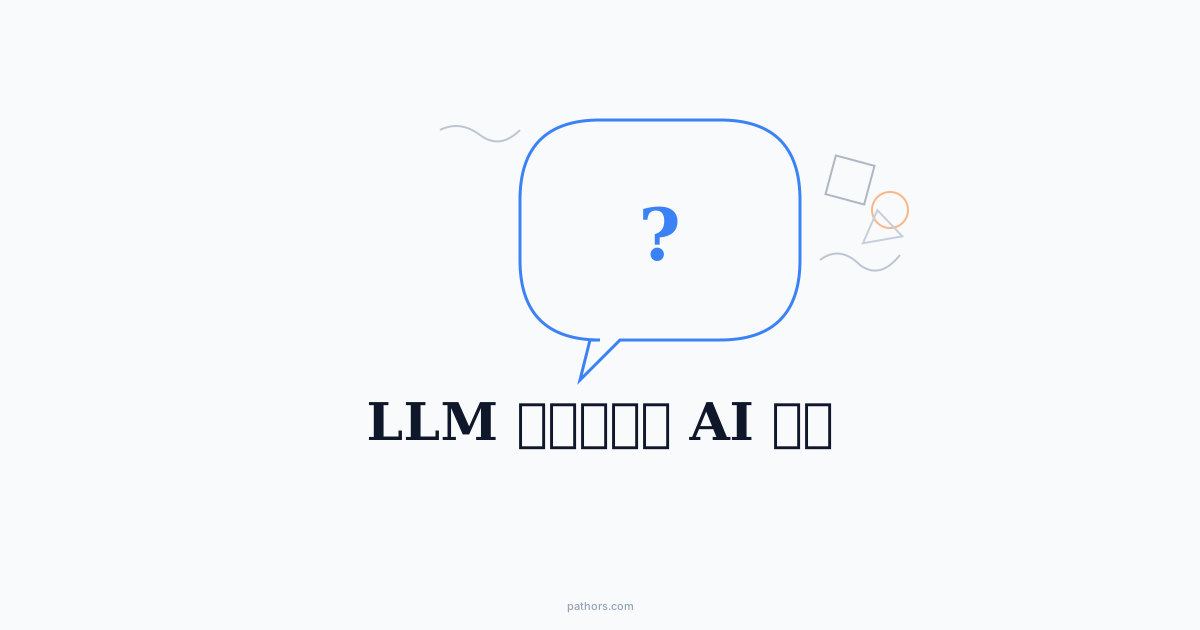
A customer asks about your return policy. The AI confidently replies: "You can return any item within 90 days for a full refund." The actual policy is 30 days, exchanges only. This is not a bug — it is an LLM hallucination, and in customer service it can trigger refund disputes, compliance violations, and brand damage at scale.
What Is an LLM Hallucination and Why Does It Happen?
Large language models generate text by predicting the most probable next token. They do not "know" facts — they pattern-match against training data. When the model encounters a query outside its training distribution or when multiple plausible answers exist, it fills in the gaps with confident-sounding but fabricated information.
In customer service, this manifests as:
Why CS Is Especially Vulnerable
Unlike creative writing or brainstorming, customer service demands factual accuracy. Every wrong answer has a concrete downstream cost — a wrongly promised discount must be honored, a fabricated shipping date erodes trust, a misquoted compliance policy could trigger regulatory action.
Strategy 1: Retrieval-Augmented Generation (RAG)
Instead of relying on the model's parametric memory, RAG forces the LLM to answer based on retrieved documents.
How it works
1. Customer query is converted into an embedding
2. The embedding searches a vector database of verified knowledge (product specs, policies, FAQs)
3. Top matching documents are injected into the prompt as context
4. The LLM generates a response grounded in those documents
Practical tips
Strategy 2: Output Guardrails and Validation
Even with RAG, the model can still hallucinate. A second layer of defense validates outputs before they reach the customer.
Approaches
Strategy 3: Confidence Scoring and Escalation
Not every query needs a generated answer. When the model is uncertain, it should say so — or escalate.
Implementation
1. Calculate a confidence score based on retrieval relevance and generation probability
2. Set thresholds: high confidence → auto-respond, medium → respond with caveat, low → escalate to human
3. Log all low-confidence interactions for review and training data collection
4. Track hallucination rate as a weekly metric alongside CSAT and containment rate
Strategy 4: Continuous Monitoring and Feedback Loops
Hallucinations are not a one-time problem to solve. They evolve as your product catalog, policies, and customer base change.
Build a feedback loop
Making Hallucinations Manageable
Zero hallucination is not achievable with current LLM technology. But a hallucination rate below 1% is — with the right architecture. The key is layered defense: ground the model with RAG, validate outputs with guardrails, escalate when uncertain, and continuously monitor performance.
The companies that succeed with AI customer service are not the ones with the most advanced models. They are the ones with the most disciplined engineering around those models.