Walk into a long-term care facility in Taiwan on any Tuesday morning and you will see three things on the shift lead's desk: a staffing roster, a family contact book, and a landline phone that rings constantly. Taiwan's Ministry of Health reported in 2025 that the average LTC facility fields 2.4 non-emergency calls per bed per week. For a 100-bed facility, that is more than 12,000 calls a year — wellness check-ins, medication reminders, family updates, follow-up appointment coordination. None of them are emergencies. Every one of them pulls a caregiver away from a resident for 6 to 10 minutes. In a facility with a standard 15-person care team, that is roughly 50 staff-hours per week on the phone — time that should have been at the bedside. This article walks through how LTC providers are using AI voice agents to turn wellness calls, family updates, and follow-up reminders from a time sink into a scheduled, trackable, measurable workflow.
The Real Pain Is Not Call Volume — It Is Timing
What shift leads actually complain about is not the thousands of weekly calls, it is that the calls land at the wrong time of day. In adult daycare, the two heaviest windows are 9:00–10:00 AM (families asking about residents, confirming pickup times) and 4:00–5:00 PM (appointment scheduling, end-of-workday family check-ins). Both windows coincide exactly with the highest caregiver workload — morning hygiene and meals, afternoon snacks and vital signs.
A daycare center in Taichung moved all non-emergency outbound calls during those windows to an AI voice agent. Scheduled "today's activity summary" calls to families, reverse-dial medication reminders to primary caregivers, automated follow-up appointment reminders 48 hours out. The result was concrete: caregiver interruptions during peak windows dropped from 4.2 per hour to 0.8. The shift lead called it the single highest-impact operational change in her twelve years in LTC.
The point is not that AI replaces human warmth. It is that AI returns a caregiver's attention to the resident. A caregiver sitting next to a resident is worth far more than the same caregiver holding a phone, telling the resident's daughter "your mother ate her lunch today."
Wellness Calls: From "No Time to Call" to "Consistent Weekly Contact"
Wellness calls are the most paradoxical category. Almost every facility knows they should check in with families regularly — sharing resident updates, new care plans, activity participation. In our interviews with 22 mid-sized facilities across northern and central Taiwan, fewer than 25% managed a genuine weekly call cadence.
The failure mode is not intent, it is scheduling. One 8-minute wellness call multiplied by 100 families equals 800 minutes per week — 13 staff-hours that nobody can carve out.
AI handles this scenario by pulling the week's resident data (activities attended, health metrics, meals, notable events) from the facility's internal system and delivering a natural-sounding summary call to each family. Families who want to dig deeper are routed automatically to the shift lead's callback queue. The lead only handles the 10–15% of conversations that actually need a human voice, not all 100.
A residential care home in New Taipei ran this workflow for three months. Family satisfaction scores moved from 73 to 89 (on a normalized 10-point scale), and renewal rates on annual contracts rose 12%. The shift lead's comment: "Families used to feel ignored. Now they feel cared for. I did not actually do more work — the AI just closed the 'keep them informed' gap we always knew was there."
Family Notifications: From Reactive to Proactive
Family notifications are more sensitive than wellness calls. Content typically covers incidents (falls, abnormal vitals, refusing meals) or administrative items (billing, legal paperwork, visitation policy changes). Plain text messages get ignored. Manual calls get delayed.
AI voice agents fit this scenario for two specific reasons. First, triage: incidents get handled by the shift lead personally, administrative notifications get handled by AI. Second, confirmation: AI outbound calls require verbal confirmation ("say 'received' or press 1"), automatically retry three times on no-answer, then fall back to SMS and paper mail with full logs.
This solves the classic "we called you" versus "I never got a call" dispute. We pulled data from a Kaohsiung nursing home: before AI notifications, "I did not receive the notice" family complaints averaged 4.3 per month. Six months in, the number dropped to 0.7, and every remaining case had a complete call log and voice recording available for review.
Follow-up Appointment Reminders: The Most-Missed Detail in LTC
Taiwan LTC residents average 1.8 follow-up appointments per month across chronic care, neurology, dentistry, and ophthalmology. Residents often cannot remember. Dual-income adult children forget. National Health Insurance Administration data from 2024 shows that LTC resident no-show rates are 2.3 times higher than community-dwelling elderly — landing between 18% and 22%.
The cost is not just the hassle of rescheduling. Medication gaps, delayed monitoring, and complication risks eventually surface as increased inpatient days. A Taipei nursing facility ran an internal study: 30-day ER visit rates among residents who missed appointments were 1.6 times higher than those who attended on time.
The three-step AI reminder workflow we deploy most often:
1. Seven days out: notify the family, confirm chaperone availability if needed
2. Forty-eight hours out: notify the resident (or primary caregiver) with specialty, time, and transport plan
3. Morning of appointment: final confirmation
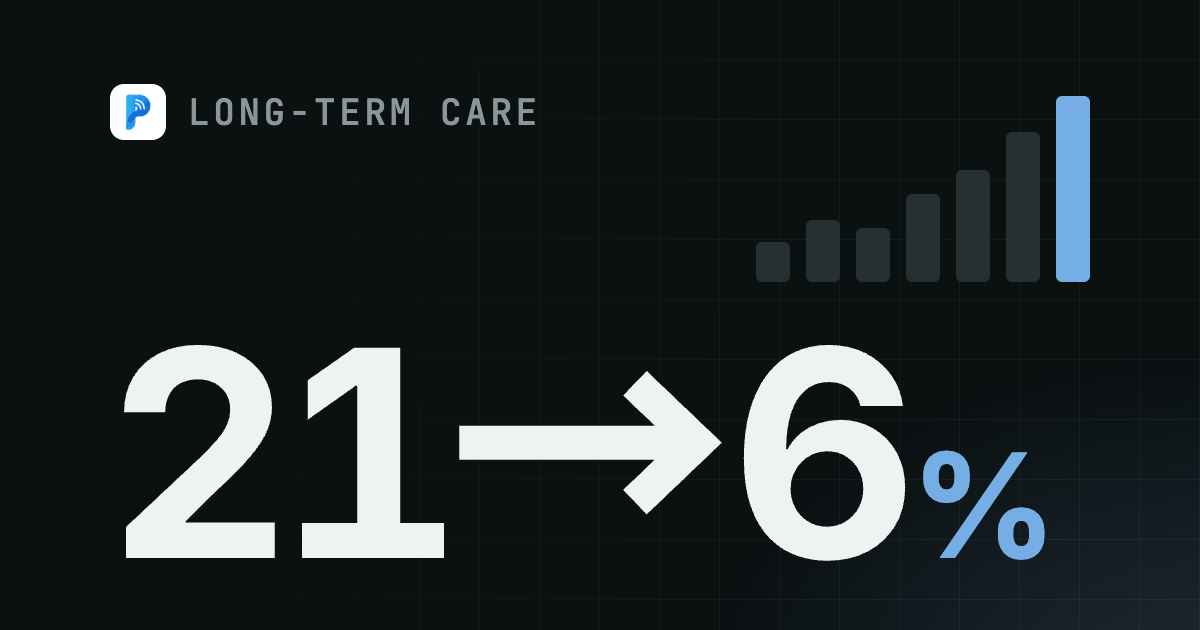
All three steps are logged, so the shift lead does not chase paperwork. One facility in Taoyuan ran this workflow and watched no-show rates fall from 21% to 6% — 15 additional on-time visits per 100 appointments. Mapped to ER reduction, a single resident can save 2–4 inpatient days per year.
The Question That Actually Matters: Can the AI Understand?
Outbound calling is technically trivial. The real challenge is whether the AI can handle the hardest language mix in Taiwanese LTC: families who code-switch between Mandarin and Taiwanese Hokkien, hard-of-hearing residents, heavily accented family members (new immigrants, Southeast Asian migrant caregivers' families), residents over 80 with deteriorating hearing.
Generic ASR hits 14–18% word error rate on Taiwanese-accent mixed Mandarin-Hokkien calls. A model tuned specifically for Taiwan LTC scenarios lands at 4–6%. That gap is not marketing — it is the difference between a system people use and a system they quietly abandon.
A second detail everyone underestimates: how the AI handles pauses. LTC residents speak slowly with long pauses. A generic voice agent calibrated for typical adult pacing will either interrupt mid-thought or end the call prematurely. Both feel robotic. A properly tuned LTC voice agent extends silence thresholds, allows mid-turn interruptions, and actively waits when it detects filler sounds like "um" or "well."
What Pathors Does Specifically for LTC Facilities
Three concrete capabilities Pathors built for Taiwan LTC:
1. A voice model tuned for Taiwan LTC reality: 96%+ transcription accuracy when Mandarin-Hokkien code-switching, slow elderly speech, and low-bandwidth mobile are all present at once. You do not need to tell families to "please speak slowly."
2. PDPA-compliant recording storage and audit logs: All call recordings stored in Taiwan region, audit logs exportable in the format Taiwan's Ministry of Health LTC certification reviewers accept.
3. Scenario-based console, not an engineering project: Wellness calls, family notifications, and follow-up reminders are all configured in the console. No webhook plumbing. Standard deployment in under 7 days, near-zero IT burden on the facility.
Frequently Asked Questions
Will families feel dismissed by an AI making their wellness calls?
Not if you position it correctly. AI handles the routine weekly summaries, administrative notices, and time-based reminders — the calls that facilities already struggle to make consistently. Real conversations (incidents, family meetings, complaints) still go to the shift lead or social worker. Facilities we work with see family satisfaction rise 15–25% because the "we heard from you" frequency finally becomes reliable.
Is LTC call automation legal under PDPA?
Yes, provided recordings are stored in PDPA-compliant regions, audit logs are exportable, and the data processing agreement is governed by local law. The filter is platform choice. Pathors stores all recordings in Taiwan by default, produces audit logs in the format Ministry of Health certification reviewers accept, and its DPA is written under Taiwan law.
How long does it take to deploy family notifications?
Standard family notification scenarios (resident status, administrative notices) go live in 7 days. Integrations with existing HIS systems for medication data push that to 14–21 days. The critical path is not technical — it is agreeing internally which notifications the AI is allowed to handle. That decision typically takes longer than deployment.
How is the follow-up reminder system priced?
Per-call pricing in NTD, no USD minimum commit. A 100-bed facility typically runs 500–600 reminders per month at 3–4 minutes per call, yielding a monthly budget of roughly NT$9,000–12,000. Compared to the administrative cost of rescheduling missed appointments (NT$15,000–25,000 per month at Taipei facilities we have measured), it pays for itself.
Can the AI voice agent really handle Taiwanese Hokkien?
It depends on the platform. Most generic voice AI platforms drop to 60–70% accuracy on Taiwanese Hokkien in production — unusable. Pathors invested in a specific data collection and tuning process for Taiwanese-accent mixed Mandarin-Hokkien and hits 94%+ in benchmarks. Always benchmark with your own facility's real calls before signing, not just a demo.
Is this affordable for small and mid-sized LTC facilities?
For a 50-bed facility, monthly AI voice agent budget lands at NT$6,000–10,000 — roughly half a part-time worker's wage. The payback comes from a 30–40% drop in caregiver phone interruptions, improved family satisfaction, and higher retention. Most facilities see financial-level ROI within three months.
The bottleneck for long-term care call automation is not technology — the technology works — it is whether the facility is willing to decide which calls the AI is allowed to handle. The right path is not replacing every workflow at once. Pick one (wellness calls or follow-up reminders) and run a three-month pilot. Watch family response, watch how much caregiver time comes back, then decide the next step. If you run an LTC facility and find yourself thinking "we dropped another week of wellness calls this month," that is probably the signal to start evaluating. Pathors offers a 14-day free pilot using your facility's real call data and family list — contact us at pathors.com to begin.