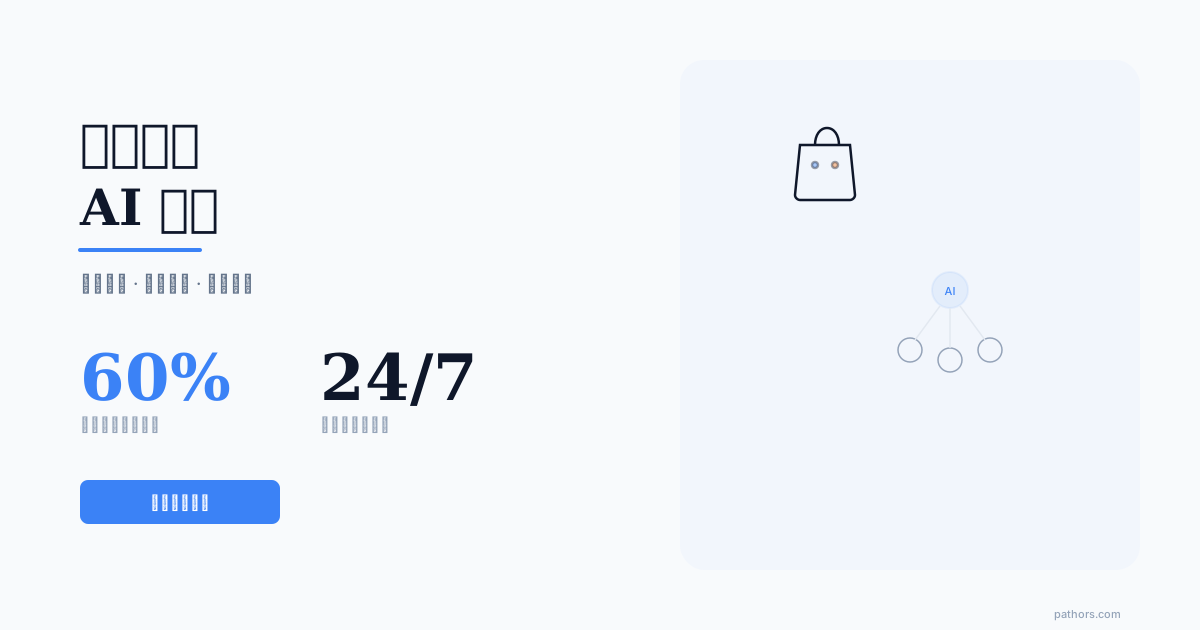
It's Friday at 5 PM. An 85-location beauty retail chain's call center has all 8 phone lines lit up. Customers are asking about store hours, loyalty points, return policies, and upcoming promotions—sometimes all in the same call. More than half of these questions have answers sitting right there on the website's FAQ page, but customers pick up the phone because they want an immediate human response. This is where AI customer service for retail enters the picture: handling the enormous volume of structured, predictable inquiries so that human agents can tackle the complex cases that actually require judgment. After working with retail brands on voice AI deployments, we've seen a consistent pattern—once repetitive calls are offloaded, agents handle more high-value interactions like complaints and complex returns, and CSAT scores climb by an average of 12 points.
The Retail Call Center Reality: 85 Stores, 8 Lines, 1,200 Calls Per Day
To ground this in specifics, let's look at a mid-sized retail chain we've worked with: 85 stores across multiple regions, a call center averaging 1,200 inbound calls per day, staffed by 12 agents on rotating shifts. That sounds like reasonable coverage—until you look at the service quality metrics:
A three-month content analysis of call recordings reveals a telling distribution:
| Call Type | Share | Avg Handle Time |
|---|---|---|
| Store info (hours, address, phone) | 28% | 45 seconds |
| Promotion inquiries | 19% | 1 min 20 sec |
| Loyalty points & redemption | 17% | 2 min 10 sec |
| Return/exchange policy | 15% | 3 min 45 sec |
| Complaints | 12% | 5 min 30 sec |
| Other | 9% | Varies |
The top three categories account for 64% of call volume, and they share a critical characteristic: the answers are structured, retrievable from a database in real time, and require virtually zero human judgment. This is the primary battlefield for retail AI customer service.
Scenario 1: Automated Store Lookup — 28% of Call Volume, Resolved in 45 Seconds
"What time does your downtown location close?" "Is the mall store open today?" "Which stores carry your organic skincare line?" These questions represent 28% of all inbound calls, and the handling pattern is nearly identical every time: hear the location reference, look it up, read the answer.
On the Pathors platform, we structure store information into a real-time knowledge base containing:
The Location Name Recognition Challenge
Retail voice AI faces a unique NLU challenge: customers refer to the same store in multiple ways. They might say a mall abbreviation, a neighborhood name, or a casual nickname. We build an alias mapping table within Pathors, averaging 4.7 spoken aliases per store location, achieving a 94% match rate.
Post-deployment results: of the 28% of calls related to store information, 89% are fully resolved by AI. The remaining 11% transfer to human agents, primarily for inventory queries involving ambiguous product descriptions. In absolute numbers, out of roughly 296 daily store-related calls, 263 no longer require a human.
Scenario 2: Promotional Outbound Notifications — Raising Reach From 45% to 88%
A typical retail chain runs 18 to 24 promotional campaigns per year: anniversary sales, end-of-season clearances, member-exclusive days, brand collaborations. The standard notification stack—email, app push notifications, and SMS—produces a combined reach rate of about 45%. That means more than half of your target audience doesn't even know a campaign is happening.
The channel-level numbers explain why: email open rates average 18%, app push click-through is around 8%, and SMS read rates are approximately 62% but at the highest per-contact cost. AI voice outbound fills this gap. Our data shows that AI voice outbound achieves an 88% confirmed reach rate—meaning the customer answered, listened to the key promotion details, and the system logged a successful delivery.
Segmentation, Timing, and Script Design
Effective promotional outbound means targeted calls, not mass dialing. We help brands configure segmented outbound logic on Pathors:
Timing matters enormously. For retail consumers, optimal pickup windows are weekday mornings (10:00–11:30 AM) and evenings (7:30–9:00 PM), with weekend calls performing best after 11:00 AM. Calling during these windows yields a 34% higher answer rate than random-time outbound.
Each promotional call is structured to stay under 35 seconds: brand greeting (3 sec) → campaign name and dates (8 sec) → core offer (12 sec) → call to action (7 sec) → SMS link delivery (5 sec).
Scenario 3: Membership Service Automation — Points, Tiers, and Birthday Rewards
Membership-related calls account for 17% of regular call volume, spiking to 31% around member-exclusive event days. The three most common inquiry types are:
1. Points balance and expiration (42% of membership calls)
2. Tier status and upgrade/downgrade rules (28%)
3. Birthday reward and member gift redemption (19%)
All three share a common trait: the answer is fully deterministic and retrievable from the CRM in real time. For points inquiries, the customer verifies their identity (phone number plus partial name), and the AI pulls their current balance, last transaction record, and the earliest expiring points batch with its date.
A key design feature we implement on Pathors is proactive extension: after a points balance query, if the system detects points expiring within 30 days, the AI proactively mentions it—"You have 350 points expiring on April 15th. You can redeem them for a store voucher or select products." This design increased points redemption rates by 27% and simultaneously reduced subsequent "where did my points go?" complaint calls.
Handling Tier Downgrades With Care
Tier downgrades are the most complaint-prone membership communication scenario. Previously communicated via email with only a 22% open rate, many customers discovered their downgrade at the point of sale—leading to unpleasant in-store confrontations. By switching to AI voice notification 14 days before downgrade takes effect, including specific guidance on how much additional spend would maintain their current tier, downgrade-related complaints dropped by 41%.
Six-Month Impact Summary: Real Performance Data
Using the 85-store brand as our reference case, here are the consolidated metrics after 6 months with the Pathors retail AI customer service solution:
| Metric | Before | After | Change |
|---|---|---|---|
| Daily human-handled calls | 1,200 | 487 | -59% |
| Average wait time | 2 min 48 sec | 38 sec | -77% |
| Call abandonment rate | 23% | 6% | -17 pts |
| FCR (first contact resolution) | 71% | 89% | +18 pts |
| CSAT (customer satisfaction) | 72 | 84 | +12 pts |
| Promotional reach rate | 45% | 88% | +43 pts |
The 12-person agent team was retained at full headcount, but their work shifted to complaints, return adjudication, and VIP relationship management. Team job satisfaction survey scores rose from 63 to 79—because nobody enjoys answering "What time do you close?" 200 times a day.
FAQ
Q1: Do customers actually accept AI phone agents?
Our survey data shows that 83% of customers don't mind whether they're speaking to a human or AI, as long as their problem is resolved quickly. However, satisfaction drops sharply if the AI can't help and the transfer to a human agent takes too long. That's why we design Pathors with a sub-15-second handoff to live agents.
Q2: How are last-minute store hour changes handled?
The backend knowledge base supports real-time updates. Store managers can report changes via LINE or a lightweight admin panel, and the AI's responses sync within 5 minutes. For large-scale disruptions like typhoon closures, we support batch imports.
Q3: Won't outbound promotional calls get flagged as spam or scam calls?
This is a legitimate concern we address through multiple measures: branded caller ID, clear brand identification within the first 5 seconds of the call, and a closing message directing customers to the official service line if they have concerns. Current complaint rates are below 0.3%.
Retail competition is shifting from product differentiation to the total customer experience, and phone-based service is an often-overlooked piece of that experience. When a customer calls about store hours and waits 3 minutes, or when their loyalty points expire without a heads-up, these small frictions quietly erode brand loyalty. AI customer service for retail eliminates this everyday friction, freeing human resources for the moments that genuinely require warmth—complaint resolution, VIP relationship building, post-purchase follow-up. The next service upgrade for a retail chain might not be opening another store; it might be making sure every phone call is handled well.