During a technical assessment with a top-10 Taiwanese bank last quarter, their IT director posed a question that perfectly captures the market's shifting mindset: "Do you see AI voice customer service as a cost-reduction tool or a revenue engine?" Three years ago, most enterprises measured AI adoption success by headcount savings. In 2025, a growing number of organizations are evaluating ROI through customer lifetime value uplift. The Taiwan AI voice customer service market is undergoing three accelerating structural shifts that will determine which enterprises build lasting competitive advantages over the next 18 months.
Trend 1: Multilingual Code-Switching Demand Surges — Now Present in 37% of Service Calls
Taiwan's linguistic landscape creates a uniquely challenging environment for voice AI. A single customer service call may flow between Mandarin, Taiwanese Hokkien, and English — sometimes within the same sentence. According to a 2024 survey by the Taiwan Customer Service Industry Association, the proportion of financial and telecom service calls involving code-switching has risen from 22% in 2022 to 37% in 2024.
The traditional approach uses a language detection module to identify the spoken language, then routes audio to the corresponding ASR model. Each switch introduces 300–500 milliseconds of latency, causing recognition fragmentation. The 2025 technical direction is unified multilingual models that process multiple languages within a single inference pipeline. Academic research shows these models achieve word error rates 28% lower than traditional switching architectures in code-switching scenarios.
The business impact is direct: if more than 30% of your customer calls involve multilingual switching, choosing an AI system with native multilingual capability directly affects first-call resolution (FCR). Enterprises that have adopted unified multilingual models report an average FCR improvement of 12 percentage points.
Trend 2: On-Premise and Hybrid Deployment Regains Ground — 68% of Financial Institutions Reassessing Architecture
The dominant narrative in 2023 was "move everything to the cloud." The 2025 reality is more nuanced. According to a late-2024 report from Taiwan's Institute for Information Industry, 68% of financial institutions are actively reassessing their AI customer service deployment architecture, considering shifts from pure cloud to hybrid or on-premise models. Three forces are driving this reassessment:
First, regulatory tightening. Taiwan's Financial Supervisory Commission issued AI usage guidelines in Q3 2024 that explicitly require "AI model inference involving customer personal data should prioritize domestic processing." This pushed many institutions using overseas cloud-based ASR services to seek domestically deployable alternatives.
Second, latency sensitivity. Voice customer service demands real-time responsiveness. Cloud-based solutions typically have round-trip latency of 150–300 milliseconds, while on-premise deployments can compress this to under 50 milliseconds. In scenarios requiring instant semantic understanding and immediate response — such as fraud interception or transaction confirmation — this gap directly impacts user experience.
Third, cost structure inflection. When monthly call volume exceeds 500,000 minutes, on-premise total cost of ownership (TCO) drops below cloud-based alternatives by approximately month 14. For large enterprises, this is a balance sheet reality, not a technology preference.
Pure on-premise has drawbacks — slower model updates and limited scaling elasticity. This is why hybrid architecture (core inference on-premise, model training in the cloud) is emerging as the preferred approach for enterprise clients. Current adoption stands at approximately 41%, projected to exceed 55% by the end of 2026.
Trend 3: From Chatbots to Agentic AI — Task Completion Rates Jump from 34% to 72%
For the past three years, most AI customer service systems in Taiwan have been built on slot-filling and decision-tree architectures: identify intent, populate fields, execute a predefined workflow. This works adequately for simple queries (account balances, business hours) but struggles with multi-step tasks (cross-account transfer + reminder setup + notification preference change). Industry data from 2024 shows traditional architectures achieve only a 34% completion rate on multi-step tasks.
Agentic AI introduces a "plan-execute-verify-correct" loop that fundamentally changes what voice AI can accomplish. The key differences from traditional architectures:
Early adopters of agentic architecture report multi-step task completion rates rising from 34% to 72%, with average handle time (AHT) decreasing by 40 seconds per call. That time savings translates directly into agent capacity.
The more significant shift is in business model potential. When AI voice service can complete the full loop of "inquiry + recommendation + order placement," it stops being purely a cost center. In 2024, Taiwanese e-commerce companies reported that AI voice customer service contributed 8% of cross-sell revenue — a figure that was essentially zero two years prior.
Where These Three Trends Converge
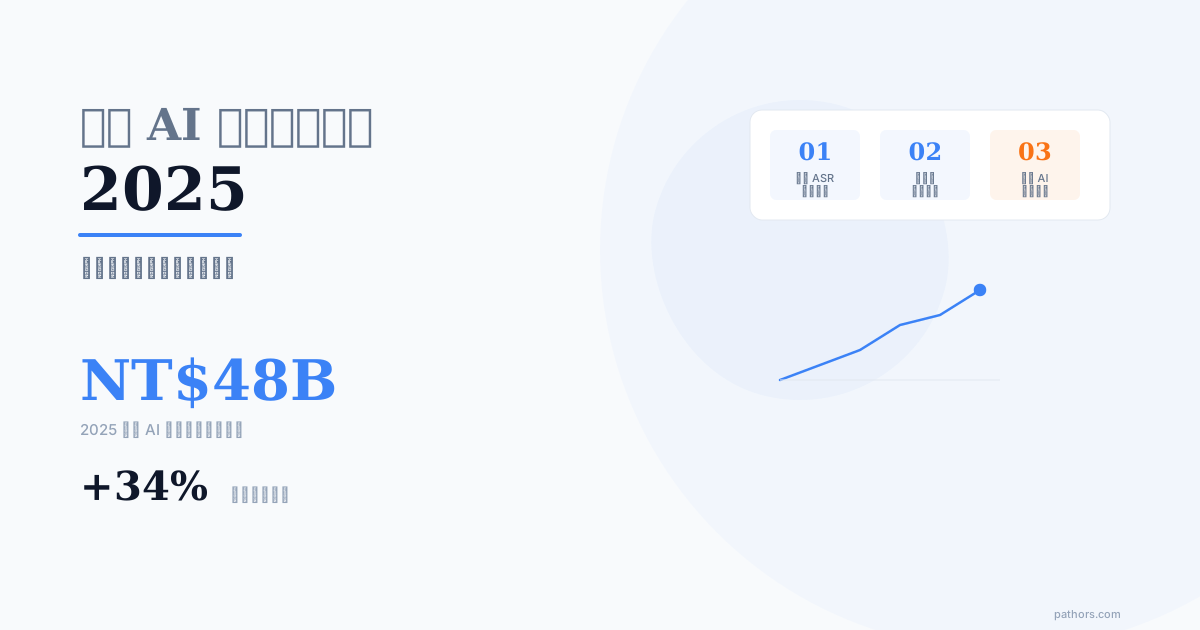
The convergence point is clear: the technical bar for enterprise AI voice customer service in Taiwan is rising rapidly in 2025. Vendors that can simultaneously address multilingual recognition, flexible deployment, and agentic architecture will capture the majority of enterprise market share. Industry projections estimate the Taiwan AI voice customer service market will reach NT$ 4.8 billion in 2025, growing at approximately 32% year-over-year. Enterprise clients (annual call volume exceeding 1 million) are expected to increase from 29% of the market in 2024 to 38% in 2025.
For organizations currently evaluating AI voice solutions, this is the right moment to reassess vendor technology stacks. The question is no longer "do you have AI customer service?" but "can your architecture support the demands created by all three of these converging trends?"
Frequently Asked Questions
How large is the Taiwan AI voice customer service market in 2025?
Industry projections estimate the market will reach approximately NT$4.8 billion in 2025, representing roughly 32% year-over-year growth. Enterprise clients with annual call volumes exceeding 1 million are expected to grow from 29% of the market in 2024 to 38% in 2025, signaling accelerating adoption among large organizations.
What is code-switching and why does it matter for AI voice service in Taiwan?
Code-switching refers to alternating between languages or dialects within a single conversation. In Taiwan, 37% of financial and telecom customer service calls now involve switching between Mandarin, Taiwanese Hokkien, and English. AI systems that cannot handle this fluently experience recognition fragmentation, which directly reduces intent accuracy and first-call resolution rates.
Why are financial institutions in Taiwan moving back toward on-premise deployment?
Three primary drivers: regulatory requirements from the Financial Supervisory Commission prioritizing domestic data processing for AI inference involving personal data; latency sensitivity where on-premise deployments achieve under 50 milliseconds versus 150–300 milliseconds for cloud; and cost structure advantages where on-premise TCO drops below cloud by approximately month 14 for high-volume operations exceeding 500,000 minutes per month.
What specifically differentiates agentic AI from traditional chatbot architectures?
Traditional architectures rely on predefined slot-filling and decision-tree workflows, achieving only about 34% completion on multi-step tasks. Agentic AI introduces dynamic planning, proactive tool calling to backend systems, and self-verification loops. This raises multi-step task completion to 72% while reducing average handle time by 40 seconds per call.
What key questions should enterprises ask AI voice vendors in 2025?
Focus on three dimensions: whether the vendor has native multilingual recognition capability (particularly Mandarin-Hokkien code-switching), whether the architecture supports hybrid or on-premise deployment to meet regulatory requirements, and whether the system has evolved from decision-tree logic to agentic AI capable of handling complex multi-step tasks. These three capabilities will define market leaders over the next 18 months.
What is the current adoption rate for hybrid deployment architecture?
Hybrid architecture — with core inference running on-premise and model training in the cloud — currently sits at approximately 41% adoption among enterprise AI voice deployments in Taiwan. This is projected to exceed 55% by the end of 2026, driven by the architecture's ability to balance regulatory compliance, low latency, and model iteration speed.
These three accelerating trends signal that 2025 will be a defining year for Taiwan's AI voice customer service market. Multilingual recognition capability, deployment architecture flexibility, and agentic AI maturity are transitioning from differentiators to baseline requirements. For enterprises evaluating or replacing their AI voice solutions, this is the optimal window to reassess technical needs against the rapidly evolving market landscape.
Frequently Asked Questions
How large is the Taiwan AI voice customer service market in 2025?
Industry projections estimate the market will reach approximately NT$4.8 billion in 2025, representing roughly 32% year-over-year growth. Enterprise clients with annual call volumes exceeding 1 million are expected to grow from 29% of the market to 38%.
What is code-switching and why does it matter for AI voice service in Taiwan?
Code-switching refers to alternating between languages or dialects within a single conversation. In Taiwan, 37% of financial and telecom service calls involve switching between Mandarin, Taiwanese Hokkien, and English. AI systems that cannot handle this fluently experience recognition fragmentation, reducing intent accuracy and first-call resolution rates.
Why are financial institutions in Taiwan moving back toward on-premise deployment?
Three primary drivers: regulatory requirements prioritizing domestic data processing, latency sensitivity where on-premise achieves under 50 milliseconds versus 150-300 for cloud, and cost advantages where on-premise TCO drops below cloud by approximately month 14 for high-volume operations.
What specifically differentiates agentic AI from traditional chatbot architectures?
Traditional architectures rely on predefined slot-filling and decision-tree workflows, achieving only about 34% completion on multi-step tasks. Agentic AI introduces dynamic planning, proactive tool calling, and self-verification loops, raising multi-step task completion to 72%.
What key questions should enterprises ask AI voice vendors in 2025?
Focus on three dimensions: native multilingual recognition capability, hybrid or on-premise deployment support for regulatory compliance, and whether the system has evolved to agentic AI capable of handling complex multi-step tasks.
What is the current adoption rate for hybrid deployment architecture?
Hybrid architecture currently sits at approximately 41% adoption among enterprise AI voice deployments in Taiwan, projected to exceed 55% by end of 2026. It balances regulatory compliance, low latency, and model iteration speed.