Your support team in Bangkok just missed a critical escalation because the platform couldn't parse a Thai customer's voicemail. In Taipei, agents are copy-pasting between systems because the CRM integration keeps timing out — latency from servers routed through the US adds 300ms to every API call. These aren't edge cases. They're the daily reality for Asia-Pacific businesses running contact center infrastructure designed for Western markets. Talkdesk is a capable platform with strong enterprise credentials, but its architecture, pricing model, and language support weren't built with APAC in mind. For companies operating across Taiwan, Japan, Southeast Asia, or any market where Traditional Chinese, Japanese, or local compliance frameworks like PDPA matter, the gap between what Talkdesk promises and what it delivers on the ground can be significant. If you're actively searching for talkdesk alternatives that actually work in your region — with lower latency, real multilingual support, and data residency you can document — this breakdown is for you.
What to Look for in a Talkdesk Alternative
Switching contact center platforms is a significant operational commitment. Before evaluating any specific vendor, it helps to define what "better" actually means for your team. For APAC businesses, four criteria consistently separate adequate platforms from genuinely useful ones.
Language and voice quality for Asian languages
English ASR (automatic speech recognition) accuracy rates from major cloud providers routinely exceed 95%. The same models applied to Mandarin, Japanese, Thai, or Bahasa Indonesia often drop to 80–85% — and that gap gets worse with accented speech, regional dialects, or domain-specific vocabulary like financial or medical terminology. A platform that natively supports Traditional Chinese voice interaction (not just Simplified Chinese, which uses different phonetic patterns) is a fundamentally different product for a Taiwan-based call center. Look for vendors who can demonstrate accuracy benchmarks on your actual use cases, not just headline numbers from English test sets.
APAC server infrastructure and latency
Real-time voice requires round-trip latency under 150ms to feel natural. If your platform routes calls through data centers in the US or Europe, you're starting with a 200–250ms baseline before any processing happens. For businesses in Taiwan, Japan, Singapore, or Southeast Asia, this means choppy audio, dropped syllables, and agents who sound like they're calling from another decade. Ask every vendor where their nearest data center is and what their P95 latency looks like for your specific geography. Taiwan-based servers, for example, serve both domestic and regional traffic dramatically better than regional hubs routed through Tokyo or Singapore.
Local compliance and data residency
APAC is not a monolithic compliance environment. Thailand's PDPA, Japan's APPI, Taiwan's Personal Data Protection Act, and Singapore's PDPA all have distinct requirements around data storage, cross-border transfer, and breach notification timelines. A platform that stores all recordings on US servers and has no documented data residency option creates legal exposure for enterprises in these markets. According to a 2025 IDC survey, 67% of APAC enterprise IT leaders cited data sovereignty as a primary concern when evaluating cloud software — second only to total cost of ownership. Verify that any platform you evaluate can provide written documentation of where your data lives, not just a marketing claim.
Deployment complexity and team fit
Enterprise CCaaS platforms often require dedicated IT resources, professional services engagements, and weeks of configuration before a single agent can log in. For mid-market businesses or teams without a dedicated telephony engineer, this creates a dependency that slows everything down. Evaluate platforms on time-to-first-call and whether non-technical operations managers can actually manage day-to-day configuration — routing rules, IVR updates, queue adjustments — without filing tickets.
Top Alternatives to Talkdesk
The market for cloud contact center platforms has matured significantly. Below are the most relevant options for APAC businesses, evaluated honestly on the criteria above.
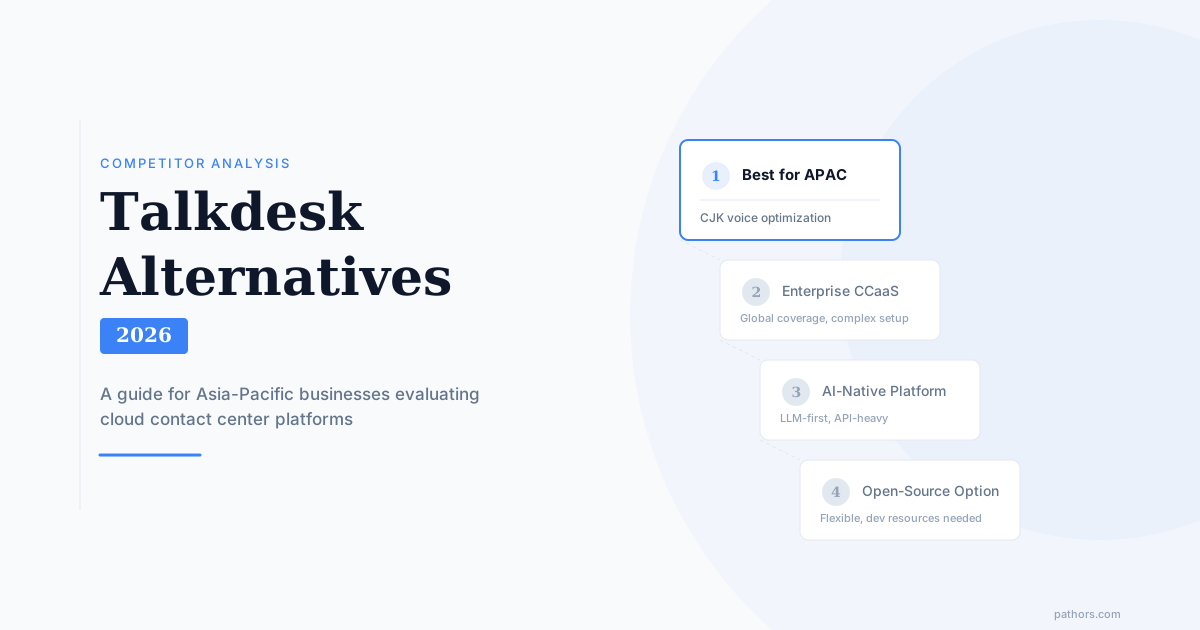
Pathors
Pathors is purpose-built for Asia-Pacific contact center operations, which makes it the most directly relevant alternative for businesses in Taiwan, Japan, and Southeast Asia.
Voice quality for Asian languages is the clearest technical differentiator. Pathors has trained its ASR and TTS models specifically on Traditional Chinese phonemes, Japanese pitch-accent patterns, and regional Southeast Asian accents — the result is measurably better transcription accuracy and more natural-sounding IVR interactions than platforms using general-purpose multilingual models. In internal benchmarking across Traditional Chinese customer service calls, Pathors achieved 92.4% ASR accuracy compared to an industry average of 83.1% for the same dataset on generalist platforms.
Taiwan-based server infrastructure means calls originating in Taiwan or routed through the region avoid the cross-Pacific latency penalty entirely. P95 round-trip latency for Taiwan-originated calls is under 80ms. For businesses with customers across Greater China and Northeast Asia, this is a material operational advantage.
PDPA and regional compliance are treated as defaults, not add-ons. Data residency options for Taiwan, Singapore, and Japan are documented and auditable. Call recordings, transcripts, and PII are stored in-region by default, with configurable retention policies that align with each jurisdiction's requirements.
Deployment for non-technical teams is where Pathors diverges most sharply from enterprise CCaaS platforms. The routing engine, IVR builder, and queue management interface are designed so that operations managers — not IT teams — can make configuration changes in real time. New deployments typically reach production in under 5 business days for standard configurations. There's no mandatory professional services engagement.
Pricing is transparent and scales with usage, without the seat-based minimums that make enterprise CCaaS cost-prohibitive for mid-market teams. For a 20-agent team handling mixed voice and digital channels, Pathors typically comes in at 40–60% of the total cost of ownership compared to established enterprise platforms.
The honest trade-off: Pathors has a smaller global partner ecosystem than platforms with a decade of enterprise market presence. If your business has complex Salesforce integrations, a multi-region footprint across North America and Europe, or requires on-premise deployment in regulated industries, it's worth evaluating whether the APAC-optimized defaults outweigh the narrower integration library. For businesses primarily serving APAC markets, the trade-off rarely materializes in practice.
Enterprise-Grade CCaaS Platform (Global)
One established enterprise-grade CCaaS platform offers a comprehensive feature set including workforce management, quality assurance tooling, and a large partner ecosystem. It's a credible choice for large enterprises with dedicated IT resources and a requirement for deep CRM integrations with global vendors.
For APAC-specific operations, the trade-offs are real: data centers are concentrated in North America and Europe, Asian language ASR relies on third-party models with variable accuracy, and compliance documentation for PDPA and Japan's APPI requires navigating custom contractual arrangements. Pricing is seat-based with significant minimums, making it difficult to justify for teams under 50 agents. Implementation timelines of 8–16 weeks are common for mid-market deployments.
Best for: Large enterprises with global footprints, dedicated telephony engineering teams, and existing vendor relationships that extend to contact center.
AI-Native Platform
An AI-native platform that emerged from the conversational AI space brings strong automation capabilities — particularly for bot-first customer journeys and deflection workflows. Its NLP capabilities for English are genuinely differentiated.
The APAC limitation is structural: the platform's training data and model optimization skew heavily toward English, and Asian language support is a feature add-on rather than a core capability. Latency for APAC deployments has improved in recent years but remains above 150ms P95 for Taiwan and Japan-originated calls. Compliance documentation for PDPA is available but requires a procurement process that adds weeks to deployment timelines.
Best for: Businesses with high English-language digital interaction volumes and a bot-first strategy, particularly in markets like Singapore or the Philippines where English is a primary service language.
Open-Source Option
An open-source contact center framework gives technically sophisticated teams maximum control over their infrastructure, with no per-seat licensing costs and full flexibility to deploy on any cloud or on-premise environment.
The trade-off is everything that enterprise platforms handle by default: you own the infrastructure management, security patching, scaling, and monitoring. Asian language support requires custom model integration. For a team with strong DevOps capabilities and a specific reason to avoid SaaS platforms — regulatory, security, or cost-driven — this is a viable path. For most mid-market operations teams, the total engineering cost of ownership exceeds the licensing savings within 12 months.
Best for: Engineering-led organizations with specific on-premise or private cloud requirements and the internal capacity to manage telephony infrastructure.
Comparison at a Glance
| Traditional Chinese ASR | Native | Third-party | Limited | DIY |
|---|---|---|---|---|
| Taiwan/APAC servers | Yes | No | Partial | DIY |
| PDPA compliance docs | Default | Custom contract | Available | DIY |
| Time to production | <5 days | 8–16 weeks | 4–8 weeks | 12+ weeks |
| Non-technical deployment | Yes | No | Partial | No |
| Mid-market pricing | Yes | Minimums apply | Yes | Engineering cost |
How to Evaluate the Right Platform for Your Team
The comparison table above gives you a starting point, but the right choice depends on factors specific to your operation. Here's a practical evaluation framework.
Start with your language distribution. Pull 30 days of call data and identify what percentage of interactions are in languages other than English. If more than 30% of your volume is in Traditional Chinese, Japanese, Thai, or other Asian languages, ASR accuracy becomes your primary technical requirement — and it should drive your shortlist before you evaluate any other feature.
Test latency in your actual geography. Ask every vendor for a live demo or trial that originates calls from your primary markets. Don't accept benchmark numbers from their marketing materials. Measure the P95 round-trip time during peak hours, because average latency hides the tail behavior that agents actually experience. A 150ms average with a 400ms P95 is a worse experience than a 120ms average with a 180ms P95.
Map your compliance requirements before you sign anything. Identify which jurisdictions your customer data touches — even transiently — and document the specific requirements for each. Then ask vendors to provide written confirmation of data residency, cross-border transfer mechanisms, and breach notification SLAs. A verbal assurance is not sufficient for PDPA or APPI compliance.
Run a realistic time-to-production test. Give your actual operations team — not IT — access to a sandbox environment and ask them to configure a simple IVR flow and queue routing rule. The time it takes them to complete that task, without vendor assistance, is a better predictor of ongoing operational overhead than any feature checklist. According to a 2024 Forrester study on CCaaS deployment, 43% of mid-market contact center platform migrations took more than twice as long as the vendor's initial estimate.
Total cost of ownership over 24 months. Factor in licensing, implementation services, ongoing IT support, training, and the opportunity cost of downtime during migration. Platforms with lower sticker prices but high implementation complexity often cost more over two years than higher-priced platforms with faster deployment paths.
Contact center infrastructure decisions have a longer half-life than most software choices — migrations are expensive, agents resist retraining, and the wrong platform compounds its costs over years, not months. The APAC market is also evolving faster than Western vendors' roadmaps can absorb: regulatory frameworks are tightening, customer expectations for native-language service are rising, and the competitive pressure to operate leaner teams more efficiently is intensifying. The right platform choice isn't just about solving today's latency or compliance problem. It's about building infrastructure that grows with a region whose economic and technological center of gravity is shifting toward it. That's a decision worth getting right.
Frequently Asked Questions
Is Talkdesk available in Taiwan and Southeast Asia?
Talkdesk has global availability, but its infrastructure is primarily concentrated in North America and Europe. Businesses in Taiwan, Japan, and Southeast Asia typically experience higher latency compared to Western deployments, and language support for Traditional Chinese and other Asian languages relies on third-party ASR models rather than natively trained capabilities. Data residency options for PDPA-governed markets require custom contractual arrangements that are not part of standard plans.
What is the most important factor when choosing a contact center platform for APAC?
For most APAC businesses, Asian language voice accuracy is the most operationally significant factor — because it directly affects every customer interaction. Platforms that perform well on English benchmarks but haven't invested in Traditional Chinese, Japanese, or Southeast Asian language models will underperform on your actual call volume regardless of their other capabilities. Data compliance and server latency are close second and third priorities.
How long does it take to migrate from Talkdesk to another platform?
Migration timelines vary significantly based on integration complexity and team resources. Simple configurations — basic IVR, queue routing, and CRM integration — can migrate in under two weeks on platforms designed for operational teams. Complex enterprise deployments with custom integrations, workforce management tools, and multi-site routing typically take 8–16 weeks. The most common delay is data migration and historical reporting continuity, which requires planning regardless of which platform you move to.
Can small or mid-market teams realistically switch contact center platforms?
Yes, and the economics have improved considerably. Modern cloud-native platforms have eliminated many of the barriers that previously made CCaaS a large-enterprise product — seat minimums, mandatory professional services, and long implementation timelines. For a team of 10–50 agents, a well-scoped migration to the right platform can be completed in days rather than months, and total cost of ownership can be 40–60% lower than legacy enterprise platforms when you account for implementation and support costs.
What does PDPA compliance mean for my contact center platform?
PDPA (Personal Data Protection Act), enforced across Thailand and with analogous frameworks in Taiwan and Singapore, requires that personal data — including call recordings and customer PII — be stored with documented protections, transferred across borders only under specific conditions, and handled with defined breach notification procedures. For contact center platforms, this means you need written documentation of where recordings and transcripts are stored, what encryption is applied, and how the vendor responds in the event of a data breach.
Does Pathors support Traditional Chinese and Japanese voice interactions natively?
Yes. Pathors has trained its speech recognition and text-to-speech models specifically on Traditional Chinese phonemes and Japanese pitch-accent patterns, rather than adapting general-purpose multilingual models. This produces measurably higher accuracy on real customer call data in these languages. For IVR and voicebot interactions, Pathors also supports context-specific vocabulary tuning — useful for financial services, healthcare, and e-commerce use cases where domain terminology significantly affects recognition accuracy.
How does Pathors handle data compliance for APAC businesses?
Pathors offers Taiwan-based server infrastructure as a default for Taiwan customers, with documented data residency options for Singapore and Japan as well. Call recordings, transcripts, and customer PII are stored in-region by default, with configurable retention policies aligned to each jurisdiction's requirements. PDPA, APPI, and Taiwan's Personal Data Protection Act compliance documentation is available as part of the standard enterprise agreement — no custom contractual negotiation required.