It is 4:30pm on a Saturday at a Traditional Chinese Medicine clinic in New Taipei. The receptionist is simultaneously handling three things: an elderly patient walking in to register, a phone ringing for the fourth time, and a couple standing beside her asking how to take the herbal powder she just dispensed. That unanswered call is a patient who finished an acupuncture session yesterday, and whose attending doctor specifically asked the clinic to call back today to check on recovery. This scene plays out every day across Taiwan's 8,700-plus TCM clinics — and AI voice assistant adoption in this segment has moved from nearly zero to a visible inflection point over the last 18 months. The driver is not that the technology got more exciting. The driver is that front desk staffing has stopped scaling.
The Three Hidden Costs of Peak Hours at a TCM Clinic
TCM clinics operate on a rhythm that differs sharply from Western medicine practices. Western clinics often peak around 7-9pm, but TCM clinics — because their core treatments include acupuncture and tuina that require fixed-slot, doctor-performed sessions — see sharper peaks on Saturday mornings and Tuesday and Thursday evenings, where incoming call traffic frequently exceeds front-desk capacity.
Clinic directors we have interviewed give surprisingly consistent numbers: during peak hours, 3 to 4 out of every 10 incoming calls are abandoned after the fifth ring. Patients trying to book default to whichever channel answers — if a clinic has LINE they message; if it doesn't, they simply forget.
The hidden cost of these missed calls breaks into three layers:
Direct Booking Revenue Loss
For a typical mid-sized TCM clinic with 80 daily visits and an average ticket of NT$450, losing 3 peak-hour booking calls per day translates to approximately NT$40,000 per month in direct revenue loss. That number excludes downstream follow-up visit value, which in TCM is structurally significant.
Treatment Protocol Interruption
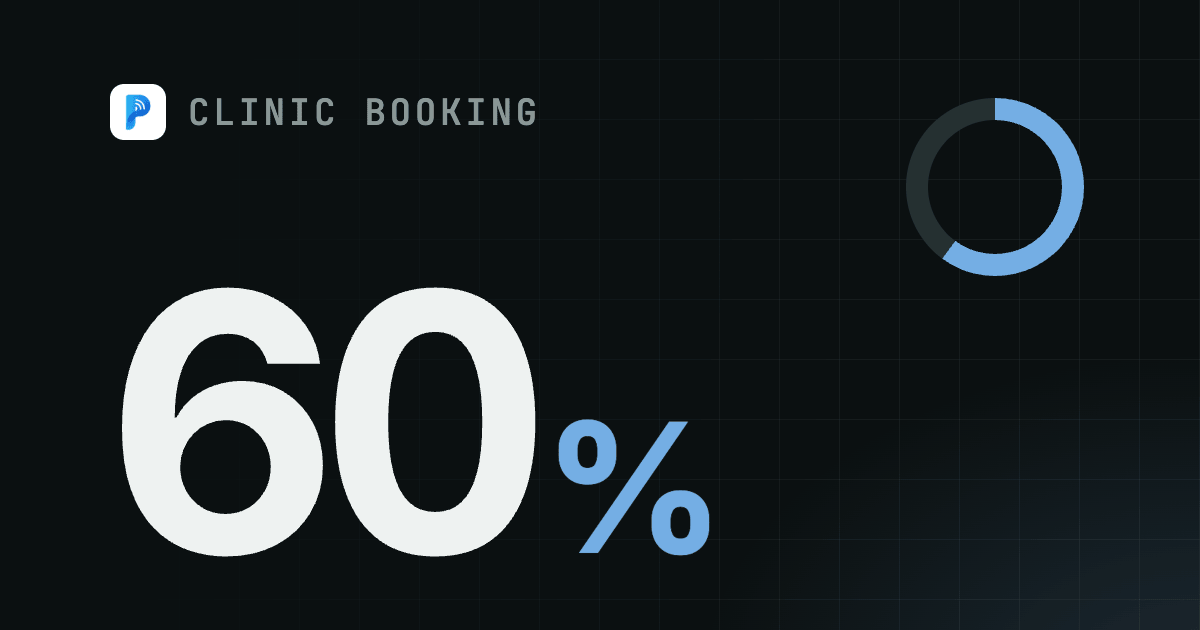
TCM treatment protocols are built on continuity — acupuncture courses commonly run 6 to 8 sessions, herbal conditioning regimens 4 to 12 weeks. A missed follow-up booking compromises clinical efficacy. Field observation suggests TCM clinics without systematic follow-up reminders see protocol completion rates around 58-65%; clinics with reminder systems in place push that to 80-85%.
Rising Front-Desk Turnover
A TCM clinic front desk simultaneously handles registration, phone, LINE, on-site medicine handoff, and insurance paperwork. The sustained cognitive load translates to turnover. An internal 2025 survey by the Taiwan Union of Chinese Medicine Doctors puts average annual front-desk turnover at 32%, notably higher than the 18% observed in Western medicine clinics. Each replacement is 1-2 months of ramp-up cost.
What an AI Voice Assistant Actually Does in a TCM Clinic
An AI voice assistant in a TCM context is not a robotic voice on the other end of the line. It is a voice agent that understands Taiwanese Mandarin with occasional Hokkien code-switching, and handles TCM-specific vocabulary — terms like acupuncture course, herbal conditioning, cupping, tuina — with production-grade accuracy. Concretely, it operates across three layers:
Inbound Booking Handling
When a patient calls, the AI answers on the first ring, understands natural phrasing like "I want to book Thursday evening with Dr. Lin, acupuncture", checks clinic scheduling in real time, writes the booking directly to the clinic system, and sends an SMS or LINE confirmation. The entire interaction takes 60-90 seconds and consumes zero front-desk attention.
The non-trivial part is handling TCM-specific booking logic:
Outbound Follow-up Reminders
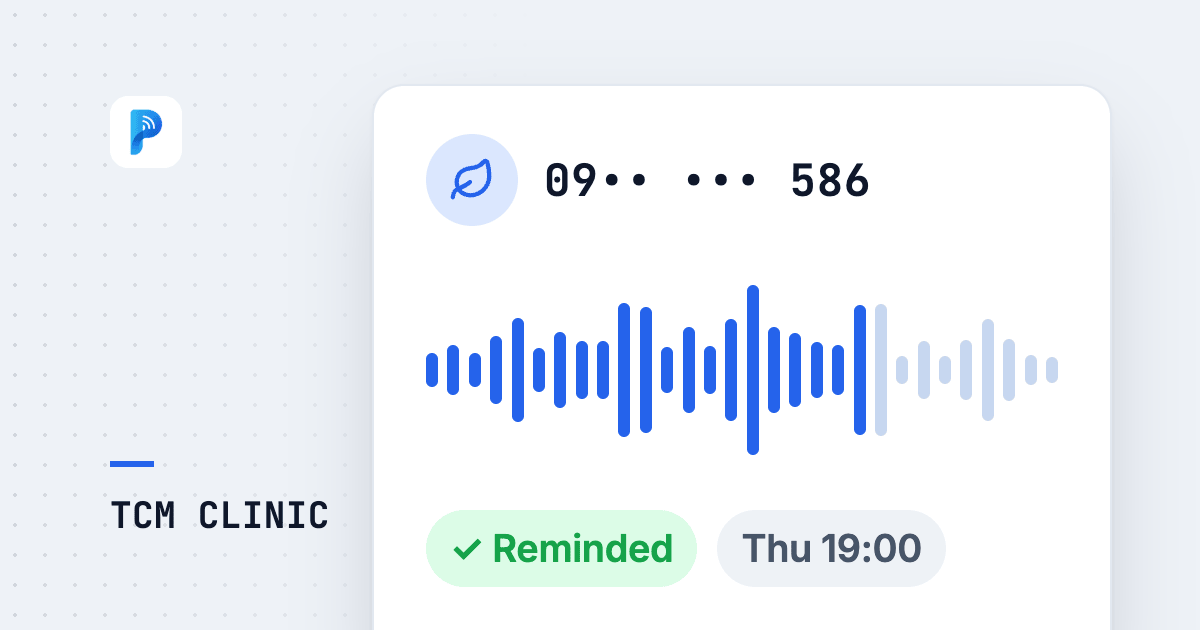
TCM efficacy depends on patients returning on schedule. The AI proactively calls 1 to 2 days before the scheduled follow-up, confirms attendance conversationally — not by playing a recorded message, but by genuinely understanding replies like "I have to take my mother to the hospital that day" and either rescheduling on the spot or routing to a human.
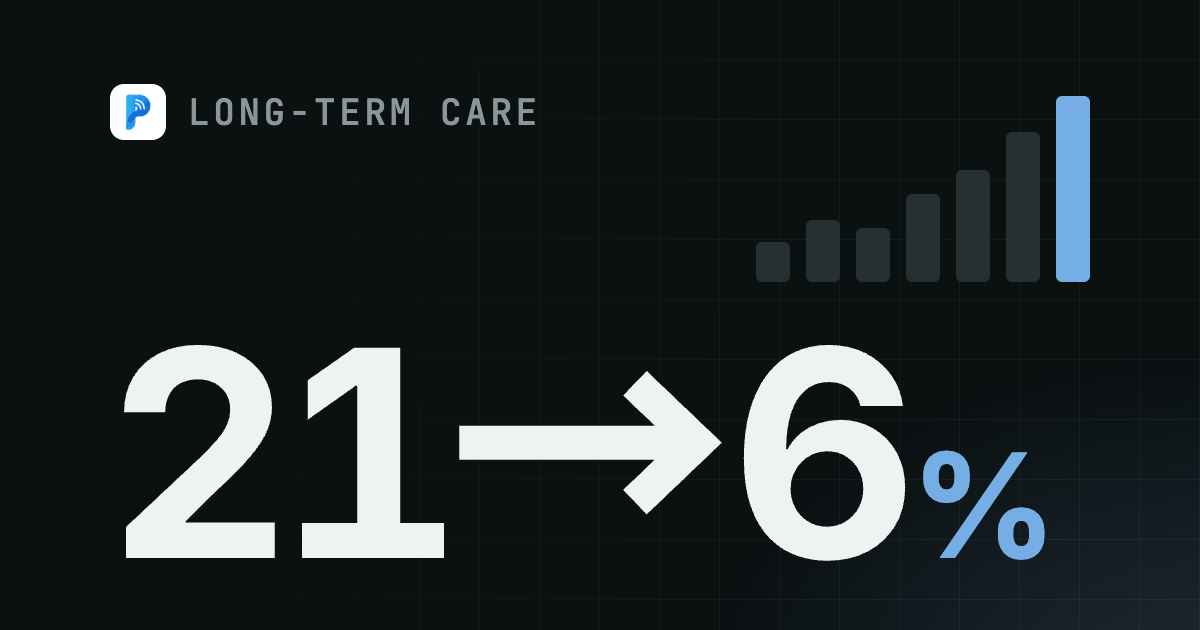
Effects we have measured after deployment: protocol completion rates rise 22-38% on average, and no-show rates drop from roughly 18% to 6-9%.
Patient Education and Medication Follow-up
TCM medication instructions are meaningfully more complex than Western prescriptions — "half an hour before meals", "one hour after meals", "on an empty stomach", specific food interactions. Patients receive the instructions in the clinic, then forget them at home. The AI can call once on the evening of dispensing, confirm the patient understands the instructions, and check for any discomfort.
The value of this layer is less about revenue and more about clinical quality and perceived care. Patients experience a clinic that follows up on whether they are actually taking their medicine — retention and word-of-mouth follow.
A Realistic Deployment Timeline for a TCM Clinic
The sequence we have walked clinics through looks like this:
1. Week 1 — data preparation. Gather existing doctor schedules, treatment types, common FAQ patterns, and medication education scripts. Typically 2-3 hours of interview time.
2. Week 2 — number and system integration. Keep the clinic's existing phone number via SIP trunk; integrate with the clinic scheduling system via API. No number change, no additional hardware.
3. Week 3 — parallel pilot. AI and front desk both answer incoming calls; anything the AI cannot handle escalates to a human immediately. The clinic director listens to 30-50 real AI calls and tunes tone and flow.
4. Week 4 onward — full rollout. AI handles after-hours and peak-hour incoming calls; front desk shifts attention to walk-ins, LINE messages, and exception handling.
Typical deployment for a mid-sized TCM clinic (2-3 doctors, 60-80 daily visits) takes 3-4 weeks, with monthly pricing in the NT$8,000-15,000 range. Assuming peak-hour recovery of 3 bookings per day, payback typically lands at 2-3 months.
What TCM Clinics Should Watch For
Localized Language Accuracy
TCM vocabulary, patient colloquialisms, and occasional Hokkien switching are the load-bearing element. Phrases like "my legs cramp at night" or "I feel my body is weak" get mis-recognized by English-first platforms. During vendor selection, run the benchmark on actual clinic recordings, not vendor demos.
Patient Data Compliance
TCM medical records fall under Taiwan's PDPA Article 6 special category data. When AI processes call content, recording storage location, audit trails, and retention periods all need to comply with MOHW and PDPA requirements. Platforms with an in-Taiwan deployment option save significant compliance effort compared to US-default cloud platforms.
Avoid Over-Automation
A meaningful part of TCM's value is the practitioner-patient relationship. AI handles the repetitive, structured, low-emotion layer well — booking, reminders, medication confirmation. It is a poor fit for high-emotion interactions or treatment detail negotiations. The deployment should explicitly route these cases to humans, without letting the AI hover in the uncanny valley of human-scale conversation.
Why TCM Clinics Often Choose Pathors for Their First Voice AI Deployment
TCM clinics have different requirements than multinational contact centers — they do not need complex features, they need a platform that actually understands Taiwanese speech, handles TCM vocabulary correctly, and can be operated by the reception team without IT support.
Pathors was designed with these constraints in mind:
Feedback from clinics that have deployed is consistent: "It wasn't that we couldn't think of using AI — it was that earlier platforms couldn't actually understand how our patients talk." Once that core problem was solved, everything else became incremental value.
TCM clinics carry relationships with their patients that are longer than almost any other industry — some families see the same practitioner across two or three generations. That kind of relationship is not built on features; it is built on the accumulation of responsive bookings, timely reminders, and felt care. AI voice assistants do not replace that trust. They remove the noise so the front desk is not drowning in simultaneity, and so the practitioner can focus on the conversations that actually require their attention. One clinic director, six months in, told us something we now quote often: "The 90 extra minutes I have every day, I spend completing a full conversation with first-time patients. Those 90 minutes used to be eaten by the phone." Digitalization in TCM gets discussed often, but most discussion stops at registration software and POS. The channel that actually shapes patient experience, protocol completion, and front-desk retention — the phone — gets comparatively little rigorous attention. It deserves a serious look from every clinic director.
Frequently Asked Questions
How much does it cost a TCM clinic to deploy an AI voice assistant?
A mid-sized TCM clinic (2-3 doctors, 60-80 daily visits) typically runs NT$8,000-15,000 per month, covering AI voice handling, outbound reminders, and system integration. Upfront hardware investment is usually zero because SIP trunk integration runs over existing lines. Assuming peak-hour recovery of 3 bookings per day, payback generally lands at 2-3 months.
Does AI really understand Taiwanese patients speaking TCM terminology?
It depends on what the platform was trained on. English-first or Simplified Chinese-first platforms degrade noticeably on TCM terms like acupuncture, cupping, tuina, and herbal conditioning, and worse on colloquial phrasings like "my joints ache" or "my qi feels blocked". Platforms tuned on Taiwanese Mandarin with TCM-domain data typically hit 92%+ in-domain accuracy. Always benchmark with your clinic's actual recordings — vendor demo numbers do not transfer.
Are there patient data compliance risks with AI voice handling?
TCM medical records are PDPA Article 6 special category data. AI voice processing must meet several requirements: clear recording storage location, exportable audit trails, explicit retention periods, and documented patient consent mechanisms. Platforms with an in-Taiwan deployment option keep data within Taiwan borders, substantially reducing compliance risk compared to US-default cloud platforms. Procurement contracts should explicitly document data flow, deletion processes, and subprocessor lists.
Our clinic's phone system is old — can we still use AI voice?
In most cases, no replacement is needed. AI voice platforms connect via SIP trunk to your existing clinic number without touching hardware, changing numbers, or disrupting internal extensions. Cutover typically completes within a single afternoon. Legacy analog lines require a one-time SIP conversion (handled by your telco or ISP) at roughly NT$3,000-8,000.
What happens when the AI encounters a situation it cannot handle?
Mature voice AI platforms include explicit human-handoff routing logic. Complex treatment detail questions, emotionally intense interactions, and complaint scenarios should automatically route to front desk or a doctor. The deployment defines trigger keywords and intents; most clinics tune this once based on the first month of real call records.
How is Pathors different for a TCM clinic compared to other voice AI options?
Pathors is built by a Taiwan-based team with explicit design choices for this segment: Taiwanese Mandarin plus Hokkien code-switching ASR, TCM-vocabulary tuning, no number change and no hardware via SIP trunk, PDPA-compliant in-Taiwan deployment, and a dashboard reception staff can operate without IT support. For TCM clinic directors, the procurement decision almost always hinges on "can it actually understand my patients" and "can my front desk operate it". Running a benchmark with your clinic's actual recordings makes the answer clear quickly.