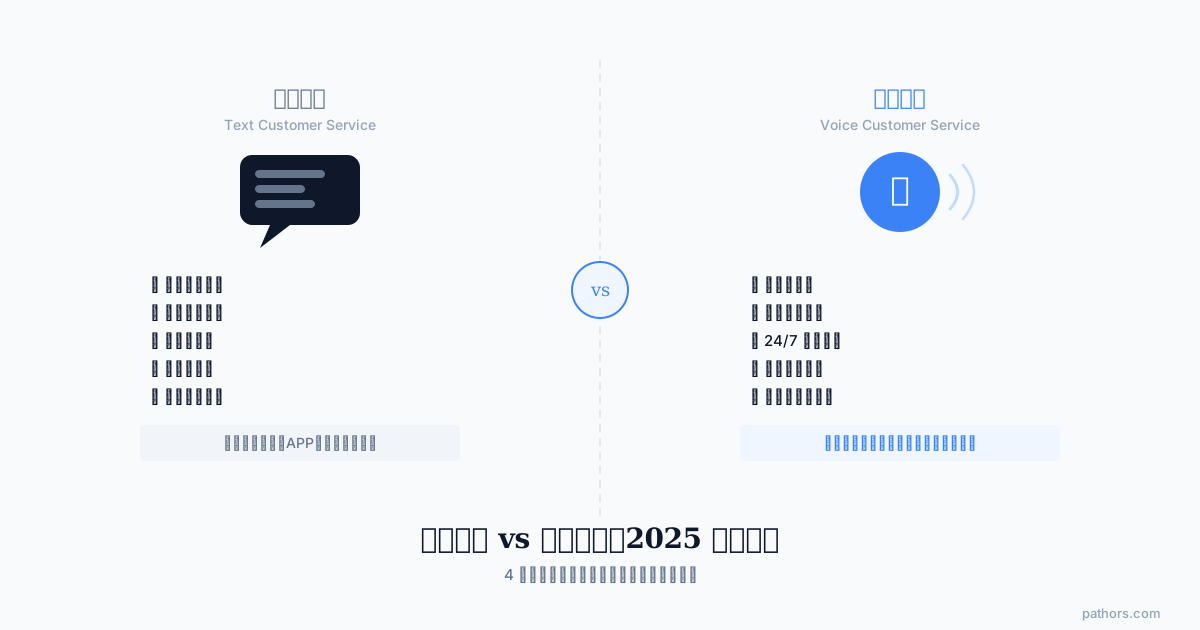
"We already have a chatbot on our website and LINE channel — do we really need voice AI too?" It's the right question, but the answer isn't yes or no. Text vs. voice customer service is a channel strategy decision, not a technology preference. The right answer depends on your customer demographics, service context, and what kinds of problems your support channel actually handles.
In 2025, both paths are technically mature. The differentiators are no longer whether they work — it's whether they match your specific usage patterns.
Here are the four questions that should drive the decision.
Question 1: What Does Your Customer's Natural Behavior Look Like?
Before comparing features or pricing, ask a simpler question: when a customer reaches out to you, what are they physically doing at that moment?
Consider two scenarios:
Scenario A: E-commerce product inquiry
A customer is browsing on their phone, sees something confusing, and their fingers are already on the glass. Typing is the path of least resistance. The question might also need a screenshot, a product URL, or a comparison table — text is the natural medium for that.
Scenario B: Restaurant reservation or clinic appointment
A customer is driving, cooking, or putting their kid to bed when they think to book. Opening an app, finding a chat widget, and typing a request creates real friction. Calling and saying "I'd like a table Friday at 7 for two" takes under 10 seconds.
Voice AI's core advantage is zero-finger interaction. In any hands-busy or low-friction scenario, voice wins. In any screen-first, detail-heavy scenario, text wins.
Question 2: How Complex and Ambiguous Are Your Typical Inquiries?
Text and voice handle complexity differently — not better or worse, just differently.
Where text chatbots excel:
Where voice AI excels:
The critical difference: voice AI has a much shorter tolerance window for misunderstanding. In text, a confusing response can be re-read, scrolled back, or screenshotted. In voice, if the AI misinterprets and responds with something off-target, frustration escalates immediately.
This means voice conversation design demands higher investment in disambiguation logic, graceful error handling, and fallback to human handoff. If you're not prepared to invest in that design quality, a text chatbot may be a safer first step.
Question 3: What Are Your Service Hours and Urgency Profile?
If your customer service demand is concentrated in business hours and your user base skews young and app-native, a text chatbot may serve you well.
But if any of the following apply, voice AI should be a priority:
High after-hours inquiry volume
Clinics, restaurants, hotels, and tutoring centers see substantial evening and weekend inquiry traffic. A chatbot that doesn't push notifications is a passive channel — a phone line that picks up is active.
Older customer demographics
Customers over 50 call. Full stop. Investing exclusively in text-first automation leaves a significant segment underserved.
Time-sensitive services
Insurance claims notification, roadside assistance, medical appointment urgency — customers in these situations don't want to type. They want to talk and be heard immediately.
Local service businesses
Community clinics, neighborhood restaurants, local car shops — these businesses' customers default to "just call them." Meeting that expectation with intelligent automation is more natural than trying to migrate them to a chat channel.
A data point worth considering: in Taiwan, SMBs lose significant revenue potential annually from missed calls outside business hours. That's not a hypothetical — it's unanswered voicemails and competitors who do pick up.
Question 4: What's Your IT Integration Complexity Tolerance?
Text and voice automation have different integration profiles.
Text chatbot integration typically follows a well-worn path: LINE Bot API, web widget SDKs, Messenger connector. Most vendors have plug-and-play connectors. Ongoing maintenance focuses on conversation script updates and knowledge base management.
Voice AI integration involves more layers:
This doesn't mean voice AI is harder — it means it benefits more from a vendor who can own the full integration stack rather than handing you components to assemble. The value of an end-to-end platform over a DIY approach is highest in voice deployments.
Our View: Not Either/Or — Define the Division of Labor
After working with dozens of enterprise deployments, our view is clear: text and voice customer service are complementary channels, not competing options.
The optimal architecture for most service businesses:
Pathors is built for this division-of-labor model. Our voice AI platform integrates with your existing text-channel investments, with both channels surfacing to a unified interaction log. Your team sees the full customer journey regardless of whether the touchpoint was a call or a chat.
If you're unsure which channel deserves priority investment first, we can analyze your inbound call data and give you a concrete recommendation within a week.