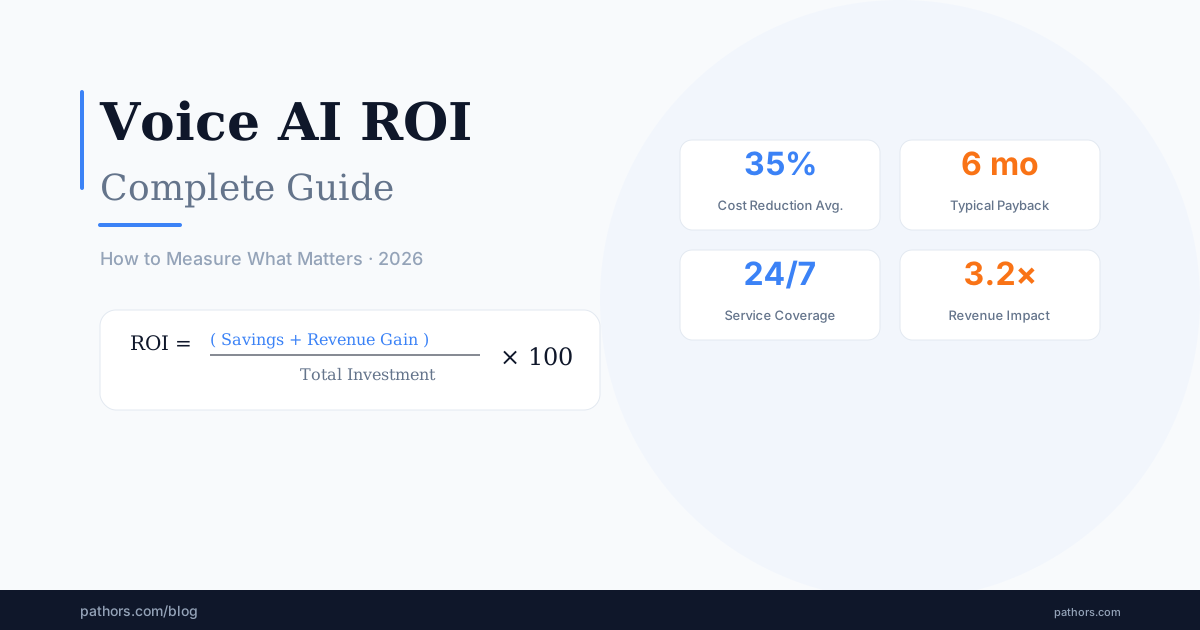
We have watched more AI projects die in the budgeting phase than in production. The pattern is always the same: the CX team runs a promising pilot, gets excited about the technology, walks into a budget meeting, and the CFO asks a simple question — "What is the ROI?" Silence. Or worse, a vague answer about "improving customer experience" that does not translate into financial terms. According to a 2025 Bain & Company survey, the inability to articulate clear ROI is the number one reason AI projects fail to secure funding, cited by 61% of enterprises that shelved planned deployments. This guide exists to make sure your voice AI project does not become that statistic. We will walk through a structured approach to calculating, validating, and presenting voice AI ROI — with actual formulas, real benchmarks, and the pitfalls that trip up most teams.
The Three Layers of Voice AI ROI
Most ROI calculations focus exclusively on cost savings — replacing human agents with AI. That captures maybe 40% of the actual value. We think about voice AI ROI in three distinct layers, each progressively harder to measure but often more valuable.
Layer 1: Direct Cost Savings
This is the most straightforward layer. Voice AI handles calls that previously required a human agent, directly reducing labor costs.
The core formula is:
Monthly savings = (Calls handled by AI x Average cost per human-handled call) - Monthly AI platform cost
Let us make this concrete. A mid-size contact center handles 20,000 inbound calls per month. Average fully-loaded cost per human-handled call (including salary, benefits, training, facilities, and technology) is $4.80. If voice AI achieves a 35% containment rate — meaning 7,000 calls are fully resolved without a human — the math looks like this:
Deloitte's 2025 Global Contact Center Survey reports that the average fully-loaded cost per call ranges from $3.50 to $8.20 depending on industry and region, with financial services at the higher end. Use your own numbers, not industry averages.
Layer 2: Revenue Impact
This layer is where most teams leave money on the table. Voice AI does not just save costs — it can generate revenue.
Extended service hours. If your contact center operates 10 hours a day and voice AI runs 24/7, you capture calls that previously went to voicemail or were abandoned. Forrester's 2025 CX research found that 23% of calls to businesses arrive outside standard operating hours. If even 15% of those after-hours callers convert to a sale or retain their subscription, the revenue impact is significant.
Reduced abandonment. Voice AI eliminates hold times. The average queue abandonment rate in APAC contact centers is 12.4% (COPC 2025 benchmark). Each abandoned call is a potential lost customer or sale. If your average customer lifetime value is $2,400 and you prevent even 2% of abandonments from churning, the revenue retention numbers compound quickly.
Upsell and cross-sell. AI agents can be programmed to identify upsell opportunities during routine calls. A Taiwanese telecom client measured a 6.2% upsell rate on AI-handled billing inquiry calls — calls where human agents historically never attempted to sell because they were focused on resolving the issue quickly.
Layer 3: Operational Intelligence
This is the layer most teams completely miss, and it is often worth more than the first two combined over a 3-year horizon.
Every call handled by voice AI generates structured data: what customers are asking about, where they get confused, what language they use to describe problems, which call flows have high drop-off rates. This data feeds back into product development, marketing, and operational improvement in ways that are hard to quantify upfront but become obvious in retrospect.
McKinsey's 2025 AI Value Report found that companies using AI-generated customer interaction data to inform product decisions saw 18% faster time-to-market for new features compared to those relying on traditional survey data. The voice AI system becomes a continuous market research engine that you are already paying for.
Building Your ROI Model Step by Step
Here is the step-by-step process we use when building ROI models with enterprise clients. We recommend building this in a spreadsheet and stress-testing every assumption.
Step 1: Baseline Your Current Costs
Gather these numbers from your operations team:
Step 2: Estimate AI Containment Rate
Containment rate — the percentage of calls fully resolved by AI without human transfer — is the single most important variable in your model. Be conservative. Industry benchmarks from Gartner's 2025 data:
Weight these by your actual call mix. If 40% of your calls are simple, 35% moderate, and 25% complex, your blended containment rate estimate might be: (0.40 x 0.75) + (0.35 x 0.40) + (0.25 x 0.15) = 0.30 + 0.14 + 0.04 = 48%.
Step 3: Calculate Direct Savings
Monthly direct savings = (Monthly call volume x Containment rate x Cost per call) - AI platform monthly cost
Using our example: (20,000 x 0.48 x $4.80) - $4,500 = $46,080 - $4,500 = $41,580 per month.
Step 4: Estimate Revenue Impact
This requires more assumptions, so build three scenarios (conservative, moderate, optimistic):
Step 5: Factor in Implementation Costs
Do not forget the one-time and ongoing costs:
Step 6: Calculate Payback Period
Payback period = Total implementation cost / Monthly net savings
A well-scoped voice AI project typically pays back in 2-4 months. If your model shows a payback period longer than 6 months, either the implementation costs are too high or the containment rate assumption is too conservative — revisit both.
Common ROI Pitfalls — What Most Teams Get Wrong
We have reviewed over 50 voice AI ROI models from enterprise prospects. These mistakes appear in more than half of them.
Pitfall 1: Using Average Handle Time as the Cost Basis
AHT measures only the call itself. The real cost includes after-call work (documentation, follow-up actions), idle time between calls, training time, and overhead allocation. Bain & Company's 2025 analysis found that the true cost of a call is typically 1.6-2.1x what you get from a simple AHT-based calculation. Use fully-loaded cost, not AHT multiplied by hourly wage.
Pitfall 2: Assuming 100% of Contained Calls Are Pure Savings
When AI handles 35% of calls, you cannot fire 35% of your agents. You still need the same peak staffing for the remaining 65% of calls, plus agents for AI escalations. The real savings come from: not hiring additional agents as volume grows, reducing overtime, improving schedule adherence, and eventually right-sizing through natural attrition. A realistic labor savings realization rate is 60-75% of the theoretical maximum in year one, rising to 85-90% by year two as you optimize staffing models.
Pitfall 3: Ignoring the Cost of Bad AI Interactions
When AI mishandles a call, the customer calls back — now angrier, needing more agent time. Factor in a "failure cost" for calls where AI attempts handling but fails. The formula: (AI-handled calls x failure rate x cost of re-handling). If your AI has a 15% failure rate and re-handled calls cost 1.5x normal calls, that is a meaningful offset to your savings.
Pitfall 4: Not Accounting for Ramp-Up
Voice AI does not hit full containment on day one. Plan for a 60-90 day ramp where containment rate gradually improves as the system learns from real interactions. In month one, expect 60-70% of your steady-state containment rate. Build this ramp into your financial model so you do not over-promise early returns.
Pitfall 5: Measuring ROI at a Single Point in Time
ROI compounds. The voice AI system improves over time as it handles more calls and you tune it. Meanwhile, labor costs increase 3-5% annually. The ROI in year three will be significantly higher than in year one. Model at least a 3-year horizon to capture this compounding effect.
Benchmarks: What Good Looks Like
Based on aggregated industry data from Gartner, Forrester, COPC, and our own observations across APAC deployments, here are the benchmarks we use for 2026:
| Metric | Below Average | Average | Above Average | Best-in-Class |
|---|---|---|---|---|
| AI Containment Rate | <25% | 25-40% | 40-55% | >55% |
| Cost per AI-Handled Call | >$1.50 | $0.80-$1.50 | $0.40-$0.80 | <$0.40 |
| Cost Reduction vs. Baseline | <15% | 15-30% | 30-45% | >45% |
| AHT Reduction (Agent-Handled) | <5% | 5-12% | 12-20% | >20% |
| CSAT Change | Negative | Neutral | +2-5 points | >+5 points |
| Payback Period | >6 months | 4-6 months | 2-4 months | <2 months |
| Year 1 ROI | <100% | 100-200% | 200-350% | >350% |
A few notes on these benchmarks. Containment rate varies enormously by call type mix — a utility company with mostly outage-status calls will naturally achieve higher containment than a healthcare provider handling complex insurance claims. CSAT can go negative if the AI experience is poorly designed, which is why we always recommend measuring it explicitly during POC rather than assuming improvement.
The cost per AI-handled call metric is particularly useful for comparing platforms. It captures both the platform fee and the efficiency of the AI in handling calls quickly. If Platform A charges less per minute but takes twice as long to resolve calls, Platform B might have a lower cost per handled call despite higher unit pricing.
From ROI Model to Business Case
Having a solid ROI model is necessary but not sufficient. You need to package it into a business case that resonates with different stakeholders.
For the CFO: Lead with Payback Period and Risk Mitigation
CFOs care about two things: how fast they get their money back, and what happens if the project fails. Present the payback period prominently. Then address downside risk: most voice AI platforms charge on a usage basis with no long-term commitment, so the financial exposure if the project underperforms is limited to implementation costs plus a few months of platform fees. Compare this to the risk of doing nothing — rising labor costs, increasing call volumes, and competitors who are already deploying AI.
According to IDC's 2025 spending forecast, APAC enterprises that delayed AI deployment by 12 months faced 23% higher implementation costs due to talent competition and platform price increases.
For the CX Leader: Lead with Customer Impact Metrics
Show the reduction in average speed to answer (from minutes to seconds) and 24/7 availability. Forrester found that a 1-point CX Index improvement correlates with $31-$65 million in incremental revenue for large enterprises.
For the IT Leader: Lead with Integration Simplicity
Address concerns proactively: API-based integration with existing telephony, no core system changes, data encryption, compliance certifications, and a clear rollback plan.
For the Operations Leader: Lead with Workforce Impact
Be honest — voice AI changes agent roles, not eliminates them. Agents handle fewer repetitive calls and more complex interactions. COPC's 2025 data shows contact centers using AI-assisted routing report 19% lower agent attrition.
The One-Page Summary
Structure your executive summary as: Problem, Solution, Investment (implementation + 12-month operating cost), Return (savings + revenue), Payback period, and Risk mitigation. Keep it to one page with the detailed model in an appendix.
Calculating voice AI ROI is not about proving the technology works — it is about proving the investment makes financial sense for your specific situation. The frameworks and formulas in this guide give you the tools to build that case with confidence. Start with your real numbers, be conservative in your assumptions, and model at least a three-year horizon to capture the compounding benefits. If you want help building your ROI model, Pathors provides a free ROI calculator and a 30-day pilot that generates real performance data you can plug directly into your business case. The numbers are more convincing when they come from your own call center, not a vendor's slide deck.
Frequently Asked Questions
What is a realistic containment rate to use in our ROI model?
For a first deployment focusing on your top 5-10 call types, plan for 30-45% blended containment rate in steady state (after 90 days of tuning). Simple call types like account balance inquiries or order status checks can reach 70-85%, while complex scenarios like disputes or technical troubleshooting might only hit 10-20%. The blended rate depends entirely on your call mix. We strongly recommend using your actual call type distribution rather than industry averages — analyze a sample of 500-1,000 calls to categorize them by complexity before building your model.
How long does it take to see positive ROI from voice AI?
Most well-scoped deployments reach breakeven in 2-4 months, with the variance driven primarily by implementation complexity and call volume. Higher call volumes reach breakeven faster because the fixed implementation cost is amortized across more calls. A contact center handling 20,000+ calls per month with a straightforward integration typically breaks even within 8 weeks. Smaller operations (under 5,000 calls per month) may take 4-6 months. If your model shows breakeven beyond 6 months, revisit either the scope of your deployment or the platform cost — something is likely misaligned.
Should we include CSAT improvement in our financial ROI calculation?
Yes, but carefully. CSAT improvement is real and measurable, but translating it to dollars requires assumptions about customer retention and lifetime value that are hard to validate upfront. We recommend including it as a separate line item labeled "revenue protection" rather than blending it into the core savings calculation. Use your company's existing data on the correlation between CSAT scores and churn rates. If you do not have that data, use Forrester's benchmark that a 1-point CSAT improvement reduces churn by 2-4% in subscription businesses. Present it as upside potential rather than guaranteed return.
What costs do teams most commonly forget when building a voice AI ROI model?
The five most commonly overlooked costs are: (1) internal team time for ongoing tuning and monitoring — plan for 10-20 hours per month, (2) the cost of failed AI interactions that require human re-handling, typically at 1.3-1.5x the cost of a normal call, (3) telephony costs for SIP trunking and phone numbers, which can add $500-2,000 per month, (4) the opportunity cost of the 60-90 day ramp period when containment rate is below steady state, and (5) change management and agent retraining costs, which are usually $200-500 per agent for the initial transition. Missing any of these can make your model look 15-25% more optimistic than reality.
How do we measure the ROI of voice AI handling after-hours calls?
Start by measuring how many calls currently arrive outside your operating hours — most telephony systems log this even if the calls go to voicemail. Then track two metrics once AI is live: (1) after-hours calls successfully contained by AI, and (2) outcomes of those calls (issues resolved, appointments booked, sales completed). The revenue formula is: after-hours calls x containment rate x conversion rate x average transaction value. For service calls, use cost avoidance: each after-hours call resolved by AI is one fewer callback your agents handle the next morning. In our experience, after-hours call handling typically contributes 8-15% of total voice AI ROI.
What ROI metrics should we track on an ongoing basis after deployment?
We recommend a monthly ROI dashboard with these metrics: (1) containment rate by call type — track trends, not just the aggregate, (2) cost per AI-handled call versus cost per human-handled call, (3) total calls handled by AI and corresponding cost avoidance, (4) CSAT scores for AI-handled versus human-handled calls, (5) escalation rate and reasons for escalation, (6) after-hours call volume and resolution rate, and (7) cumulative ROI versus the original business case projection. Review monthly for the first six months, then quarterly. The most important thing is comparing actual performance to your original model assumptions so you can update projections and identify tuning opportunities.
Is voice AI ROI different for APAC markets compared to US or European markets?
Yes, in several meaningful ways. First, labor cost arbitrage is often smaller in APAC because agent salaries are already lower than in the US, which means the per-call savings are smaller in absolute terms — but platform costs are also frequently lower for APAC-focused providers. Second, the multi-language requirement means containment rates can be lower initially if the platform struggles with dialect handling, making language accuracy a direct ROI driver. Third, APAC call durations tend to be longer (4.2 minutes average in Taiwan versus 3.1 in the US per Deloitte), which affects per-minute pricing models significantly. Finally, regulatory compliance costs for data residency and consent management should be factored into APAC models — these can add $500-3,000 per month depending on the platform and jurisdiction.