In 2024, the conversation was about whether ChatGPT could write copy. In 2025, the focus shifted to whether AI Agents could complete full workflows autonomously. By 2026, the most important frontier has moved from text to voice — because businesses worldwide have finally realized that the highest-frequency, highest-cost customer interaction channel isn't a chat window. It's the phone.
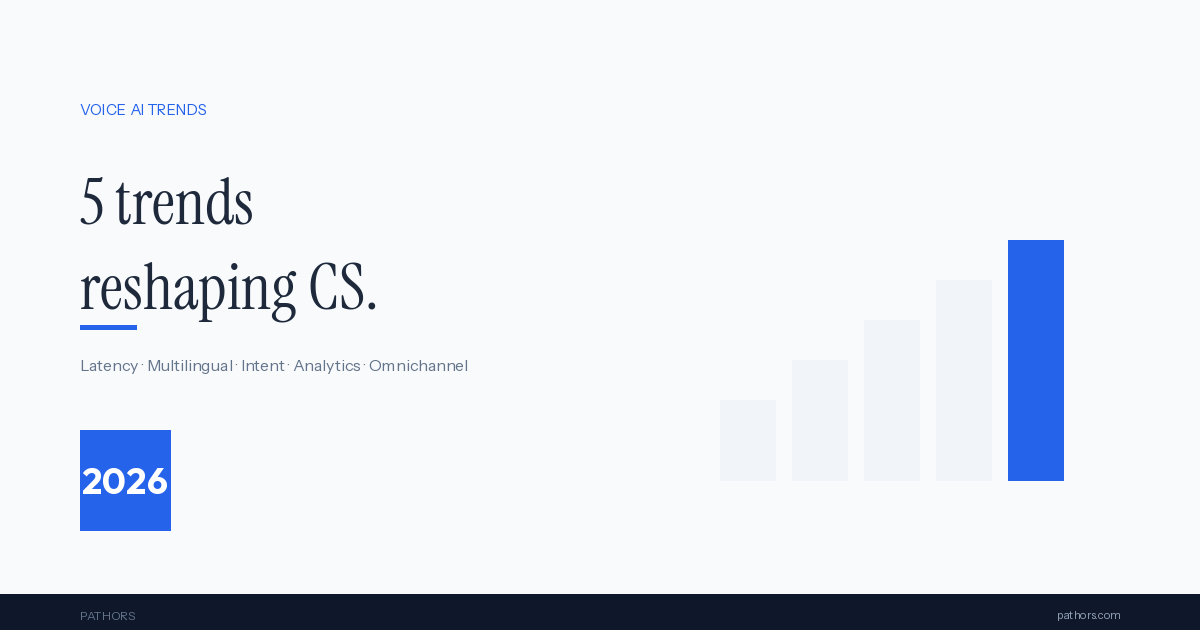
Voice AI isn't a new concept, but the technical breakthroughs of the past two years have transformed it from "barely usable" to "genuinely good." Here are five trends we're watching reshape the customer service industry.
Trend 1: End-to-End Latency Breaks the 500ms Barrier
The biggest experience bottleneck in voice AI has always been latency. If there's more than one second between when a customer finishes speaking and when the AI starts responding, the conversation feels "choppy." Legacy architectures required three sequential steps — speech-to-text (STT), large language model inference (LLM), then text-to-speech (TTS) — adding up to 1.5–2 seconds end-to-end.
The 2026 trend is end-to-end voice models: instead of decomposing speech into text for processing, they go directly from voice input to voice output. This architecture pushes latency below 500 milliseconds — close to the response time of natural human conversation. The impact on customer service is enormous: callers no longer feel like they're talking to a machine, and both call completion rates and satisfaction scores rise significantly.
Trend 2: Multilingual and Dialect Support Becomes Standard
Early voice AI was essentially English-only, with other languages being an afterthought. As multilingual voice models have matured, recognition quality for Mandarin, Japanese, Korean, Spanish, and other major languages is now approaching English-level accuracy.
More notable is dialect support. In Taiwan, Hokkien (Taiwanese) recognition accuracy is improving rapidly. In Southeast Asia, support for Indonesian, Thai, and Vietnamese is advancing. This means voice AI is no longer just a tool for Western companies — businesses across Asia-Pacific can finally deploy AI customer service in their customers' native languages and dialects.
Trend 3: From "Answering Calls" to "Understanding Intent"
First-generation voice AI was essentially a talking chatbot: hear the question, search the knowledge base, read out the answer. The voice AI of 2026 is beginning to demonstrate deeper intent understanding and multi-step reasoning.
Concretely, AI can now complete multiple related tasks within a single call. For example, if a customer says "I'd like to change tomorrow's appointment, and while I'm at it, can you tell me about parking fees?" — the AI doesn't need the customer to ask twice. It handles both intents in one conversation. This capability comes from the LLM's function calling and tool-use abilities: the AI can invoke external systems (check appointment availability, modify the time slot, query pricing) all within a single phone call.
Trend 4: Voice Analytics Shifts from "Post-Call Reports" to "Real-Time Coaching"
Traditional voice analytics was a retrospective process — after a call ended, transcribe it, run sentiment analysis, generate a report. The 2026 trend is real-time voice analytics: AI can detect emotional shifts in a customer's voice during the call, identify keywords and intent pivots, and provide live guidance on the agent's screen.
The implications for contact center management are significant. Supervisors no longer need to review recordings after the fact for quality control — they can intervene while the call is still happening. When AI detects an escalating customer, it can automatically prompt the agent to slow down, use specific de-escalation language, or transfer to a senior representative.
Trend 5: Voice AI Becomes the "Unified Brain" Across All Channels
Historically, enterprise customer service channels operated in silos — one system for phone, another for LINE, another for web chat. The 2026 trend is using voice AI as the unified intelligence layer across all channels. The same AI engine, the same knowledge base, the same SOP logic — whether a customer calls, sends a LINE message, or types on the website, the quality of the response is consistent.
Taking it further: cross-channel conversation continuity. A customer who asked a question via LINE in the morning and calls to follow up in the afternoon can have the AI pick up exactly where the morning conversation left off — no re-explanation required. This experience is rare today, but it's already technically achievable.
What Do These Trends Mean for Your Business?
For companies considering AI customer service adoption, these trends carry a clear message: now is the best time to start. The technology has crossed the threshold from "barely adequate" to "genuinely good," and the pace of improvement means the system you deploy today will only get stronger — not weaker — over time.
The cost of waiting is rising, because your competitors may already be answering phones with AI.
For more analysis on AI voice customer service trends, follow the Pathors Tech Blog. This is precisely the direction we're building toward at Pathors — an AI voice platform that supports multilingual, low-latency, omnichannel customer service.