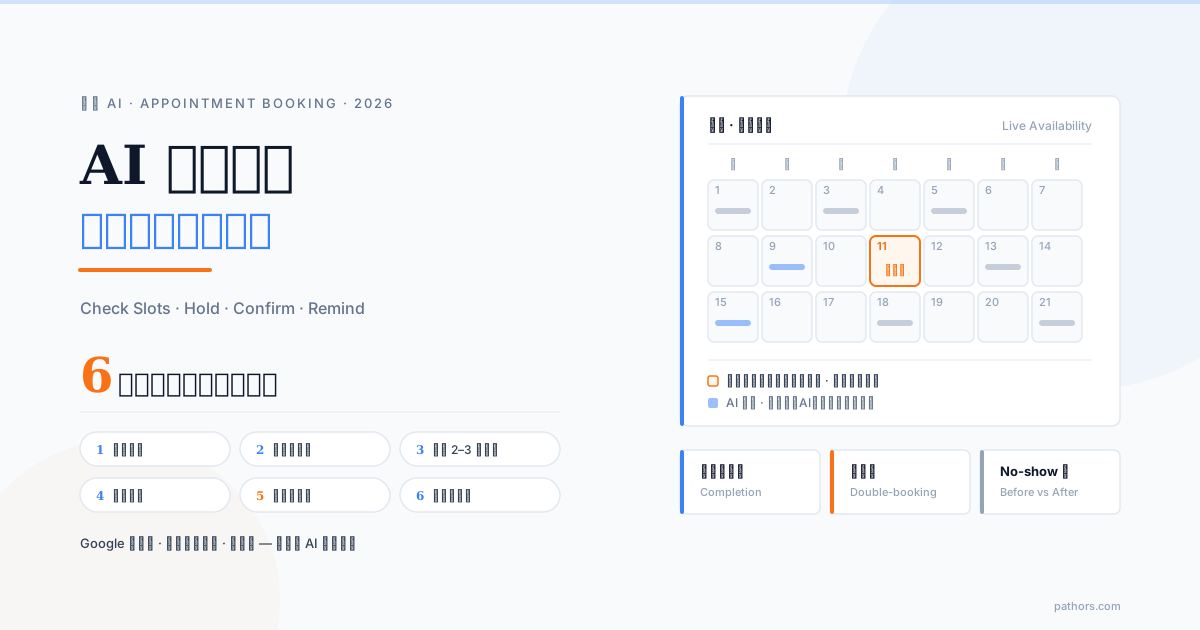
Whether AI phone booking works has little to do with how natural the voice sounds. It depends on whether the AI can check real-time availability during the call, write the booking into your calendar or booking system, and then send confirmations and reminders automatically. A well-designed booking call breaks into six steps: confirm the request, check live availability, offer two or three options, confirm details, write to the system, send confirmation and reminders. Double bookings, wrong slots, and reschedules that never sync almost always trace back to one of those steps, not to the AI mishearing.
This is a cross-industry design guide: clinic appointments, restaurant reservations, salon bookings, repair drop-offs, and consulting sessions all follow the same flow. You do not need a booking system to start; Google Calendar or a spreadsheet will do. But availability rules and double-booking safeguards must be settled before launch, because those are business rules, not something the AI can guess. Industry specifics are covered in the clinic and restaurant articles linked at the end.
The short version: six steps in one booking call
Clinic, restaurant, or salon, the AI walks the same path on every booking call. What changes is the system each step connects to and the rules it applies.
| Step | What the AI does | What it connects to | Where it usually breaks |
|---|---|---|---|
| 1. Confirm the request | Understand the service, party size or staff preference, and preferred time | Knowledge base (services, durations, bookable staff) | Callers use everyday words; "teeth cleaning" has to map to the right service |
| 2. Check live availability | Find open slots according to business rules | Calendar API, booking-system API, or a spreadsheet | Reading cached or stale data instead of the live state |
| 3. Offer 2 to 3 options | Read available slots as sentences people can follow | None | Listing five or six slots at once; callers cannot keep track |
| 4. Confirm details | Name, phone, party size or service, special requests | Caller ID, customer records or CRM | Asking three things in one breath and losing one of the answers |
| 5. Write to the calendar or booking system | Hold the slot, then write, and re-check on failure | Same as step 2 | Telling the caller "you are booked" when the write actually failed |
| 6. Confirm and remind | SMS or LINE confirmation, day-before reminder, write replies back | SMS gateway, LINE official account, outbound calling | A caller replies "need to reschedule" and nobody sees it |
What to connect: a calendar, an existing booking system, or a spreadsheet for now
Before choosing, ask one question: what does the front desk use to schedule today? The AI must look at the same data the front desk looks at. Otherwise you will double book no matter how good the technology is.
| Integration | Real-time | Double-booking protection | Setup time | Best for |
|---|---|---|---|---|
| Google Calendar / Microsoft 365 | High; API reads and writes are near-instant | The calendar itself does not block overlaps; holds and capacity rules live on the AI side | Short; typically days to one or two weeks (rule of thumb) | Salons, consultants, repair shops, single-location businesses that schedule by staff member or equipment |
| Existing booking system (clinic HIS, restaurant reservation platform, salon booking SaaS) | Depends on whether the system exposes an API | Best; the system handles capacity and conflicts natively | One to several weeks with an API; without one, manual or semi-automated sync stretches the timeline | Businesses that already have a system and whose front desk actually schedules in it |
| Spreadsheet | Medium; AI reads and writes instantly, but manual entries lag | Weak; you build the lock column and capacity checks yourself | Shortest; running within days | Businesses validating the flow, with low volume, that have not chosen a system yet |
A common path is to get the flow working on a calendar or spreadsheet first, then move to the real booking system. The rules table carries over; the safeguards need re-verifying.
Write the availability rules first: they are business rules, not AI guesses
What decides whether a slot can be taken is a set of rules only the business knows. Unwritten, the AI takes the most permissive reading and books people into the lunch break, a stylist's day off, or a clinic session that is already full.
Before launch, write these into an availability rules table:
A salon example: the caller says "Wednesday at three, color, with Amy." The AI checks Amy's Wednesday calendar, takes 15:00 plus 2.5 hours plus a 15-minute buffer, and accepts only if nothing is booked before 17:45 and Wednesday is not her day off. Every condition was set by the business; the AI just executes.
A practical check: throw ten different caller requests at the rules table. Each must resolve to "can book" or "cannot book." The one that does not is the rule you have not written yet.
Preventing double bookings: hold first, confirm second, re-check on failure
Double bookings come from four sources, each with its own fix.
Two calls discussing the same slot at once. Use hold-then-confirm: once the AI finds an open slot, it places a three-to-five-minute hold, then confirms details with the caller. Only a yes turns the hold into a real booking. The second call sees the held slot and is steered to the next option. If the caller hesitates past the window, the hold expires and the AI re-checks before offering again.
Write failures. When the API returns an error or a conflict, the AI must go back to the availability step and offer new options. One rule: only after the system returns success may the AI tell the caller the booking is done.
Sync delays. Direct API reads and writes are near-instant. But if the integration is a scheduled sync, say every five minutes, those five minutes are the double-booking window. Re-check right before writing, shorten the interval, or have the AI write to the primary system instead of a copy.
Two sources: the front desk plus the AI. The most common double booking and the hardest to solve with technology. The front desk writes a booking on paper and enters it later; in between, the AI sees the slot as free. The only real rule is one shared system with immediate entry. If that is not achievable yet, designate one source as primary, sync the other one way, and prefix AI-created events (for example, "AI") so reconciliation can tell them apart.
Capacity-based settings like restaurants add one detail: a double booking is not "the slot is taken" but "this seating already has six tables." Write the rule as a count, and have holds decrement it rather than block the whole slot.
Designing the details-confirmation dialogue
Phone confirmation is not a web form. Callers cannot hold long sentences in their head or re-read anything. A few principles:
As a rule of thumb, a smooth booking call lands between one and a half and three minutes. Past four, the confirmation questions are too wordy or too many options were offered.
Rescheduling and cancellation: find the booking, release the slot, track no-shows
Changes have one more step than new bookings: find the original.
Confirmation and reminders: SMS, LINE, AI outbound, and writing replies back
What happens after the call decides whether the customer shows up.
Send a confirmation immediately. SMS or LINE with a fixed template: business name, date and time with weekday, service, staff member, address, and how to change or cancel. It is also the last line of defense against a misspelled name.
Day-before reminder. SMS or LINE is usually enough. When a no-show is expensive (a first clinic visit, a three-hour color service, a repair bay held open), switch to an AI outbound call. It turns "will you attend" into a conversation: the customer says "move it to next week," and the AI reschedules on the spot. For calling-hour limits and compliance, see the outbound section of the phone AI complete guide.
Write replies back. When a customer replies "1 to confirm, 2 to reschedule," or says "I will be there" on an outbound call, that status must land in the booking system (confirmed, rescheduled, cancelled) so the front desk sees it in the morning. This step is skipped most often: reminders go out, replies come in, nobody looks.
Suggested timing: the afternoon before, plus the morning of for high-cost services. More than that feels like spam.
Three numbers to watch after launch
Do not track dozens of metrics at first. Watch three.
| Metric | How to calculate | What to do with it |
|---|---|---|
| Booking completion rate | Of calls with booking intent, the share successfully written to the system | If low, find the step where calls drop: no availability, confirmation too long, or write failures |
| Double-booking / error rate | Of AI-created bookings, the share corrected by the front desk or found overlapping | Target near zero; trace every case to a missing rule or a sync delay |
| No-show rate | Booked, did not show, did not cancel | Compare before and after launch to see whether reminders work |
Make the no-show comparison fair: take four to eight weeks before launch as the baseline, use the same definition, compare an equal-length period after launch, and split "received a reminder" from "did not." Totals alone make it easy to credit seasonal swings to the AI.
One habit that is not a number but pays off: for the first two weeks, listen to ten booking-call recordings a day, specifically for how the AI reads dates, confirms details, and responds when a write fails. Most rule gaps surface there.
Stable AI phone booking comes down to three things, none of them the model: the AI and the front desk share one calendar or booking system, availability is written as explicit business rules, and slots are held before writing, with success reported only after the system confirms. Get those right and clinics, restaurants, and salons run on the same flow with different rules tables.
If you are still evaluating phone AI as a whole, start with What is phone AI: the 2026 complete guide. For industry specifics, see AI appointment calls for clinics and AI reservations for restaurants. If most of your booking calls arrive after hours, designing after-hours phone AI is the next read.
Frequently Asked Questions
Can AI phone booking connect to Google Calendar?
Yes, and it is the most common starting point. The AI reads and writes your Google Calendar or Microsoft 365 calendar through the API in real time, so a booking made on the phone becomes an event immediately. One caveat: the calendar itself does not block overlapping events, so capacity, service durations, buffers, and temporary holds have to be configured on the AI side rather than left to the calendar.
Will the AI double book?
Not if the flow is designed correctly. Three things matter: the AI and the front desk use the same calendar or booking system; the AI places a short-lived hold on a slot before confirming with the caller; and on a write failure it re-checks availability and only reports success after the system confirms. Most real double bookings come from the front desk writing on paper and entering it later, which is a process fix, not a technical one.
What if a customer wants to change the time at the last minute?
The AI finds the original booking by caller ID, reads it back, and runs the reschedule flow: check the new slot, hold it, confirm the write succeeded, then release the old slot. The order cannot be reversed, or the caller can lose the original slot without getting the new one. Cutoff rules, such as changes within 24 hours going to a human, are set by the business in advance; outside those rules the AI hands off.
Can we start without a booking system?
Yes. Google Calendar or a spreadsheet is enough to run the flow, usually within days, and it suits businesses that want to validate their rules while volume is still low. The difference is that double-booking protection, meaning holds and capacity checks, has to be built on the AI side. Once the flow is stable, move to a proper booking system; the rules table carries over.
Will the AI book the wrong time?
Wrong times usually have two causes: rules that were never written (no lunch break, no buffer) or a weak date-confirmation dialogue. The first is fixed by completing the availability rules table before launch. The second is dialogue design: the AI reads back the weekday, date, and time in plain speech rather than a numeric format, converts relative phrases like next Wednesday into an absolute date, and summarizes everything once before writing.
Where is the booking data stored?
The booking itself lives in the system you choose: Google Calendar, your booking system, or a spreadsheet, the same one the front desk uses. Call recordings and transcripts are stored on the phone AI platform, so confirm the storage location, retention period, and access controls meet Taiwan's Personal Data Protection Act. On the call, the AI reads back only partial information, such as the last digits of a phone number, never full personal data.