Most AI voice customer service deployments that fail don't fail because the technology doesn't work. They fail because the process was wrong. Organizations skip requirements scoping and rush to sign contracts. PoC environments look nothing like production. Testing gets compressed to one week. The first real customers become unwilling beta testers.
There's a repeatable way to do this right. Here's the implementation framework we use with every client.
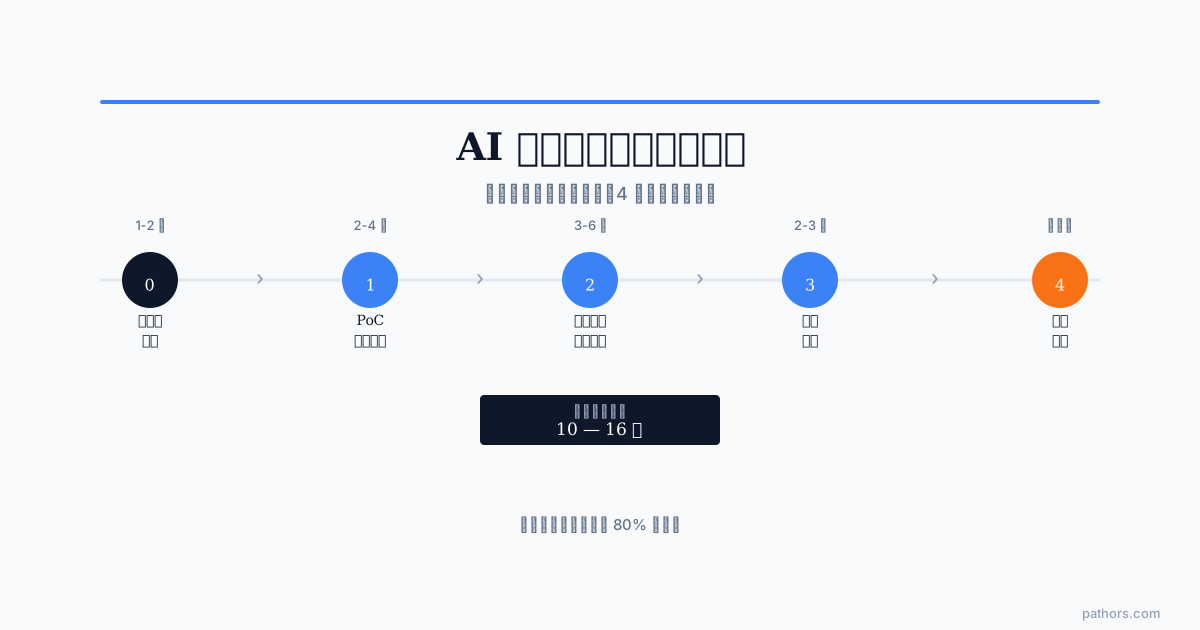
Phase 0: Pre-Implementation Assessment (1–2 Weeks)
Before any contracts are signed or technical work begins, answer three questions:
Question 1: Is Your Service Model a Good Fit for Voice AI?
Voice AI creates the most value in environments where:
If your call volume is dominated by highly unique complex problems, or if your brand depends heavily on personal relationship — voice AI can supplement, but it can't lead.
Question 2: How Complex Is Your Backend Integration?
The ceiling on what your voice AI can accomplish is set by your backend systems. An AI can ask "what time would you like to book?" but if it can't write to your booking system, it can record the answer and nothing more.
Pre-implementation, audit:
Incomplete API access is the most common source of deployment scope surprises. Identify it early.
Question 3: Who Owns This Internally?
This sounds obvious, but it's the most frequently skipped step. AI customer service implementation requires cross-functional ownership:
Without a named owner in each role, decisions stall and timelines slip.
Phase 1: Proof of Concept (2–4 Weeks)
A PoC is not a demo. A PoC's purpose is to validate automation rates against real data before full deployment commitment.
How to Run a PoC That Actually Tells You Something
Choose representative scenarios, not easy ones
Test against your highest-volume call types, including at least one that requires backend integration. A PoC built on your three simplest scenarios will show 95% automation — which means nothing for your real deployment.
Set explicit success criteria upfront
Before the PoC starts, agree on the numbers that mean it worked:
Record everything
All PoC calls should be recorded (with appropriate consent) and reviewed. These recordings are your most valuable design input for the full deployment.
Why Paid PoCs Deliver Better Results
Free PoC offerings typically mean the vendor is deploying a templated environment with minimal customization. You get a prototype, not a pressure test. A paid PoC means your vendor invests real integration work — the resulting analysis report is your ROI decision document, and it's worth the cost.
Phase 2: Conversation Design and System Integration (3–6 Weeks)
Once PoC validates the approach, full build begins on two parallel tracks.
Track A: Conversation Script Design
The single biggest mistake in voice AI scripting is applying text-form logic to a voice medium.
Wrong approach:
> "Please state your full name."
> "Please state your phone number."
> "Please state your preferred appointment date."
This is a form survey read aloud. Callers hate it.
Right approach:
> "Hi, how can I help you today?"
> Caller: "I want to schedule a teeth cleaning for next Thursday."
> AI: "Sure, Thursday works — morning or afternoon? I have 10am and 2pm available."
Design principles for voice conversation:
Track B: Backend Integration
Integration complexity depends on your system state:
| Integration Type | Complexity | Notes |
|---|---|---|
| REST API reads | Low | Order status, availability lookup |
| REST API writes | Medium | Create booking, update record |
| Authenticated operations | Medium-high | Requires secure identity verification flow |
| Legacy system integration | High | May need middleware or RPA layer |
Flag legacy systems early. They can extend timelines significantly.
Phase 3: Testing and Tuning (2–3 Weeks)
Testing is chronically under-resourced. The cost of compressing this phase is paid in early user complaints and emergency patches.
Three Levels of Testing
Functional testing: Walk every branch of every conversation flow. Build a scenario matrix and check off each path.
Load testing: What happens with 20, 50, 100 simultaneous calls? Measure latency, error rates, and system stability under realistic peak conditions.
User acceptance testing: Find 10–20 real users who have never seen the system (not your IT team) and have them try to accomplish actual tasks. Document where they get confused and where they give up.
Voice-Specific Test Cases
These are often missed:
Phase 4: Staged Go-Live
Never flip the switch to 100% on day one.
Weeks 1–2: 10% traffic
Route a small percentage of inbound calls through the AI system. Monitor daily. Confirm no systemic failures before expanding.
Weeks 3–4: 50% traffic
Enough volume for statistically meaningful data. Review low-score call recordings daily. Iterate on conversation scripts quickly.
Week 5+: Full deployment
Once metrics are stable, complete the transition. Maintain human fallback capacity and define automatic transfer triggers for AI failures.
Post-Launch: Continuous Improvement
Launch is not a finish line. Voice AI quality degrades over time if left unmanaged — new products, policy changes, and evolving customer language all create gaps.
Track these metrics monthly:
Run a monthly sample analysis of calls where the AI underperformed. Treat those transcripts as training data for your next conversation design iteration.
If you're in the early assessment stage, or if a prior deployment didn't deliver expected results, Pathors' implementation consulting service is designed to help you get the process right — not just sell you a platform.