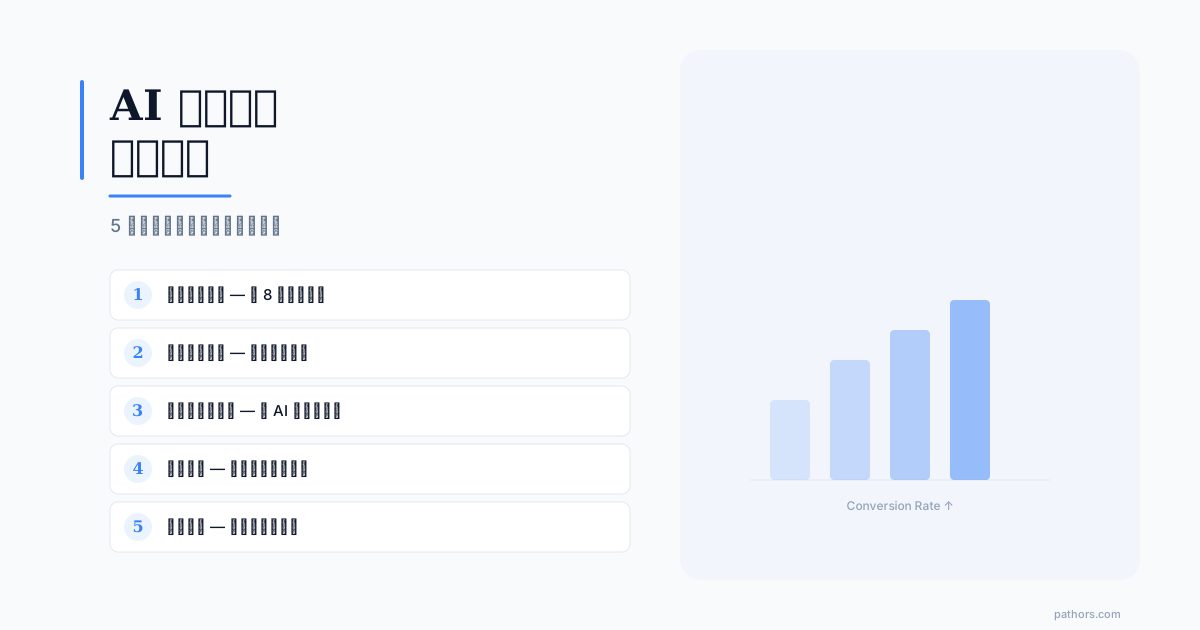
The most advanced AI voice technology will underperform if paired with a poorly designed script. Gartner's 2025 report on conversational AI found that systems with structured conversation design achieve 2.4x higher conversion rates than those with unoptimized scripts. Over the past year, we've helped more than 60 businesses design AI outbound scripts, and we've distilled the learnings into 5 core principles. These aren't theoretical frameworks — they're derived from A/B testing across thousands of real calls.
Principle 1: The 8-Second Opening Hook
According to Marchex's call analytics data, outbound call recipients decide whether to continue listening within the first 8 seconds. The opening is the most critical — and most frequently botched — part of any outbound script.
Lead with Relevance, Not Introduction
Traditional outbound scripts open with "Hi, I'm [name] from [company]." In AI outbound contexts, this approach sees hang-up rates as high as 45%. A more effective approach is "reason-first" — immediately explaining why the recipient is receiving the call.
Example: "Hi, this is regarding the Japanese course inquiry you submitted on our website yesterday. I'm calling to confirm a few details — do you have about two minutes?"
In our A/B tests, this approach improved the listen-through rate from 55% to 78%. The mechanism is simple: recipients stay engaged when they immediately understand the call's relevance to them.
Time Commitment Reduces Resistance
Including an explicit time commitment ("this will take about 2 minutes") in the opening measurably reduces call anxiety. A 2024 ContactPoint study found that openings with time commitments achieved 31% higher completion rates.
Principle 2: Layered Objection Handling
Objections during outbound calls are expected and healthy. McKinsey's 2025 Sales Productivity Report found that successful sales calls average 2.3 objection-handling moments, while failed calls typically end after the first objection.
Categorizing Common Objections
We classify AI outbound objections into four categories:
Two-Layer Response Design
Each objection category needs at least two response layers. Layer 1 is the direct address (e.g., for time objections: "Understood — when would be a better time? Would tomorrow at 3 PM work?"). Layer 2 is the graceful exit when the objection isn't resolved ("No problem at all. I'll send a course summary to your LINE — feel free to reply anytime you're interested.").
Our data shows that scripts with two-layer objection handling achieve 19% higher final conversion rates than single-layer responses.
Principle 3: Dynamic In-Call Personalization
Salesforce's 2025 State of the Connected Customer report shows that 73% of consumers expect businesses to understand their unique needs. In AI outbound, personalization extends far beyond inserting a name in the opening — it means adapting the entire conversation in real time.
Three Tiers of Personalization Data
Effective personalization operates at three levels:
Designing Conditional Branches
For an education enrollment scenario, the AI adjusts course recommendations based on the answer to "How many days per week can you attend?" If the answer is "one day," it routes to weekend intensive programs; "three or more" routes to regular weekday courses.
In Pathors' script design tool, these conditional branches are built through a visual flowchart interface — no coding required. Our testing shows that adding dynamic personalization increased course recommendation acceptance rates from 22% to 41%.
Principle 4: Data-Driven Timing Optimization
Even a perfect script underperforms when delivered at the wrong time. InsideSales.com research demonstrates that timing optimization alone can improve answer rates by 30-50%, though optimal windows vary by industry and audience.
Optimal Call Windows by Industry
| Industry | Best Call Window | Answer Rate Lift |
|---|---|---|
| B2C Education | Wed-Thu, 6-8 PM | +42% |
| Retail/E-commerce | Tue-Thu, 2-4 PM | +35% |
| Financial Services | Mon-Wed, 10 AM-12 PM | +28% |
| Healthcare | Fri, 3-5 PM | +31% |
Adaptive Scheduling
Beyond industry-level windows, AI systems can learn individual recipients' answer patterns. If a recipient has answered three previous calls on Thursday evenings, the system automatically schedules the next attempt at the same time. Pathors' intelligent scheduling engine optimizes call timing based on historical answer patterns, improving answer rates by an additional 23% in production.
Principle 5: Compliance Guardrails and Quality Control
Regulatory compliance isn't optional. In Taiwan, AI outbound calls must comply with the Personal Data Protection Act and telecommunications regulations. A 2024 NCC survey found that 12% of businesses encountered compliance issues with outbound marketing, with average resolution costs of approximately USD 27,000.
Essential Compliance Safeguards
Ongoing Quality Metrics
After script deployment, continuous monitoring is essential. Key metrics to track:
Pathors provides a real-time call analytics dashboard that automatically flags anomalous calls and generates script optimization recommendations. To explore how to design high-conversion AI outbound scripts for your use case, book a free script audit with Pathors.
AI outbound script design sits at the intersection of behavioral psychology, data analytics, and iterative testing. These five principles — opening hook design, layered objection handling, dynamic personalization, timing optimization, and compliance guardrails — form a comprehensive design framework. The most important mindset shift is accepting that scripts are never "done" — continuous A/B testing and data-driven iteration are how conversion rates keep climbing.
Frequently Asked Questions
How much call data do I need before I can start optimizing my AI outbound script?
We recommend at least 200 calls before running the first optimization round. This sample size is sufficient to identify trends in opening hang-up rates, objection type distribution, and call completion rates. After that, iterate every 500 calls.
How often should I update my AI outbound script?
At minimum, conduct a full script review quarterly. High-volume scripts (over 3,000 calls/month) benefit from monthly tweaks. Seasonal campaigns (back-to-school, holiday promotions) require dedicated script versions.
What's the ideal length for an AI outbound call script?
The main conversation thread should target 90-150 seconds. Our data shows completion rates drop 35% beyond 180 seconds. However, this excludes objection handling and Q&A branches — the total branching content typically spans 5-8 minutes.
How should I A/B test my AI outbound scripts?
Test one variable at a time (e.g., opening A vs. opening B) by randomly splitting your call list into two groups of at least 100 calls each. Compare call completion rate and final conversion rate. Avoid testing multiple variables simultaneously — you won't be able to attribute which change drove the result.
Do different industries need fundamentally different AI outbound scripts?
The five core principles apply universally, but implementation details vary significantly. B2C education scripts emphasize time commitments and trial invitations. Retail scripts focus on order relevance and promotional offers. Financial services scripts require stricter compliance language and risk disclosures.
What script design features does Pathors offer?
Pathors provides a visual script flow editor with conditional branching, variable insertion, dynamic content switching, and multi-version A/B testing. The built-in call analytics dashboard shows real-time drop-off rates at each script node, helping designers quickly identify optimization targets.