You are probably here because someone asked you to put together a budget for AI voice customer service, and the vendor proposals on your desk range from $2,000 to $25,000 per month for what sounds like roughly the same thing. That spread is not random — it reflects fundamentally different pricing architectures that are easy to compare on a spreadsheet but behave very differently at scale.
The AI voice market in Taiwan is projected to reach NT$4.2 billion by 2027 (MarketsandMarkets, 2025), growing at 34% CAGR. As more vendors enter the market, pricing has become both more competitive and more confusing. This guide cuts through the noise.
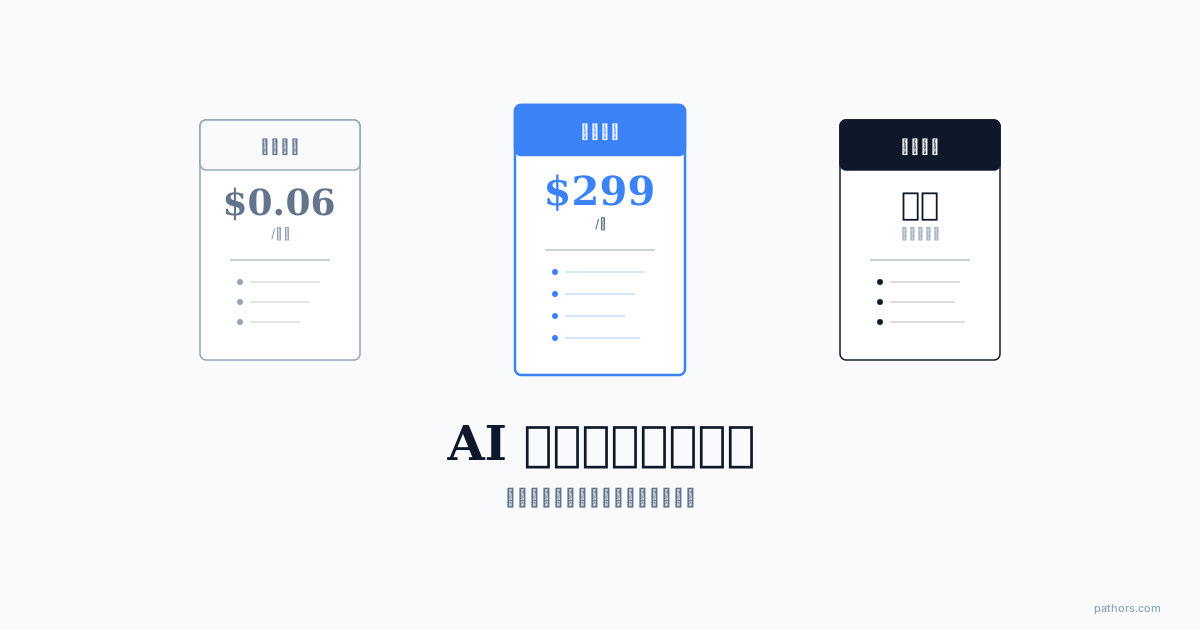
The Four Pricing Models You Will Encounter
Per-Minute Pricing
The most common model for AI voice platforms. You pay for the actual minutes of AI conversation. Rates in the Taiwan market range from NT$1.2-6.0 per minute ($0.04-0.20 USD), depending on the provider and features included.
What is typically included: ASR processing, LLM inference, TTS generation, and basic telephony. What is often extra: CRM integration, custom voice training, recording storage beyond 30 days, and dedicated support.
The advantage: predictable costs that scale linearly with usage. The risk: vendors with low per-minute rates may charge separately for components that others include, making true comparison difficult.
Per-Seat/Per-Agent Pricing
Borrowed from traditional contact center pricing. You pay a monthly fee per AI "agent" (concurrent conversation capacity). Typical range: NT$15,000-45,000 per seat per month.
This model makes sense if your call volume is consistently high and predictable. It penalizes businesses with variable volume — you pay the same during a quiet Tuesday as a peak Monday.
Platform Fee + Usage
A monthly platform fee (NT$30,000-80,000) for access to the system, plus per-minute or per-call charges for actual usage. This model front-loads cost, which can be problematic for pilot deployments. It tends to become more economical at scale because the platform fee is amortized across higher volume.
Revenue Share / Performance-Based
Rare but emerging: the vendor takes a percentage of revenue generated or cost saved through the AI system. Typical range: 10-20% of attributed value. Attractive because it aligns vendor incentives with your outcomes, but difficult to measure accurately and can become expensive if the AI performs well.
Hidden Costs That Blow Up Budgets
Every AI voice vendor we have evaluated has at least one cost that is not in the headline rate. Here are the ones that catch buyers most often:
Telephony pass-through. Some platforms quote AI processing costs only, with PSTN/SIP telephony billed separately at NT$0.4-1.2 per minute. On a 5-minute average call, that adds 20-60% to the effective per-minute rate.
LLM token costs. If the platform passes through LLM API costs (GPT-4, Claude, etc.), your bill fluctuates with model pricing changes and conversation complexity. A single long conversation with many turns can generate surprisingly large token bills.
Custom voice and language training. Fine-tuning the ASR for your industry vocabulary or training a custom TTS voice can cost NT$50,000-200,000 as a one-time fee. Worth it for large deployments, but it is not always disclosed upfront.
Integration and setup fees. CRM connectors, API customization, and workflow configuration: NT$30,000-150,000. Some vendors bundle this into the first year's contract; others charge separately.
Recording storage. Call recordings accumulate fast. At 1,000 calls per day with 4-minute average duration, you generate roughly 4,000 minutes of audio daily. Storage costs vary from free (30-day retention) to NT$0.02-0.05 per minute per month for long-term archival.
How to Calculate True ROI
The ROI formula for AI voice customer service is not just cost reduction — it includes revenue that would otherwise be lost.
Cost reduction components:
Revenue protection components:
A worked example: A business receiving 100 calls/day with 4-minute average duration, currently missing 30% of calls during peaks.
| Component | Monthly Value |
|---|---|
| AI cost (100 calls × 4 min × 30 days × $0.08) | $960 |
| Saved agent time (70 calls × 4 min × 30 days × $0.40) | $3,360 |
| Recovered missed calls (30 calls × 30 days × 40% conversion × $50 avg) | $18,000 |
| After-hours revenue (25 calls × 30 days × 30% conversion × $50) | $11,250 |
| Net monthly ROI | $31,650 |
Pathors Pricing in Context
Pathors uses a per-minute pricing model that includes ASR, LLM orchestration, TTS, and telephony in a single rate — no hidden pass-through charges. For the Taiwan market, this provides cost predictability that platform-fee or per-seat models cannot match at variable volumes.
The platform includes CRM integration, recording storage, and analytics dashboards in the base rate. Custom voice training and on-premise deployment are available as add-ons for enterprise clients.
What to Ask Every Vendor Before Signing
1. What exactly is included in the per-minute (or per-seat) rate?
2. Are telephony costs included or billed separately?
3. What happens to my rate if LLM pricing changes?
4. What are the setup, integration, and training fees?
5. How long are call recordings stored, and what does extended storage cost?
6. Is there a minimum commitment period or volume?
7. What SLA guarantees come with the pricing tier?
AI voice pricing in 2026 is not a simple per-minute comparison. The vendors with the lowest headline rates are not always the cheapest when you account for telephony pass-through, LLM token costs, and integration fees. The most useful exercise is calculating total cost of ownership at your expected volume, including every line item the vendor can charge for. Ask for a detailed cost breakdown at 1x, 5x, and 10x your current volume — the answer will tell you more than any sales deck.
Frequently Asked Questions
What is the average cost of AI voice customer service per minute in Taiwan?
In the Taiwan market, AI voice customer service costs range from NT$1.2-6.0 per minute ($0.04-0.20 USD). The wide range reflects different pricing architectures — some include telephony and LLM costs in the rate, others bill these separately. Pathors offers all-inclusive per-minute pricing to avoid hidden charges.
Is AI voice customer service cheaper than human agents?
Yes, significantly. The average cost per interaction for an AI voice agent in Taiwan is $0.04-0.12/min, compared to $0.30-0.50/min for a human agent (including salary, benefits, training, and management overhead). At typical call volumes, AI costs 70-85% less per interaction.
What hidden costs should I watch for in AI voice pricing?
The most common hidden costs are: telephony pass-through (PSTN/SIP charges billed separately), LLM token costs that fluctuate with usage, custom voice/language training fees, CRM integration charges, and long-term recording storage fees. Always request a complete cost breakdown before signing.
How do I calculate ROI for AI voice customer service?
ROI includes both cost reduction (lower cost per interaction, reduced headcount for routine calls) and revenue protection (after-hours calls answered, missed calls recovered, lower no-show rates). A business handling 100 calls/day typically sees net monthly ROI of $15,000-30,000 depending on average transaction value.
Does Pathors offer a free trial or pilot program?
Pathors offers a pilot deployment program that allows businesses to test the platform with real call volume before committing to a full deployment. Contact the sales team for pilot terms and pricing specific to your use case and volume.