"Will AI replace customer service agents?" The question is framed wrong. The real question: when AI handles 80% of customer interactions, what does the remaining 20% of human work look like? The contact center of 2030 will not disappear. But the people, processes, and metrics inside it will be fundamentally different.
The Structural Shift: 2024 to 2030
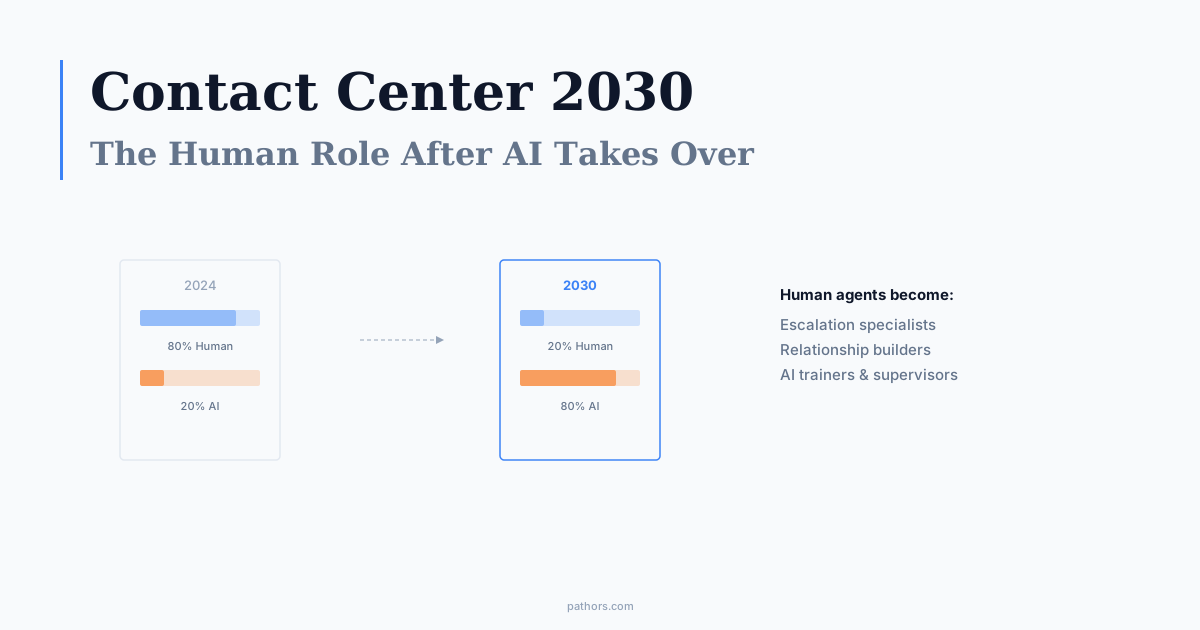
Today, most contact centers run at roughly 80% human, 20% automated. By 2030, that ratio inverts. Industry analysts project conversational AI will save the global contact center industry over $80 billion in the next five years.
This does not mean mass layoffs. It means a complete reshuffling of roles:
| Role | 2024 Share | 2030 Projection |
|---|---|---|
| Frontline agents | 60% | 15% |
| Escalation specialists | 15% | 30% |
| AI trainers / QA monitors | 5% | 25% |
| Customer relationship managers | 10% | 20% |
| System admin / engineering | 10% | 10% |
Three Emerging Human Roles
1. Escalation Specialist
Cases that reach a human in a mostly-automated center are inherently harder — higher emotional intensity, more complexity, cross-department coordination. Escalation specialists need stronger empathy, negotiation skills, and systems thinking. They are problem solvers, not phone answerers.
2. AI Trainer
AI models require continuous improvement. AI trainers analyze failed interactions, label data, adjust conversation flows, and test new scenarios. The role demands domain expertise in customer service combined with basic AI operations literacy.
3. Customer Relationship Manager
High-value accounts and VIP customers expect a human touch. Relationship managers proactively nurture these accounts with personalized service. Their KPI is not call volume — it is customer retention and expansion revenue.
What Organizations Should Do Now
1. Redesign role hierarchy and compensation — escalation specialists and AI trainers command higher pay than traditional frontline agents because they require more specialized skills
2. Invest in reskilling programs — existing agents should be transitioned, not eliminated; provide training in AI tool operation, data analysis, and advanced complaint resolution
3. Redefine success metrics — shift from "calls per agent per hour" to "AI independent resolution rate," "escalation first-contact resolution," and "customer lifetime value"
4. Choose a scalable AI platform — your AI customer service system needs to expand automation scope incrementally while preserving seamless human-AI handoff capabilities
2030 Will Not Arrive Overnight
The transition is gradual, but preparation starts now. Pathors' AI voice agent platform is designed for human-AI collaboration: AI handles automatable interactions, seamlessly transfers to humans when needed, and makes all call records and analytics available in real time. This lets businesses expand automation progressively rather than making an all-or-nothing bet. Learn more at pathors.com.