The hard part of multilingual AI customer service is not translation. It is voice. Multilingual text support is a question of whether the translation is accurate. Multilingual voice support is a question of whether the system can hear it at all — the accent of Taiwanese Mandarin, the English words dropped mid-sentence, the customer who suddenly switches to Taiwanese. None of that is a translation problem. All of it has to be resolved and answered within two seconds of the caller opening their mouth.
This guide covers both halves: how multilingual differs between text and voice, and what to ask during evaluation if your customers pick up the phone. It covers handling Taiwanese and Chinese-English code-switching in practice, the trade-off between a single model and language-specific pipelines, cultural tone configuration, and the language priority order for Taiwanese companies expanding into Southeast Asia.
What Is Multilingual AI Customer Service? Start by Separating Text from Voice
Multilingual AI customer service means one thing on paper: a single service system that can serve customers in several languages without staffing a separate team for each one. But the difficulty of that sentence is entirely different on text channels and on voice channels.
| Core problem | Translation quality | Understanding it, and sounding native |
|---|---|---|
| Response window | A few seconds is fine | Detect and start speaking within 2 seconds |
| The hard part | Localised phrasing, proper nouns | Accents, dialects, code-switching |
| What failure looks like | Stilted translation, wrong nuance | Straight mishearing, answering the wrong question |
| Adding one language | Mostly a content exercise | Content + ASR + TTS + tuning |
Most published material on multilingual AI customer service is really about text support. That is not wrong — but if your customers pick up the phone, it is a different subject.
Multilingual in Text and Multilingual in Voice Are Two Different Problems
The gap shows up in three places.
First, the time pressure is not comparable. Text support can read the whole message before deciding which language to reply in. Voice support has to identify the language within the first two seconds of the caller speaking, then immediately speak in the right one. Detect too slowly and the caller assumes nobody is there. Detect wrongly and the caller hears a language they do not understand.
Second, the failure modes differ. When a translation is wrong, the customer can usually still work out the gist. When speech recognition is wrong, the meaning of the whole sentence collapses. Mishear a Mandarin request to move a booking to the day after tomorrow as a request about a back end system and every answer after that is wrong.
Third, sounding native is a bar that only exists in voice. The same Japanese sentence with and without keigo represents two completely different levels of professionalism on a phone call. The same Mandarin sentence, read with a mainland accent over Taiwanese place names, tells the caller something is off within the first line. Text does not have this problem. Voice does.
The conclusion is simple: if your customers call, multilingual capability cannot be validated on translation quality alone. It has to be tested on real calls.
Handling Taiwanese and Chinese-English Code-Switching
This is the most distinctive part of the Taiwan market, and the part least often answered directly.
Chinese-English code-switching is the norm, not the exception. Taiwanese customers say things like: I want to cancel my subscription, with cancel and subscription in English inside a Mandarin sentence; or, hold this case for me, with hold and case in English. If the speech recognition pipeline is locked to a single-language model for the whole call, sentences like these get force-fitted to phonetically similar Mandarin words and the meaning goes with them. The right approach is a Mandarin recognition pipeline that has itself been tuned for Taiwanese Mandarin with English mixed in — not a rule that switches to an English model when English is detected, because within one sentence there is nothing to switch.
Taiwanese (Hokkien) and Taiwanese Mandarin accents are a second layer. Older callers, callers from the south, and calls into traditional industries carry a high proportion of Taiwanese mixed with Mandarin. Platform support for Taiwanese varies enormously today, and a spec sheet that says Taiwanese supported usually means it can recognise a set of common expressions, not that it can carry a whole conversation. A practical evaluation has three steps:
Design safeguards matter more than the model. However accurate recognition is, critical information should always be read back for confirmation, and when something is unclear the system should rephrase rather than repeat the same sentence. Getting those two right raises real-world usability in Taiwanese scenarios more than swapping models does.
The Technical Architecture of Multilingual AI Voice Service
Deploying multilingual AI voice requires capability at four technical layers at once.
Layer 1: Multilingual ASR
This is the most underestimated challenge. Multilingual speech recognition is not just multiple language models — it is multiple regional accent variants within each language. Vietnamese pronunciation differs significantly between northern and southern Vietnam. Malay and Indonesian are mutually intelligible but have notable vocabulary and expression differences. Thai is a tonal language where tone recognition accuracy is directly tied to overall recognition performance.
Effective multilingual ASR requires locale-specific tuning, not general-purpose models applied uniformly to each language.
Layer 2: Multilingual Knowledge Base for Dialogue AI
The same product information needs to be deliverable accurately across multiple languages. This is not purely a translation problem — literal translations often sound awkward in local context, and localised phrasing matters.
More importantly, different markets may have different product specifications, pricing, and promotions. Knowledge base architecture needs to support layered management of universal knowledge and market-specific knowledge.
Layer 3: Localised TTS Voice
Customers notice the difference between a foreigner speaking my language and someone who sounds like they are from here. The experience gap is substantial.
High-quality multilingual TTS requires locally trained voice models for each language, with speech pacing, intonation, and pause patterns matching that language's conversational norms.
Layer 4: Automatic Language Detection
Customers do not open a call by saying they would like to speak Thai. The system needs to detect the language from the first few seconds of the caller's opening statement and switch to the appropriate mode instantly. Detection speed and accuracy determine the first impression.
Architecture: Single Model versus Language-Specific Pipelines
Option A: Universal multilingual model
One speech recognition model and one understanding layer handle every language. Simpler to maintain, but accuracy suffers on lower-resource languages.
Option B: Language-specific pipelines
Detect the language first, then route to a dedicated recognition, understanding and synthesis pipeline per language. Higher accuracy, more complex infrastructure.
The practical middle ground
Most production systems use a hybrid: a lightweight language detector at the front, followed by language-optimised models behind it. Conversation logic and business rules stay shared — only the speech and language layers are specialised. This part is critical: if every language requires rewriting the flow, maintenance cost runs away from you as the language count grows.
| Accuracy | Fine on major languages, drops on smaller ones | Highest | High |
|---|---|---|---|
| Maintenance cost | Low | High | Medium |
| Adding a language | Fast | Slow | Medium |
| Chinese-English code-switching | Inconsistent | Needs extra handling | Can be tuned for the primary language |
Culturally Appropriate Responses
Direct translation is not enough. Japanese customers expect keigo. Taiwanese customers expect warmth and patience. American customers expect efficiency and brevity. The AI's personality has to adapt to cultural norms, not just translate words.
In practice this shows up in very concrete places: Japanese responses default to keigo and appropriate humble forms; Mandarin responses match Taiwanese conversational habits, using the warmer everyday phrasing rather than stiff formal register; English responses stay concise and direct with minimal ceremony. These should live as one tone profile per language, not as a single script translated four times.
Language Priority for Taiwanese Companies Serving Southeast Asia
For Taiwanese companies entering or expanding across Southeast Asia, the recommended deployment sequence:
Priority 1: English. Commercial contacts across essentially every Southeast Asian market operate in English, and English speech recognition and synthesis are the most mature. If you can only deploy one additional language, deploy English.
Priority 2: Thai. Thailand is one of the most established Southeast Asian markets for Taiwanese companies, and Thai-speaking customers have strong phone usage habits relative to digital alternatives.
Priority 3: Vietnamese. Vietnam is Southeast Asia's fastest-growing manufacturing and consumer market, and Vietnamese voice AI quality has improved rapidly and continues to.
Priority 4: Malay and Indonesian. These two are mutually intelligible enough to plan together, and between them they cover Malaysia and Indonesia — two of the region's largest markets.
Three Operational Challenges Nobody Plans For
The hard part of a multilingual deployment is not launch. It is what happens after launch.
Knowledge base synchronisation: when headquarters updates a product, how do all language versions update at the same time? The recommended architecture is a Chinese-language master knowledge base, AI-assisted translation into each target language, and confirmation by a local-language reviewer before publishing.
Quality monitoring: does your QA team have the capability to review Thai call quality? If not, you need either local-language quality monitoring in each market, or AI-assisted multilingual conversation quality evaluation.
Script iteration: optimising multilingual dialogue scripts requires contributors who actually speak the language. Establishing a local script owner role for each deployed language is what sustains quality over time.
How to Choose Multilingual AI Customer Service Tools
Tools on the market split into three categories by channel, with very different capability boundaries:
| Category | Typical form | Where multilingual is strong | Where it is weak |
|---|---|---|---|
| Text support platforms | LINE and website chatbots, social auto-reply | Mature content translation and template management | Barely touches telephone voice |
| Knowledge-base AI assistants | Document retrieval question answering | Multilingual document retrieval, answer consistency | No voice channel, no live conversation |
| Voice AI support | Inbound and outbound calls | Accents, dialects, live language detection, localised tone | Needs tuning to deploy, adding a language costs more |
When evaluating, ask in this order:
Multilingual Support at Pathors
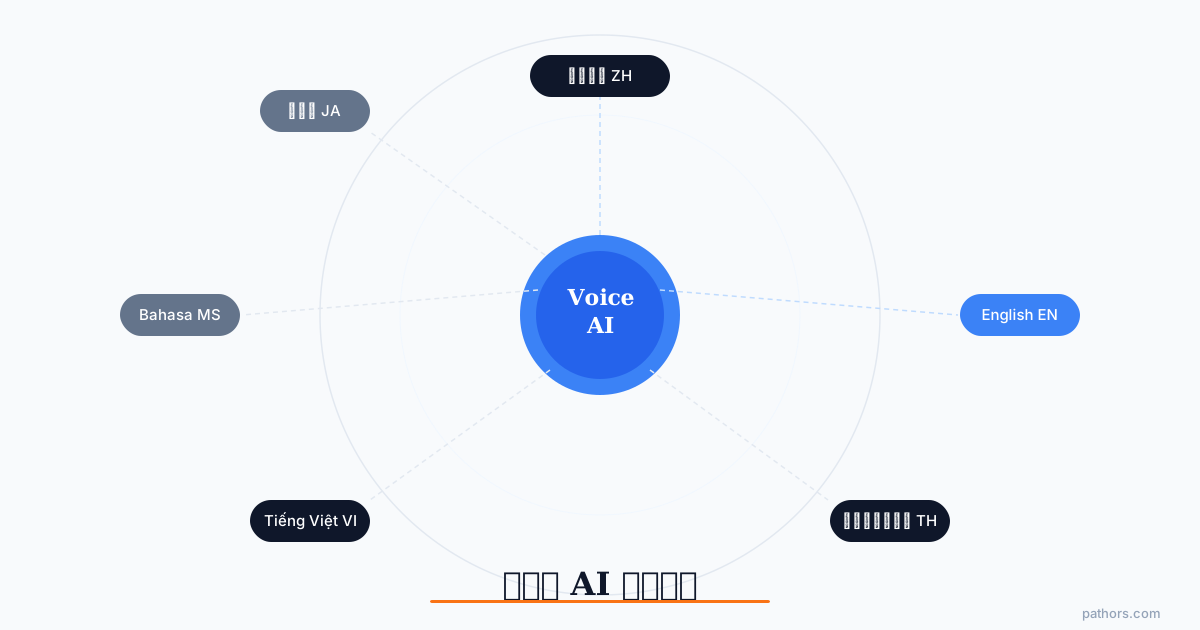
The Pathors voice AI platform currently supports Traditional Chinese (including Taiwanese Mandarin accents and Chinese-English code-switching tuning), English, Japanese, and Southeast Asian languages including Thai and Vietnamese, with language coverage continuing to expand.
Architecturally it takes the hybrid approach: a lightweight language detector at the front identifies the language within two seconds of the caller speaking and routes to the corresponding pipeline; business rules, flows and API integrations are defined once and shared across every language; and each language carries its own tone profile — Japanese defaults to keigo, Mandarin matches Taiwanese conversational style, English stays clear and direct.
For Taiwanese companies planning a multilingual deployment, Pathors provides more than the platform: multilingual knowledge base architecture design, localised voice selection and calibration, a cross-language conversation quality monitoring framework, and a phased roadmap for language expansion.
The multilingual service problem, at its core, is how to deliver consistent service quality across several language markets without growing headcount in a straight line. On text channels that problem is largely solved. On telephone voice, credible answers are only now arriving.
If your customers call, remember three things during evaluation: test with real calls rather than reading a spec sheet, confirm the cost structure of adding a language, and confirm that the system transfers honestly instead of guessing when it does not know. The pace of entering a new market should not be limited by the pace of recruiting language talent.
Further reading: the complete guide to phone AI, how to choose an AI customer service system for hotels, the real challenges of Mandarin speech recognition.
Frequently Asked Questions
Which languages can AI customer service support?
For voice AI support, the most mature languages today are English, Traditional Chinese (including Taiwanese Mandarin accents), Japanese and Korean. Among Southeast Asian languages, Thai and Vietnamese are improving quickly, and Malay and Indonesian can be planned together. Note that supported on a spec sheet usually means it can recognise the language, not that it holds up at real call quality — so test with actual recordings during evaluation.
If a customer speaks Taiwanese, can the AI understand?
Partly, and coverage varies enormously between vendors. Taiwanese supported on a spec sheet usually covers common expressions only, which is not the same as carrying a whole conversation. The practical way to verify is to prepare ten recordings of real scenarios in Taiwanese and in mixed Taiwanese-Mandarin (not synthetic speech), run them through recognition, and count how many dates, numbers and names come back wrong. Design safeguards matter more than the model itself: always read back critical information, rephrase rather than repeat when something is unclear, and transfer to a person when the answer is unknown.
What is the difference between multilingual voice support and multilingual text support?
Three things. Time: text can read the full message before replying, voice has to identify the language and start speaking within two seconds. Failure mode: a bad translation still conveys the gist, a mishearing destroys the meaning of the sentence. And sounding native: the same Japanese sentence with or without keigo reads as two different levels of professionalism on a call, a bar that does not exist in text. That is why multilingual voice has to be validated on real calls — you cannot see it by reviewing a script.
Does multilingual support require building a separate knowledge base for each language?
Use a layered approach rather than one knowledge base per language. Universal knowledge (product specs, policies, procedures) lives in a single master knowledge base, gets AI-assisted translation into each language, and is confirmed by a local-language reviewer. Only market-specific knowledge — local pricing, promotions, regulatory differences — is managed as a separate layer. Business rules and conversation flows should be defined once and shared across languages. If every added language means rewriting the flow, maintenance cost scales out of control with the language count.
How long does a multilingual voice deployment take, and does the cost double?
A single-language deployment usually lands in four to six weeks. Each additional language mainly adds knowledge base localisation, voice selection and tuning time, which in practice runs one to two weeks rather than starting over. On cost, ask three specific questions: whether adding a language triggers a new build fee, whether the monthly fee is priced per language, and whether the flow has to be rewritten. With a shared conversation logic architecture, the marginal cost from the second language onward drops noticeably.