In 2024, voice AI was still in the "barely functional" stage — inconsistent recognition accuracy, robotic-sounding synthesis, multi-turn conversations that frequently dropped context. By 2026, the situation has undergone a qualitative shift.
The emergence of Speech Foundation Models has transformed voice AI from the clumsy pipeline of "convert speech to text, then process text" into an end-to-end architecture that directly understands spoken meaning. This isn't just a few percentage points of accuracy improvement — the entire technical paradigm is shifting.
What does this mean for the customer service industry? Here are five Voice AI trends we're observing in real deployments.
Trend 1: End-to-End Voice Models Replacing the ASR + NLU + TTS Pipeline
Traditional voice AI pipelines are three-stage: ASR converts speech to text, NLU understands the text's intent, and TTS converts the response back to speech. Information loss between these stages — tone, pauses, emphasis, emotion — is unavoidable.
Next-generation Speech Foundation Models attempt to bypass the text intermediary entirely, going directly from speech input to speech output. This means AI doesn't just "understand what you said" — it can perceive *how you said it*: fast speech signals urgency, pauses signal hesitation, elevated pitch signals agitation.
The customer service impact: AI can respond more naturally to customers' emotional states, moving beyond the robotic experience of "no matter how upset you are, I'll respond with the same tone and the same scripted answer."
Trend 2: Real-Time Emotion Detection and Dynamic Response
Highly related to Trend 1. When voice AI can process audio signals directly rather than only text, emotion detection accuracy improves substantially.
This goes beyond coarse classifications of "positive / neutral / negative" to recognize more nuanced emotional signals: confusion (the same question rephrased three different ways), impatience (speech rate accelerating, responses getting shorter), anxiety (repeatedly confirming the same thing).
AI can dynamically adjust its response strategy based on detected emotional state: when impatience is detected, skip unnecessary confirmation steps and resolve directly; when anxiety is detected, slow down and provide additional reassurance; when anger is detected, trigger early transfer to a human rather than waiting for the customer to demand it.
Trend 3: Code-Switching No Longer a Problem
Previous ASR systems could only process one language at a time. When customers switched between Mandarin and Hokkien, or mixed Chinese and English, accuracy fell off a cliff.
Speech Foundation Models, trained on massive multilingual corpora, have seen qualitative improvement in handling code-switching. Within a single sentence that moves from Mandarin to English to Hokkien, the model can dynamically identify language boundaries and process each segment appropriately.
This has particular significance for the Taiwan market. The Mandarin-Hokkien code-switching challenge described in our piece on Mandarin ASR challenges is being progressively solved by this technology trend.
Trend 4: Voice AI Evolving from "Answering Calls" to "Making Calls"
In 2024, most businesses imagined voice AI in an inbound context — catching calls that customers initiate. By 2026, more and more businesses are recognizing that outbound is where voice AI creates the highest value.
Expiration reminders, renewal follow-ups, satisfaction surveys, delivery notifications, appointment confirmations — these tasks share common characteristics: high volume, clear SOPs, brief conversations, but consuming massive amounts of human time.
Speech Foundation Models make outbound calls sound increasingly close to human conversations: no longer the stiff, obviously-robotic voice that customers immediately recognize as a machine, but dialogue that naturally adjusts tone and pacing based on the other party's responses. Outbound answer rates and completion rates have risen measurably as a result.
Trend 5: The "AI Will Replace Customer Service" Narrative Is Being Corrected
The dominant narrative in 2023–2024 was "AI is going to replace customer service agents." By 2026, real-world market experience is correcting this framing.
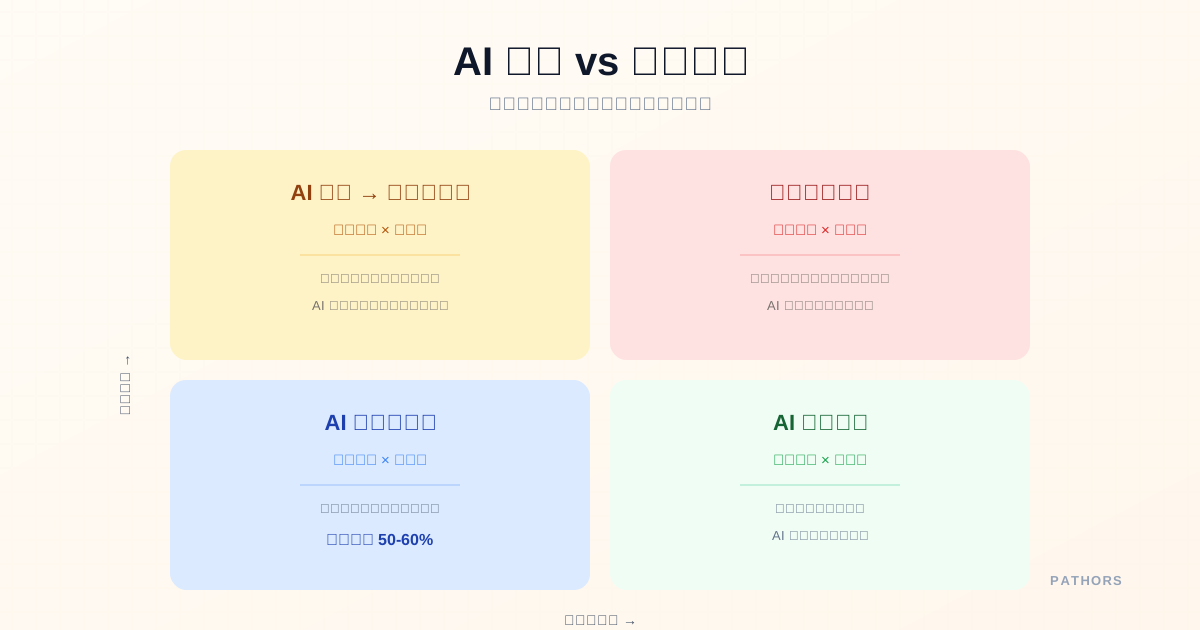
What's actually happening isn't "replacement" — it's "reallocation." AI has taken over a large volume of standardized queries and notification tasks, but the role of human agents in handling complex situations, providing emotional support, and building trust has become more valued, not less.
A more accurate description: AI has inverted the customer service center "pyramid." Previously, 80% of labor handled simple problems and 20% handled complex ones. Now AI handles 80% of the simple problems, and human labor is 100% concentrated on that 20% of high-value interactions.
Agent roles have shifted from "the person who answers phones" to "the expert who handles what AI can't." This isn't a downgrade — it's an upgrade. But it requires businesses to invest in advanced training for these agents so they can handle increasingly complex situations.
The technical barrier to voice AI is falling rapidly. The barrier to deployment is no longer technical capability — it's whether you've thought clearly about what problem you're solving, and whether you're willing to invest the time in good conversation flow design and knowledge base building.
Pathors continuously tracks the latest voice AI developments and integrates new capabilities into our voice customer service platform, so Taiwan businesses can access the most advanced voice AI capabilities without having to track every technology trend themselves. For more technical analysis on AI voice customer service, follow the Pathors Blog.