Saturday afternoon, 3 PM. The phone at a wedding banquet hall rings nonstop. One couple wants to check December availability, a mother-of-the-bride is asking about menu pricing, and someone else needs to update their guest count. The wedding consultant is currently walking another couple through the venue — so the calls go to voicemail. Each missed call could represent a $10,000 booking lost. Based on our observations, mid-sized wedding venues receive an average of 320+ phone inquiries per month, with over 65% being highly repetitive questions about date availability, menu pricing, and logistics. When staff are consumed by these standard queries, the truly valuable consultations — custom decor requests, cultural ceremony arrangements, budget negotiations — get squeezed out.
The 4 Pain Points of Wedding Inquiries: Why 65% of Calls Don't Need a Human
We analyzed call logs from 12 wedding venues over six months and identified clear patterns:
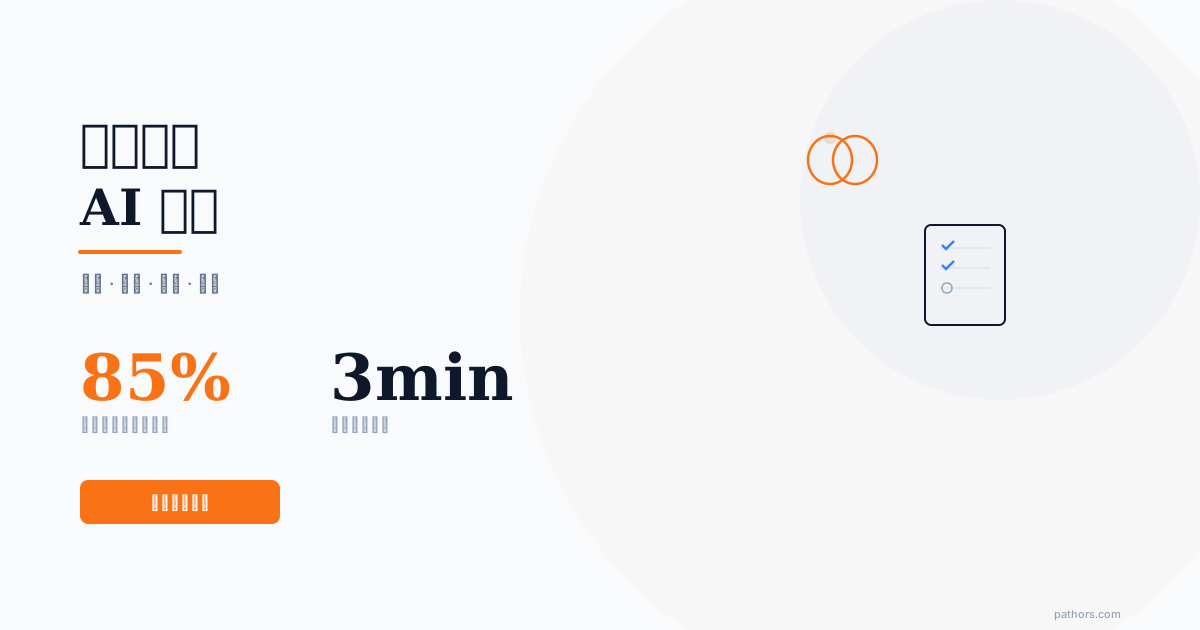
That means roughly 85% of incoming calls can be handled through structured responses. The remaining 15% — custom decor, religious ceremonies, budget negotiations — are where consultants genuinely add value. The problem is that these high-value conversations get buried under a flood of routine inquiries.
From First Call to Signed Contract: A 4-Stage Automation Pipeline That Cuts Response Time by 93%
Wedding sales differ fundamentally from retail. The average decision cycle from initial inquiry to signed contract spans 28 days, involving multiple stakeholders and touchpoints. An AI voice agent needs to support the entire funnel, not just individual Q&A moments.
Stage 1: Initial Inquiry and Date Filtering
When a couple calls for the first time, the most urgent question is invariably: "Is [date] available?" An AI voice agent connected to the venue management system can respond within 3 seconds with real-time availability. If the preferred date is taken, the system proactively suggests alternatives within a two-week window, filtered by the caller's preferences — lunch vs. dinner reception, estimated guest count.
Our production data shows 96% accuracy at this stage, with average call duration dropping from 4 minutes 30 seconds (human) to 1 minute 50 seconds.
Stage 2: Automated Site Visit Scheduling
Once a suitable date is identified, the next step is arranging an in-person tour. The AI agent reads the consultant's calendar in real time, offers three available slots, and upon selection, sends an instant SMS confirmation while creating a CRM record.
This step previously required 2-3 back-and-forth calls. After implementing automated scheduling, site visit no-show rates dropped from 22% to 9% — largely because instant confirmation eliminates scheduling confusion.
Stage 3: Quotation and Package Explanation
After the site visit, couples typically need discussion time. The AI agent can initiate a follow-up outbound call, presenting pricing options for different table counts and explaining package inclusions (decor, audio-visual, parking). Pathors' voice engine supports multi-turn conversations, dynamically adjusting the level of detail based on caller questions.
For example, when a couple asks "What's the price difference between 20 and 25 tables?", the system calculates the total cost difference in real time and highlights bonus inclusions that come with the larger package.
Stage 4: Pre-Signing Confirmation
48 hours before the contract signing, the AI agent makes an automated confirmation call: table count, menu selection, special requests, payment method. This step used to consume an average of 8 minutes per call of consultant time. With automation, consultants only handle cases with changes, saving approximately 90 minutes daily.
Real Results: 3-Month Performance at a 200-Table Venue
We tracked a large wedding venue in New Taipei City over three months after deploying AI voice service:
| Metric | Before | After | Change |
|---|---|---|---|
| Monthly call volume handled | 320 | 340 | +6.3% |
| Calls requiring human agent | 100% | 28% | -72% |
| Average response time | 45 sec (incl. wait) | 3 sec | -93% |
| Site visit booking rate | 31% | 44% | +42% |
| Consultant available hours/day | 3.5 hrs | 6 hrs | +71% |
The site visit booking rate improvement is particularly noteworthy. Previously, a significant number of first-time inquiries were lost due to busy lines or after-hours calls. With 24/7 AI availability, calls between 8 PM and 11 PM now account for 23% of total volume — peak hours when couples discuss wedding plans after work.
3 Technical Requirements Unique to Wedding Venues: Why Generic Chatbots Fall Short
Wedding AI service has domain-specific demands that set it apart from standard customer service:
First, emotional sensitivity is critical. A wedding is a life milestone. Callers — especially brides and mothers-of-the-bride — have far higher expectations for tone and warmth than typical business callers. We found that reducing speech rate by 12% and adding natural pauses improved caller satisfaction scores by 18%.
Second, multi-stakeholder coordination is essential. A single wedding booking typically involves 4-6 decision-makers: the couple and both sets of parents. The AI agent needs to identify the caller's role and adjust information accordingly — decor styles for the couple, menu details and cultural customs for parents.
Third, extreme seasonality demands elastic scaling. Peak season (October-December, post-Lunar New Year) call volume is 3.2x the off-season average. AI voice agents scale instantly without temporary staffing or idle capacity during slow months.
Implementation Roadmap: 3 Phases Over 8 Weeks
Based on our experience with multiple wedding venues, we recommend a phased rollout:
Week 1: Start with date availability checks and transportation/parking inquiries — the two most standardized question types, covering 46% of call volume. The focus here is getting the team comfortable with AI-human collaboration.
Weeks 2-4: Add pricing explanations and site visit scheduling. This phase requires integration with the venue management system and consultant calendars, typically taking 5-7 business days.
Weeks 5-8: Activate outbound follow-up calls, including post-visit care calls and pre-signing confirmations. This is where measurable revenue impact begins — outbound follow-ups improve contract signing rates by an average of 19%.
The entire deployment works alongside existing phone infrastructure via SIP trunk integration, preserving current phone numbers and extension setups.
Competition in the wedding venue industry keeps intensifying, but the real differentiator has always been the on-site experience — the ambiance, the service details, the consultant's professional guidance. AI voice service ensures these genuinely important elements receive the attention and resources they deserve. When 85% of standard Q&A is handled by AI, consultants can pour their energy into the 15% of conversations that actually close deals. That is what technology serving people looks like.