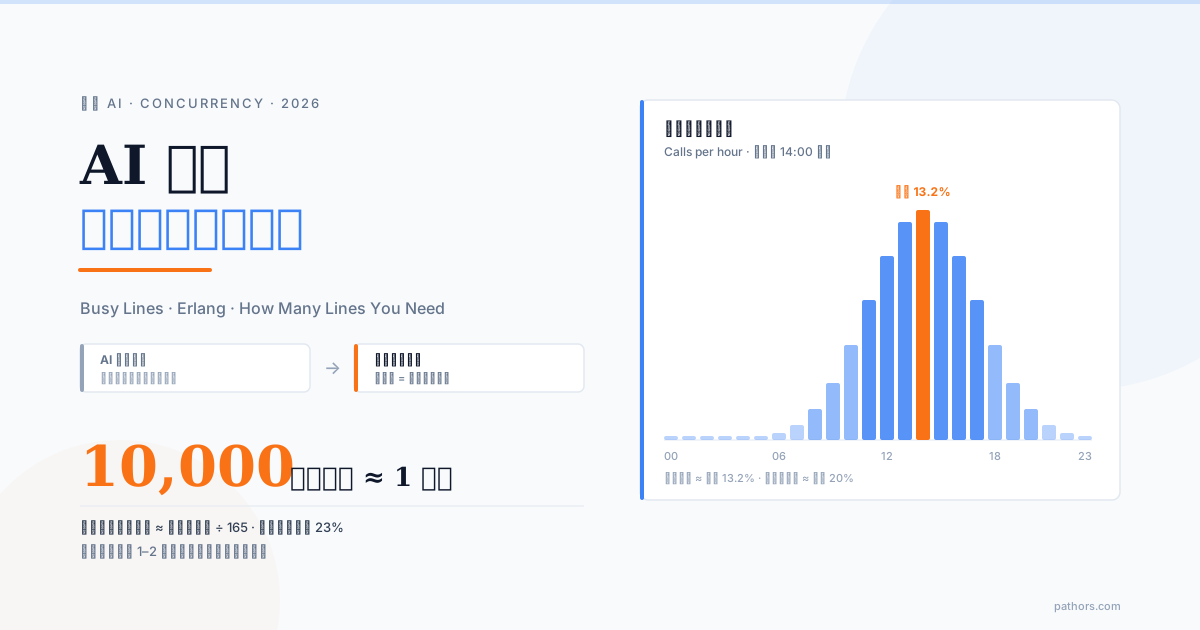
How many calls can phone AI handle at once? The AI itself is almost never the limit. One AI deployment can run dozens or hundreds of conversations in parallel; the real ceiling is how many phone lines you have. A line carries one call at a time, so the second caller on a single line hears a busy tone. Most small and mid-sized businesses stay under 10,000 call minutes a month and are fine with one or two lines. What matters is not your monthly total but how many calls overlap in your busiest hour.
When business owners evaluate phone AI, they usually ask the vendor "how many calls can it take at once?" and get back a big-sounding number: 50, 100, unlimited. That figure is normally the platform's technical ceiling and says little about whether your customers will hit a busy signal. This guide separates three terms that get mixed up (busy, engaged, concurrent) and walks through the sizing model Pathors uses internally, so you can work back from monthly minutes to the lines you actually need.
The short answer: the AI is not the bottleneck, the line count is
With human agents the limit is intuitive: three people can hold three conversations, and the fourth caller waits or gets a busy tone. People are the bottleneck.
Phone AI works differently. The AI is not "one person." The platform opens a separate conversation for every incoming call, and handling dozens at once is routine. So "how many calls can the AI take?" is aimed at the wrong component.
The real constraint sits on the telephony side: every line, whether it is a landline, a channel on a SIP trunk, or a cloud number, carries exactly one call at a time. With two lines, the third caller hears a busy tone no matter how capable the AI is.
So reframe the question:
For most small and mid-sized businesses the answer is one or two lines. A month's worth of calls looks like a lot, but they do not happen at the same moment.
How busy signals happen: the human era vs. the AI era
In the human era, busy meant nobody was free to answer. The switchboard might have four lines, but with one person answering, the other three calls rang through to voicemail. US and UK studies put the average missed-call rate for small businesses at 62% (source), and of callers who reach voicemail, 86% hang up without leaving a message and 85% never call back (source). The root cause was staffing, not lines.
In the AI era, busy means the lines are full. People stop being the bottleneck: if a call can get in, the AI answers it. The flip side is that once every line is occupied, the caller hears a busy tone, and the AI's intelligence is irrelevant.
Three terms worth separating:
| Term | Meaning | What the caller hears |
|---|---|---|
| Engaged (line busy) | A single number or line is in use | The standard busy tone |
| Busy (all lines busy) | Every available line is occupied; new calls cannot enter | Busy tone, or a carrier announcement |
| Queued | The call got in, but no agent is free; hold music plays | Hold music, "please hold" |
With one line, "engaged" and "busy" are the same thing. With several lines, the system is only busy once all of them are occupied. And queuing in the AI era usually only appears at the handoff to a human, because the AI itself picks up immediately.
What "concurrent calls" actually measures
Concurrency is simply the number of calls in progress at the same instant. One line equals one simultaneous call, so "how many lines do I need" is the same question as "how many calls overlap at peak."
To convert "calls per hour" into "calls at the same time," telephony uses the Erlang: number of calls multiplied by average call length. For example, 200 calls an hour at 3 minutes each is 600 call-minutes, which divided by 60 minutes is 10 Erlangs (source). That means on average 10 calls are in progress at any moment during that hour, so you need at least 10 lines, before accounting for calls bunching up randomly.
Traditional contact centers then apply Erlang C to work out how many agents are needed for a service level such as "80% of calls answered within 20 seconds." With AI, answering is instant, so the question moves to the lines: with N lines carrying a given load, how likely is a busy signal? That is what Erlang B calculates.
Back to the vendor's "100 concurrent calls." If that describes the platform, it is the AI side of the equation. What you need to ask is how many lines are attached to your number and how many concurrent calls your plan allows.
Working back from monthly minutes: the Pathors sizing model
In theory one line can carry 24 x 60 x 30 = 43,200 minutes a month. In practice you will never get close, because traffic clusters into particular hours.
The assumptions Pathors uses internally:
Run the numbers: 10,000 minutes a month gives about 61 minutes of talk in the peak hour, roughly 1 Erlang, meaning one line is close to fully occupied during the busiest hour. That is where the rule of thumb "about one line per 10,000 minutes a month" comes from. The implied line utilization is 10,000 / 43,200, or about 23%, which is in line with what contact centers typically see.
| Monthly minutes | Peak-hour call minutes (÷ 165) | Concurrent calls at peak (÷ 60) | Suggested lines |
|---|---|---|---|
| 100 | about 0.6 | 0.01 | 1 |
| 1,000 | about 6 | 0.1 | 1 |
| 3,000 | about 18 | 0.3 | 1 |
| 10,000 | about 61 | 1.0 | 1–2 |
| 30,000 | about 182 | 3.0 | 3–4 |
Why 1–2 lines at 10,000 minutes rather than exactly one? Pushing 1 Erlang of load through a single line means, by the Erlang B formula, roughly half of peak-hour callers hit a busy tone. Two lines bring that down to about 20%, three lines to about 6%. Businesses with a low tolerance for busy signals (clinics, hotels, urgent-service trades) should add a line.
This is an estimate. Your traffic may be more concentrated or more even. To get real numbers, read monthly call minutes off your PBX or carrier bill, or start with one line for two weeks and read peaks and busy events out of the call log.
Three peak patterns need three different calculations
The model above assumes traffic is "peaky but smooth." In practice there are at least three patterns:
Even: general customer service, B2B enquiries
Calls trickle in all day with a mild afternoon bump. The ÷ 165 model applies directly.
Concentrated: opening time, storm nights, promotion days
A clinic opening bookings at 8:30, a hotel on a typhoon night, an e-commerce brand on sale day. Traffic piles into a 30–60 minute window, the peak hour carries far more than 13.2%, and a monthly average will always undercount. Size on the busiest 15 minutes instead:
Event-driven: the surge after an SMS or push notification
Your own SMS campaigns, LINE broadcasts and outbound notifications pull in callbacks within minutes. The upside is that you control the trigger: send in batches, route callbacks to a different number, and avoid your existing peak. Remember that outbound calls occupy lines too; if the same lines dial out and receive at once, count both.
Designing the experience when lines run out
However carefully you size, there will be moments you exceed capacity. What callers hear then should be a deliberate decision, not the carrier's default busy tone. Four common options:
The worst design is "busy, then voicemail." The overseas figures above show 86% of voicemail callers leave no message and 85% never call back: the call is simply thrown away.
Five questions to ask the vendor
Once you have a quote, get clear answers on these five points:
1. Is the concurrency limit a plan limit or a technical limit? The technical limit is what the whole platform can carry and is not about you. The plan limit is what your contract says (for example, two concurrent calls on the basic tier); beyond it, calls are rejected or billed extra. You care about the second one.
2. How are extra lines priced? A monthly fee per line, tiered by concurrency, or per-minute with no concurrency cap. The differences matter a lot depending on your peak pattern, so read this alongside the AI voice pricing guide.
3. Does peak capacity scale automatically or must it be preconfigured? If a sale day suddenly needs five concurrent calls, does it expand on its own, require advance notice, or force a plan upgrade? At what price?
4. Does multi-line on one number need the carrier's cooperation? Putting several lines behind a single landline number usually means the carrier sets up a hunt group or adds SIP trunk channels. It is not a switch the platform can flip. Details in the phone AI and PBX integration guide.
5. Can the overflow strategy be customized? Can you configure human overflow, callbacks and SMS yourself, and vary them by time of day?
Verifying after launch
After go-live, watch three numbers rather than relying on gut feel:
Observe for the first week without changing anything. After two weeks, adjust: if the peak stays below half your line count, you do not need more; if busy events show up daily, add a line. Review monthly, add lines ahead of promotions or high season, and scale back afterwards.
The correct answer to "how many calls can phone AI take at once" is: the AI is effectively unlimited, the lines are the ceiling, and the number of lines you need depends on your peak, not your total. Start with "monthly minutes ÷ 165 ÷ 60," switch to the busiest-15-minutes method for concentrated traffic, design what happens on overflow, and most businesses can launch on one or two lines and tune with real data after two weeks.
Further reading:
Frequently Asked Questions
How many calls can phone AI handle at the same time?
The AI itself has practically no limit. The platform opens a separate conversation for every incoming call and can run dozens in parallel. The real ceiling is your line count: one line carries one call at a time. So the answer depends on how many lines are attached to your number and how many concurrent calls your plan allows, not on the AI's capability.
How many lines should I buy?
Take your monthly call minutes, divide by 165 to get peak-hour call minutes, then divide by 60 to get concurrent calls at peak. Under 10,000 minutes a month, one or two lines is usually enough; around 30,000 minutes, three to four. Add a line if busy signals are costly in your business. It is an estimate, so check it against your own traffic pattern.
What do callers hear when all lines are busy?
Whatever you configure. The default is the carrier's busy tone, which is the worst outcome. Better options are overflow to a human, hold music, having the AI capture the number and call back, or an automatic SMS follow-up. Callback is the best value in the AI era because it costs no staff time and the caller does not have to redial.
Which matters more, concurrency or minutes?
They govern different things. Minutes are your total volume and drive cost; concurrency is your peak and decides whether callers hit a busy tone. Most small businesses have modest minutes but concentrated peaks, so concurrency is the constraint that bites first. Size the peak first, then compare per-minute pricing, rather than comparing unit rates alone.
What if call volume spikes on a promotion day?
Ask the vendor beforehand whether concurrency can be expanded temporarily and at what price, and add lines before the promotion starts. Size the day on the busiest 15 minutes rather than a monthly average. Pair it with callbacks and SMS follow-up so demand that cannot get through is still captured, and scale the lines back once the promotion ends.
How many minutes can one line handle in a month?
The theoretical maximum is 43,200 minutes (occupied around the clock), but traffic clusters into afternoons and weekdays, so one line realistically serves about 10,000 minutes, a utilization of roughly 23%, which is typical for contact centers. This is Pathors' experience-based estimate; the more concentrated your traffic, the fewer minutes a single line can serve.