An AI call center is software that answers and makes phone calls in place of a human operator, completes the task during the call — booking a table, checking an order, confirming a delivery — and writes the result back into the company's own systems. This guide is for decision makers with no technical background. Every term is explained the moment it appears, and every figure comes from a post already published on this site, with a link. By the end you should be able to follow any AI voice vendor's proposal, and know what to ask next.
What is an AI call center, and how is it different?
An AI call center is a customer service phone line where software, not a person, handles the conversation from start to finish. It listens, works out what the caller wants, performs the action, and speaks the answer back — the same work a human agent does at a desk, done by a program.
It differs from an ordinary call center in three ways:
An AI voice agent is the individual "worker" inside an AI call center — one configured assistant that handles one kind of call. A business normally runs several: one for reservations, one for order status, one for outbound reminders. Each agent is given a scope (what it may talk about), an SOP (standard operating procedure — the fixed steps the company wants followed), and a connection to the systems it reads from and writes to.
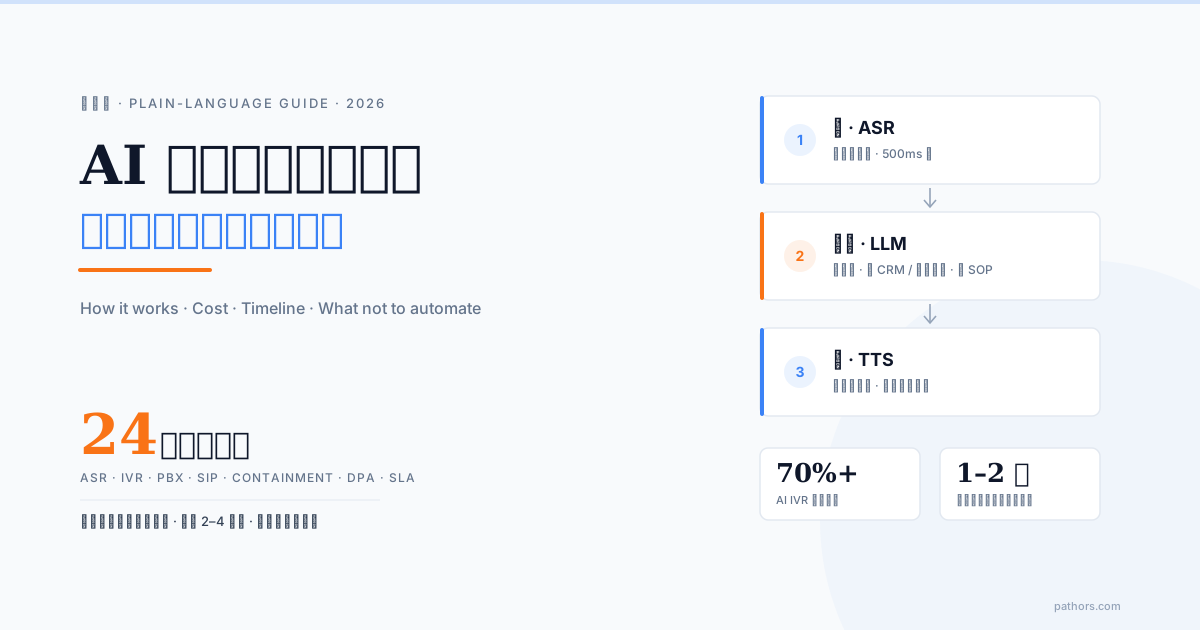
How an AI voice agent works: hear, decide, speak
Every time the caller speaks, the system repeats three steps:
1. Hear — ASR (automatic speech recognition, software that turns spoken audio into written text). The caller says "I want to change my delivery to Thursday," and the system writes that down as text while it is being spoken.
2. Decide — the language model and decision engine. The system works out what the caller actually wants (the *intent* — here, "reschedule a delivery") and follows the company's rules. This is where it queries your order system, booking system or CRM (customer relationship management system — the database holding customer records and history).
3. Speak — TTS (text-to-speech, software that turns written text back into a spoken voice).
All three must finish fast enough that the caller does not think the line has gone dead. The industry term for that delay is latency. The tightest budget is on the first step: speech recognition needs to stay under 500 milliseconds, or the conversation develops audible dead air.
One qualification: newer speech-to-speech models take audio in and put audio out without round-tripping through text on every turn. Latency drops, and tone, pauses and the ability to pick up after an interruption all survive. Hear–decide–speak is still the right mental model; it is no longer always three separate pieces of software. For the full architecture see The complete guide to phone AI.
Conversational AI vs traditional IVR
Traditional IVR (interactive voice response — the "press 1 for sales, press 2 for support" menu) makes the caller learn the system's structure. Conversational AI lets the caller say what they want in their own words.
| Aspect | Traditional IVR | Conversational AI voice agent |
|---|---|---|
| How the caller interacts | Presses keypad buttons through a fixed menu | Speaks a normal sentence |
| If the request doesn't fit a menu | Caller is stuck, or transferred to a person | Agent handles it, or transfers with context attached |
| Handles the task itself? | Usually only routes the call onward | Completes the task and updates the system |
| Changing it | Rebuild the menu tree | Change the instructions and rules |
| Calls resolved without a person | Routing only — the menu resolves nothing itself | Over 70% self-served on an AI IVR |
That last row uses a term you will meet in every vendor proposal: containment rate — the percentage of calls the AI finishes on its own. A 70% containment rate means seven callers in ten hang up satisfied having spoken only to the AI, and three are passed to a person.
Containment is not one number. It depends entirely on how hard the questions are:
| Call type | Typical containment | Top quartile |
|---|---|---|
| Account balance or status enquiries | 88–94% | 96%+ |
| Order tracking | 79–85% | 91%+ |
| Appointment scheduling | 72–81% | 87%+ |
| Technical troubleshooting | 31–42% | 55%+ |
| Billing disputes | 18–25% | 35%+ |
| Complaints and escalations | 5–12% | 20%+ |
For how to read this table alongside the other KPIs, see the AI customer service KPI guide.
Does it replace the phone system we already have?
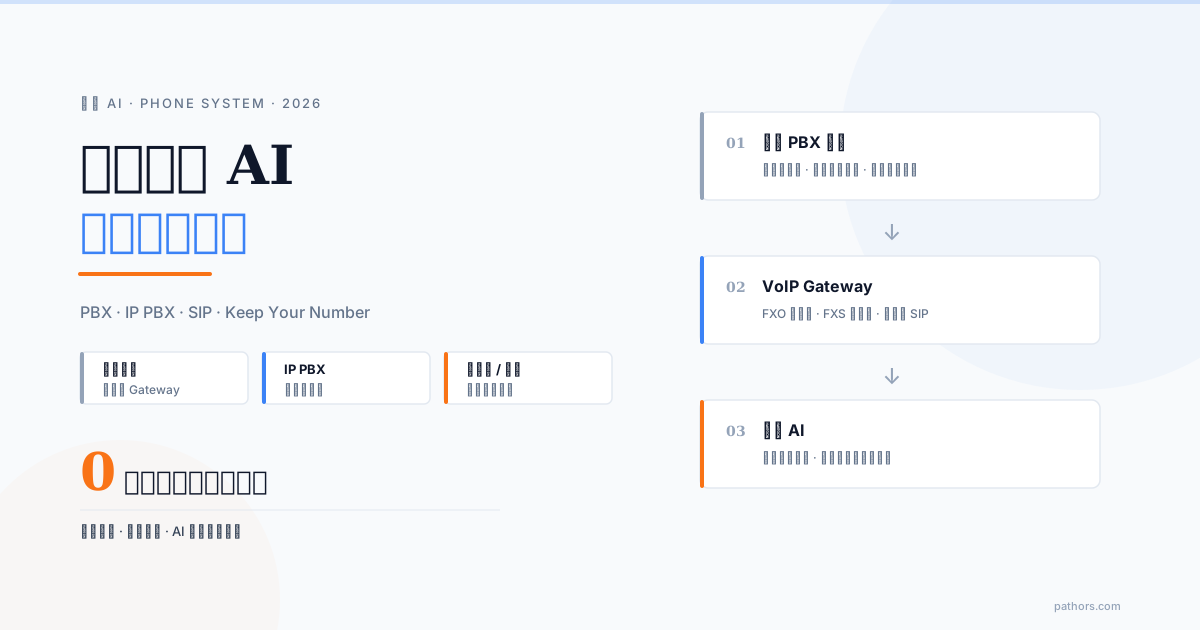
No. In most cases adding phone AI does not require a new phone number, and does not require replacing your PBX (private branch exchange — the equipment that routes calls inside a company). You would only add a number for a dedicated AI booking line, or to split traffic for separate reporting.
| Your setup | What happens | Time to live |
|---|---|---|
| Landline, no PBX | Carrier forwarding rules point at the AI's number | Same day, reversible any time |
| IP PBX | Configuration only, no hardware — the AI's SIP address becomes a forwarding target, or the platform is added as a trunk | One to three working days |
| Traditional PBX | One VoIP gateway converts analog to SIP | One to two weeks, waiting on hardware |
| SIP trunk | The number lands directly on the AI platform or IP PBX | Weeks, if a number port is involved |
During a call the AI reads and writes your business systems: CRM, ERP (enterprise resource planning — orders, stock and invoicing), e-commerce platforms (in Taiwan, commonly 91APP, SHOPLINE and Cyberbiz) and logistics systems, connected through an API (application programming interface — a defined way for two systems to exchange data automatically). For the wiring details by PBX type see the phone AI PBX integration guide.
What does it cost?
Taiwan market pricing for AI voice customer service runs NT$1.2–6.0 per minute, so a five-minute call costs roughly NT$6–30 in platform charges. Telephony is often billed separately at a further NT$0.4–1.2 per minute.
The four pricing models you will be quoted:
| Model | Typical Taiwan rate |
|---|---|
| Per minute | NT$1.2–6.0 per minute |
| Per seat | NT$15,000–45,000 per seat per month |
| Platform fee plus usage | NT$30,000–80,000 a month, plus usage |
| Revenue share | 10–20% of attributed value |
Most Taiwan quotes are structured in three parts — a one-off build fee, a platform monthly fee, and per-minute call charges. As a market reference, common brackets are a build fee of around NT$60,000-plus, a monthly fee near NT$5,000 and about NT$5 per minute, with deeper work such as CRM integration pushing the build fee past NT$100,000. These are market rates, not Pathors' prices; what each vendor includes varies so much that comparing unit prices alone usually misleads.
Pathors uses a per-minute model, with a single rate covering ASR, LLM orchestration, TTS and telephony — no pass-through charges. Telephony sits inside the rate rather than on top, which gives cost predictability that platform-fee and per-seat models cannot match at variable volume. CRM integration, recording storage and analytics dashboards are included in the base rate; custom voice training and on-premise deployment are enterprise add-ons. This guide does not invent a Pathors rate card — for an actual quote, contact us. For the full breakdown of pricing models see the AI voice pricing guide and AI voice customer service cost.
Against a human call: commonly cited figures put a human-handled contact at US$5.50–11.00 and an AI-handled contact at US$0.25–0.80, somewhere between a tenth and a twentieth. The number most cost models miss: a call the AI starts and then escalates to a human costs more than sending it straight to a person. Failed containment is the expensive outcome, which is why scoping matters more than headline rate.
What is the ROI, and how soon does it pay back?
Most clients reach payback within 2–4 months. Below 1,000 calls a month, that extends to 6–8 months. Payback period is the point at which accumulated savings equal what you spent; after that it is net saving.
ROI is usually modelled on six metrics: cost per interaction, agent time saved, first-call resolution rate, customer satisfaction impact, the scalability cost curve (what double the calls costs — for AI close to nothing extra, for staffing double), and implementation and maintenance total cost of ownership. For the method see the AI call center ROI guide.
The thing to compare on: the single biggest driver is containment rate. A platform costing more per minute but resolving far more calls unaided is usually the cheaper one overall. See How to calculate voice AI ROI.
How long does deployment take?
It depends entirely on scope:
| Scope | Time |
|---|---|
| After-hours coverage only, no PBX changes | 1–2 weeks |
| Replacing a phone menu with an AI IVR | 2–4 weeks |
| A typical single-scenario deployment | 4–6 weeks |
| Kickoff to first launch, full rollout | 6–12 weeks |
| Assessment through the end of testing, before staged go-live | 8–15 weeks |
| Assessment through full deployment, staged go-live included | roughly 13–20 weeks |
A vendor promising a one-week go-live on a full rollout is skipping knowledge base building and testing. A vendor quoting twelve weeks to forward your after-hours calls is overselling. Whatever the scope, the time goes on six things: scoping, knowledge building, integration, testing on real recordings, a staged launch on a small share of live calls, and weekly transcript review and tuning. The sixth does not end at launch — an AI voice agent is coached continuously, like a new staff member. For the phases see the AI voice implementation guide and the AI customer service onboarding guide.
What should it not be used for?
Being direct about limits is the fastest way to a credible proposal:
A well-designed rollout sorts calls into three groups: fully automated, AI-handled first then passed to a person, and human-only from the start. The third group is meant to exist. When the AI hands off, it should pass the transcript, the detected intent, sentiment, any account data already retrieved and what it has tried, so the caller does not repeat themselves. For the design see Designing the AI-to-human handoff.
What about compliance?
Three risks to address: incomplete recording disclosure (Taiwan's Personal Data Protection Act and Communication Security and Surveillance Act both require clear notice before recording), voice data storage and residency (where audio and transcripts physically live, and under whose law), and the DPA with your vendor (data processing agreement — the contract stating what a vendor may do with your customers' data). Financial institutions face additional FSC requirements: AI inference involving customer personal data should be processed domestically, and voice interaction audit trails must be retainable within Taiwan. Voice data and recordings can be stored entirely in Taiwan to satisfy both. Outbound calling has separate rules on legality, recording and debt collection; before launching any campaign read Is AI outbound calling legal in Taiwan? and the voice AI compliance guide.
Recognition accuracy is marketed heavily, but published benchmarks are measured on clean, formal speech, and accuracy drops sharply on real telephone audio. Ask every vendor to run their system against a sample of your own recorded calls, and judge it on that. A benchmark figure quoted without the audio behind it is not evidence, including ours. A reasonable contractual floor is 90%+ recognition accuracy on standard Mandarin conversation, alongside 99.95% uptime and a 10-minute first response on P1 incidents. See the AI voice vendor SLA guide.
24 terms to know
| Term | Plain meaning |
|---|---|
| API | A defined way for two software systems to exchange data automatically |
| ASR | Automatic speech recognition — turning spoken audio into written text |
| Call abandonment | The share of callers who hang up before anyone answers |
| Containment rate | The share of calls the AI finishes without passing to a human |
| CRM | Customer relationship management — the database of customers and their history |
| Data residency | The requirement that data physically stays inside a given country |
| DPA | Data processing agreement — what a vendor may do with your customers' data |
| ERP | Enterprise resource planning — the system holding orders, stock and invoicing |
| First-call resolution | The share of issues settled on the first call, with no callback |
| FSC | Financial Supervisory Commission — Taiwan's financial regulator |
| Intent | What the caller actually wants, behind the words they used |
| IVR | Interactive voice response — the "press 1 for sales" keypad menu |
| Latency | The pause between the caller finishing a sentence and the AI replying |
| LLM | Large language model — interprets language and decides what to say |
| On-premise | Running the software on servers your own company owns and controls |
| PBX | Private branch exchange — the system routing calls inside a company |
| PDPA | Personal Data Protection Act — Taiwan's personal data law |
| Payback period | How long until accumulated savings equal what you spent |
| ROI | Return on investment — what you get back compared with what you put in |
| Retention policy | How long recordings and data are kept before automatic deletion |
| SIP trunk | The internet connection carrying phone calls to and from your provider |
| SLA | Service level agreement — the contractual performance commitments |
| SOP | Standard operating procedure — the fixed steps staff (or the AI) must follow |
| TTS | Text-to-speech — turning written text into a spoken voice |
Nothing in this guide is a new figure; every number comes from a post already on this site, so treat it as the index to the other hundred-plus. Three next steps: read The complete guide to phone AI once for the architecture, use the AI customer service RFP guide to list the questions you will put to vendors, and gather your own call recordings so you can hold every vendor to the phone AI test call checklist. If you would like to hear Pathors' AI take one of your calls, book a demo.
Frequently Asked Questions
What is an AI call center?
A phone support operation where software answers, understands and resolves customer calls instead of human agents. It operates around the clock and is usually charged per minute rather than per employee. It handles many calls at once, though the practical ceiling is how many phone lines you have, since each line carries one call at a time.
What is the difference between an AI voice agent and traditional IVR?
IVR requires the caller to press numbered keys through a fixed menu and usually only routes the call onward. Conversational AI lets the caller speak naturally and completes the task itself. On an AI IVR, over 70% of calls can be self-served without reaching a person.
How much does AI call center software cost in Taiwan?
Roughly NT$1.2–6.0 per minute in platform charges, so a five-minute call costs about NT$6–30, with telephony sometimes billed separately. Commonly quoted three-part market rates are a build fee of around NT$60,000-plus and a monthly fee near NT$5,000 — market reference brackets, not any one vendor's price. Pricing models are per minute, per seat, platform fee plus usage, or revenue share, so compare the total cost of a month of real volume rather than the headline rate.
How long does it take to deploy?
Forwarding after-hours calls can be live in one to two weeks; an AI IVR takes two to four weeks; a full rollout across several call types is six to twelve weeks from kickoff, and longer if you count staged go-live through to full traffic.
What happens when the AI cannot answer?
It transfers the caller in a warm handoff that passes the transcript, detected intent, sentiment, any account information already retrieved and what the AI has tried, so the customer does not repeat themselves. Escalation should trigger when confidence drops below a set threshold (typically 60–70%), when tone shifts to frustration, whenever someone asks for a person, and on any legal, safety or discrimination issue.
Is AI voice customer service compliant with Taiwan's PDPA?
It can be, and compliance depends on configuration rather than the technology. Requirements include recording disclosure, storing personal data under the PDPA, defined retention and deletion periods, a data processing agreement with the vendor, and exportable audit logs. Regulated industries usually deploy on servers in Taiwan or on their own on-premise hardware.