AnalyticsJan 30, 2026

Why Context Matters More Than Volume in AI Data Analytics

Brandon Lu

Brandon Lu

COO

Why Context Matters More Than Volume in AI Data Analytics

Enterprise data is growing at an explosive rate every year, yet AI analytics outputs still feel "not quite right" more often than they should. The problem isn't insufficient data — it's that AI lacks the context needed to make meaningful decisions.

This article examines why unstructured data is becoming the key engine for AI to understand business context, and what this shift means for enterprise AI analytics strategy.

The Ceiling of Traditional AI Analytics: Patterns Found, Context Lost

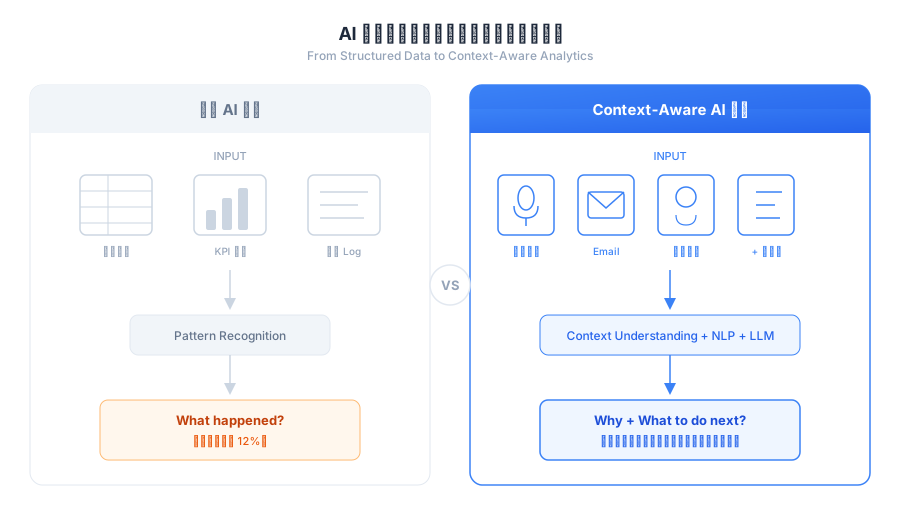
Traditional AI analytics tools excel at processing structured data — transaction records, user behavior logs, sales figures. They're genuinely powerful at pattern recognition and forecasting, but they share a fundamental limitation: they can see "what happened" but not "why it happened."

Here's a concrete example. An AI analytics system can tell you: "Customer churn rate increased 12% last month." But it can't tell you whether those customers sounded frustrated, disappointed, or had already given up during their last support call. It can't tell you whether the agent's response at the three-minute mark was the pivotal moment that caused the customer to hang up.

That's the value of context. Intent, emotion, timing, constraints — these signals rarely appear in structured datasets, yet they're precisely the elements required for meaningful decision-making.

If AI can only process pre-organized numbers, the insights it delivers will forever remain at the "descriptive analytics" level. To move forward into "why" and "what to do next," AI needs to understand the stories behind the numbers.

80% of Enterprise Data Is Unstructured — and Most of It Is Ignored

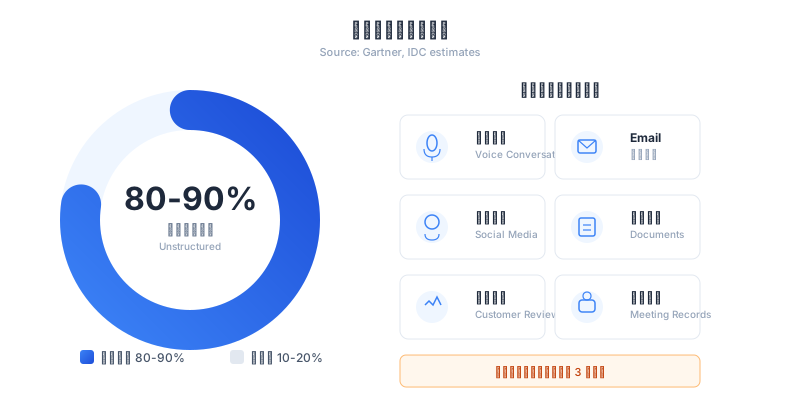
According to Gartner estimates, 80% to 90% of enterprise data is unstructured — emails, customer service transcripts, meeting recordings, social media comments, customer reviews. And unstructured data is growing at more than three times the rate of structured data.

The irony is that most enterprise AI analytics investment still focuses on the 10-20% that's structured. The unstructured data that actually contains customer intent, emotional context, and business signals? It sits in a corner gathering dust.

This isn't a technology problem — NLP, ASR (automatic speech recognition), and LLMs are more than mature enough to handle unstructured data at scale. The real bottleneck is that organizational analytics strategies haven't caught up. Many enterprises are still stuck in a "more data is better" mindset, rather than "richer context is better."

diagram data proportion

From "More Data" to "Better Context": The Mindset Shift

There's a critical mindset shift that needs to happen: the next step in AI analytics isn't feeding more data in — it's feeding data with richer context.

Consider a customer service scenario. The traditional approach feeds call duration, wait time, and resolution rate as KPIs into the analytics engine. But if every customer service call's voice content is also part of the analysis — understanding whether the customer's opening sentence was a complaint or a question, whether the agent's tone gradually became impatient from minute one to minute five, how the emotional arc of the entire call progressed — the depth of analysis is on a completely different level.

This leap from "what happened" to "why it happened" is the value context delivers. And voice conversations, text-based support records, and email exchanges are the richest sources of that context.

In Pathors' experience building AI voice assistants for customer service, outbound calls, and appointment scheduling, every conversation is a high-density context carrier. A customer's tone, word choice, pauses, even their silences carry information that structured data simply cannot capture. When this conversational data is effectively analyzed, enterprises aren't just "processing support tickets" — they're continuously building a deeper understanding of what customers actually need.

What Should Enterprise Analytics Teams Do?

If you accept that "context matters more than volume," enterprise AI analytics strategy needs adjustment on at least three fronts.

First, bring unstructured data into the analytics pipeline. Stop analyzing only the fields in your CRM. Pull in customer service conversations, emails, and social feedback. Today's NLP and LLM technologies are mature enough for large-scale processing, and the barrier to entry is lower than you might think.

Second, build cross-disciplinary analytics teams. A team of pure data scientists isn't enough anymore. You need people who understand the business to interpret context — what emotional patterns signal churn risk? What conversation rhythms correlate with high conversion rates? These judgments require domain expertise that models alone can't produce.

Third, shift from "report-driven" to "action-driven." Context-aware analytics shouldn't just produce prettier dashboards. They should directly trigger actions — detecting price sensitivity expressed during a conversation and automatically triggering a retention offer, or discovering that complaint severity for a particular product line is notably higher and immediately notifying the product team.

Closing Thoughts: AI Analytics Competitive Edge Lives in Context

We're experiencing a paradigm shift from "big data" to "right data." Over the past decade, enterprises raced to accumulate data volume, building data warehouse after data warehouse. But over the next decade, whether AI analytics can truly generate business value won't depend on how large your data lake is — it'll depend on how much understandable context lives within your data.

Unstructured data — especially conversation records between people and people, and between people and AI — is the most concentrated carrier of context. Enterprises that can effectively mine this data will gain a structural advantage in the AI analytics race.


Brandon Lu

Brandon Lu

COO

Passionate about leveraging AI technology to transform customer service and business operations.

Read More Articles

Ready to Transform Your Call Center?

Schedule a personalized demo and see how Pathors can revolutionize your customer service

🚀
Pathors

Pathors empowers businesses with intelligent voice assistant solutions, streamlining customer service, appointment management, and business consulting to enhance operational efficiency.

02-7751-8783

Resources

Industries We Serve

© 2026 Pathors Technology Co., Ltd. All rights reserved.
派斯科技股份有限公司 | 統一編號:60410453